















SM
Clara Fargo
EBMT Clinical Research Quality Assurance Coordinator
I have finalised the demo for the ICH-GCP E6 R3 refresher course. Overall, I liked the content and the interface. I also want to thank Whitehall Train...
 AI Clinical
 New
New
 Clinical Practice
 Pharmacovigilance
 Manufacturing
 Laboratory Practice
 Distribution
 Medical Devices
 Regulatory Affairs
 Research Compliance
 Health & Safety
 Quality Assurance
 Biostatistics
 Trending
 Pharmaceutical MedicineNew
 All Bundles








 New
New 94% Recommended
 Updated 2026
 2 hour
 199 active users
 3 points
Your Study Basket
1 x Randomization & Blinding in Clinical Research Trials
| Total | |



Secure Payment Service

Rest assured we use secure processes to protect your payment.
Secured by:




The Randomization & Blinding in Clinical Research Trials Course is designed to provide a clear understanding of key study design principles used to reduce bias and ensure reliable clinical trial results. It focuses on how randomization and blinding strengthen the validity and integrity of clinical research outcomes.
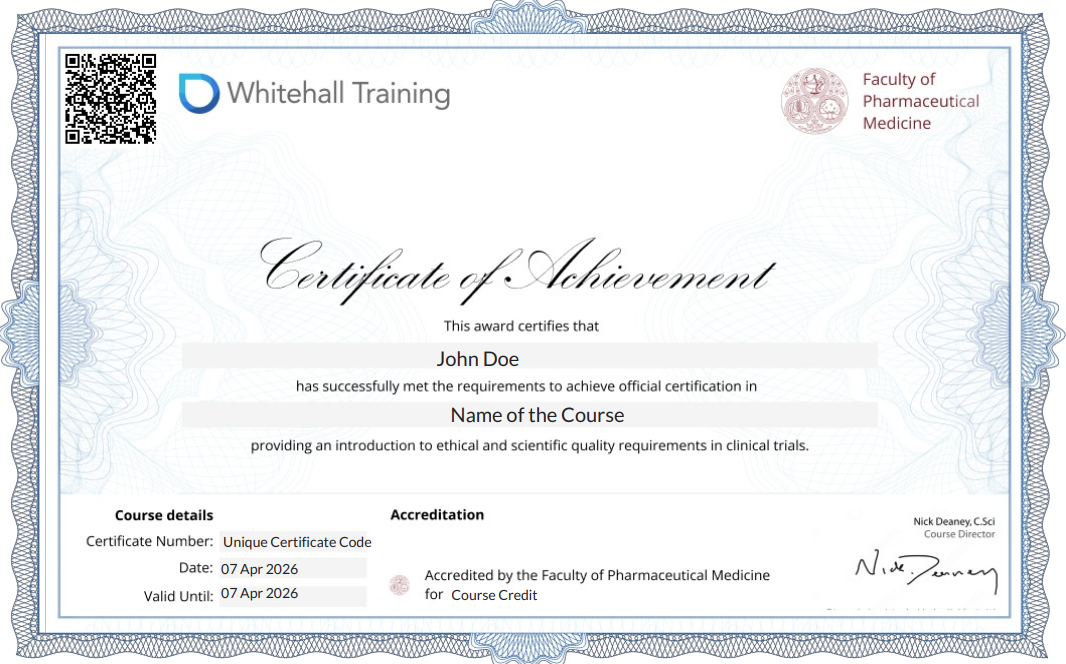
This course covers types of randomization, allocation concealment, blinding methods (single, double, and triple), unblinding procedures, and their application in clinical trial design. It also emphasizes Good Clinical Practice (GCP) compliance, regulatory expectations, and practical implementation in clinical studies. Upon completion, learners receive a certification demonstrating competency in randomization and blinding concepts.
Understand the fundamentals of randomization in clinical trials, including its purpose, ethical considerations, role in reducing bias, and importance in generating reliable clinical evidence.
Learn key randomization techniques such as simple, block, stratified, and adaptive randomization, along with allocation concealment and regulatory expectations.
Gain knowledge of blinding methods, including single, double, and triple blinding, as well as strategies to maintain study integrity and prevent bias.
Develop understanding of unblinding procedures, including emergency unblinding, interim analysis, documentation requirements, and impact on trial validity and compliance.





This course is ideal for individuals looking to understand core clinical trial design concepts, including: