












ICH GCP R3 is now in English & EU languages. Book Now

About

This course provides an overview of GCP clinical trial audit preparation aligned with ICH E6(R3), covering audits versus inspections, audit types, and the full audit lifecycle. It focuses on key areas such as Investigator Site File (ISF) management, informed consent, and delegation logs, while emphasizing ALCOA-C principles and data integrity. The course also highlights practical strategies including mock audits and staff interview preparation, with a strong focus on building audit readiness and a sustainable quality culture.

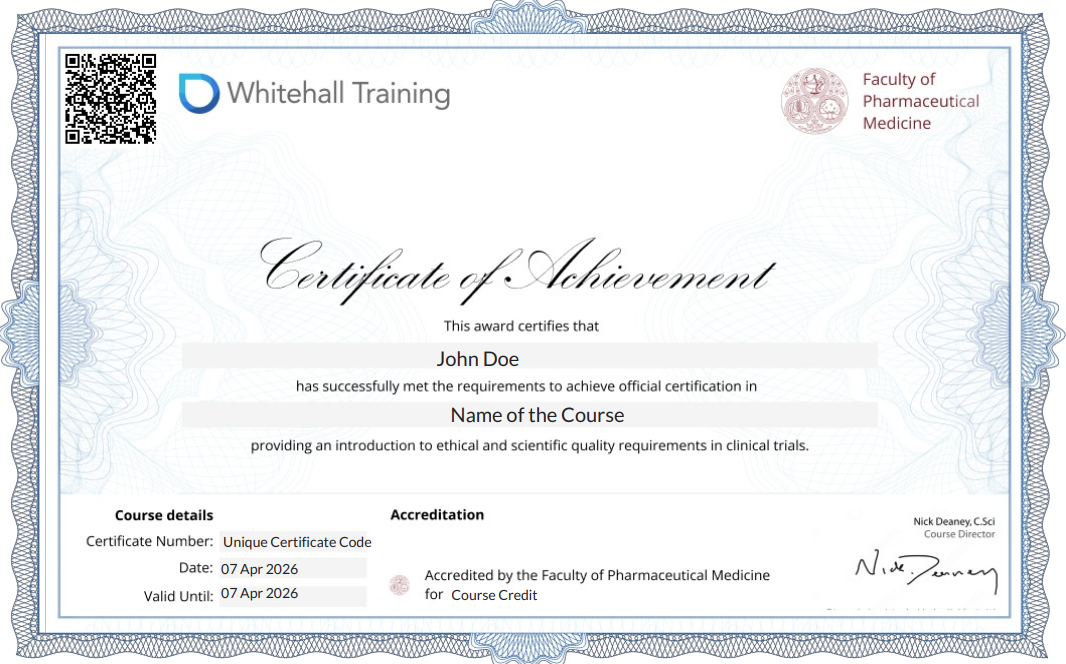
PLEASE NOTE: while the curriculum aligns fully with TransCelerate BioPharma Inc. training standards, Whitehall Training cannot independently verify compliance if your previous GCP certification was obtained through another provider.

Course Syllabus

  1. Audit vs Inspection — Core Definitions
  2. Why Audit Readiness Matters — Industry Data
  3. Audit vs Inspection — Side by Side
  4. Legal & Regulatory Basis for Audits & Inspections
  5. Expert Insight

  1. Five Types of Sponsor / CRO Audits
  2. Types of Regulatory Inspections
  3. For-Cause Audit Triggers — Know Your Risk
  4. Pre-NDA / Pre-MAA Inspections — What to Expect
  5. Case Study - The Unannounced FDA Inspection — A US Oncology Site

  1. The Six-Stage Audit Process — Full Timeline
  2. Notification Received — Your First 24 Hours
  3. Case Study - Two-Week Notice — What One Site Did Right
  4. The Opening Meeting — How to Set the Right Tone
  5. Stage 4 — Document Review: What Auditors Do
  6. Source Data Verification (SDV) — What Auditors Are Looking For
  7. Stage 5 — Staff Interviews: What to Expect
  8. Top 10 Interview Questions Auditors Ask the PI
  9. REAL-WORLD SCENARIO — A Difficult Interview Question — The PI's Moment
  10. Stage 6 — The Exit / Closing Meeting

  1. The 365-Day Audit Readiness Calendar
  2. The Mock Audit — Your Best Pre-Audit Investment
  3. Case Study - Mock Audit Prevents a Major Finding — Germany
  4. ISF Readiness Checklist — Part 1: Regulatory & Ethics Documents
  5. ISF Readiness Checklist — Part 2: Participant Documents
  6. ISF Readiness Checklist — Part 3: Staff, Training & Site Qualifications
  7. ISF Readiness Checklist — Part 4: Data, Safety & Monitoring
  8. Creating Your Audit-Ready Room
  9. What the Audit Room Tells the Auditor

  1. Document #1 — Informed Consent Forms (Most Scrutinised Area)
  2. Case study - The ICF Version Control Failure — A Cautionary Tale
  3. Document #2 — Delegation of Responsibilities Log
  4. Document #3 — Source Documents & the ALCOA-C Principles
  5. ALCOA-C — Where Most Violations Occur (Industry Training Data)
  6. Document #4 — Drug Accountability Log
  7. REAL-WORLD SCENARIO — Drug Accountability Discrepancy — A Close-Out Finding
  8. Document #5 — Protocol Deviation Log

  1. Audit Day — An Hour-by-Hour Guide
  2. Rules of Conduct During the Audit
  3. Handling Unexpected Findings Mid-Audit
  4. Expert Insight
  5. REAL-WORLD SCENARIO — Missing Training Certificate — A Real-Time Recovery
  6. Staff Interview Preparation — Practical Guide
  7. The Over-Eager Coordinator — How Good Intentions Created a Major Finding

  1. The 8 Habits of Consistently Audit-Ready Sites
  2. Expert Insight
  3. Case Study - From Critical Finding to Reference Site — A Two-Year Journey
  4. DECISION POINT
  5. Building Quality Culture — The PI's Role
  6. Quality Culture — The Long-Term Impact
  7. The CRA — Your Pre-Audit Partner
  8. Common Audit Preparation Mistakes
  9. Module 1 — Key Takeaways & Your Action Plan
  10. Expert Insight

  1. What is the Exit Interview?
  2. How to Take Notes During Exit Meeting
  3. What You CAN vs MUST NOT Do at Exit Meeting
  4. SCENARIO: Correcting a Factual Error at Exit Meeting
  5. Case Study - The Irish Site: When Defensiveness Backfired

  1. Classification System: Critical, Major, Minor
  2. Finding Distribution Across Audits
  3. Critical Findings in Detail
  4. Case Study - FDA Disqualification: A Critical Finding in Action
  5. Major Findings in Detail
  6. MHRA Satisfactory vs Unsatisfactory Outcomes
  7. MHRA Grade 1–4 Terminology

  1. Structure of a Formal Audit Report
  2. First Steps When the Report Arrives
  3. Disputing a Finding (with evidence) vs Accepting a Finding
  4. Case Study - The Belgian Site: Disputing via Evidence

  1. Why RCA is Non-Negotiable
  2. The 5 Whys Method — Worked Example
  3. Fishbone/Ishikawa Diagram — Consent Timing Failure
  4. Case Study - Five Whys in Practice: Delegation Log Finding
  5. Weak RCA vs Strong RCA

  1. Anatomy of a Perfect CAPA
  2. CAPA Template — Structured Form Layout
  3. CAPA Language: Tone and Tense Guidance
  4. Weak CAPA vs Strong CAPA — Comparison
  5. SCENARIO: CAPA Under Time Pressure
  6. Evidence That Strengthens a CAPA
  7. Case Study - The Belgian Site: CAPA That Changed Sponsor Relationship

  1. FDA Form 483 — Detailed Guide
  2. FDA Warning Letter — What It Means + Consequences
  3. MHRA Inspection Response — UK Framework with Grades
  4. EMA/NCA Inspections — EU CTR Context
  5. FDA vs MHRA Key Response Differences
  6. Case Study - FDA Warning Letter: A Cautionary Case (2020)

  1. Closing the Quality Loop — 5 Phases
  2. Follow-Up Inspection Preparation
  3. The CAPA Tracker — Practical Tool Structure
  4. Case Study - UK Site: From Unsatisfactory to Exemplary Over 2 Years
  5. Building a Quality Management System — What It Includes
  6. Mature QMS vs Developing QMS
  7. DECISION POINT: CAPA That Did Not Prevent Recurrence
  8. Learning from Other Sites' Public FDA/MHRA Findings

  1. The Perfect Storm Audit: 3 Findings, Immediate Response, Exit Meeting
  2. The Complete Audit Response Cycle - 7-Step Summary
  3. Key Takeaways + Post-Audit Checklist

Our Certified Customers

novartis
NHS
takeda
roche
baxter

Learner Rating & Reviews

4.7
Average Rating
536 global ratings
87.0%
5.0%
3.0%
3.0%
2.0%
RC

Working with Whitehall training for the last two years of partnership has been a very successful experience – I have fast access to all the GCP course...

SM

I have finalised the demo for the ICH-GCP E6 R3 refresher course. Overall, I liked the content and the interface. I also want to thank Whitehall Train...

Frequently Asked Questions

The GCP – Clinical Trials Audit Preparation course by Whitehall Training is designed to provide a comprehensive understanding of audit and inspection readiness for investigator sites. Suitable for investigators, study coordinators, and research professionals, this course builds a strong foundation in audit processes, key documentation, and regulatory expectations. It focuses on essential areas such as ISF management, informed consent compliance, data integrity (ALCOA-C), and CAPA development to ensure inspection readiness and continuous quality improvement.

You will explore key topics such as the differences between audits and inspections, types of audits, and the full audit lifecycle from notification to CAPA response. The course covers essential areas including Investigator Site File (ISF) management, informed consent compliance, delegation logs, and ALCOA-C data integrity principles. Through practical examples and real-world scenarios, you will learn how to prepare for audits, handle document reviews and staff interviews, and respond effectively to findings. It also provides guidance on mock audits, root cause analysis, and building a strong quality culture to ensure ongoing audit readiness.

This course is ideal for individuals involved in clinical trial conduct and audit readiness, including:


  • Principal Investigators and Sub-Investigators
  • Clinical Research Coordinators and Study Nurses
  • Clinical Research Associates (CRAs)
  • Ethics Committee / IRB Members
  • Regulatory Affairs Professionals
  • Clinical Trial Assistants and Site Staff
  • Pharmacists and Laboratory Personnel involved in trials
  • Anyone responsible for maintaining GCP compliance and preparing for audits or inspections.

  • Comprehensive understanding of clinical trial audit and inspection readiness
  • Aligned with ICH GCP E6(R3) and global regulatory expectations
  • Practical, scenario-based learning covering real audit situations and findings
  • Build confidence in handling audits, inspections, and CAPA responses
  • Strengthen documentation practices, data integrity (ALCOA-C), and quality systems