
I have finalised the demo for the ICH-GCP E6 R3 refresher course. Overall, I liked the content and the interface. I also want to thank Whitehall Train...
About
ISO 20916: Good Study Practice for IVD Clinical Performance Studies provides an advanced and practical overview of the principles, processes, and regulatory requirements necessary to plan, conduct, and report high-quality clinical performance studies for In Vitro Diagnostic (IVD) medical devices.
This course covers key study design requirements including specimen classification, risk-based study tiering, ethical approvals, informed consent considerations, sponsor and principal investigator responsibilities, data integrity, safety reporting, site audits, substantial protocol modifications, and post-market performance follow-up (PMPF). Learners will understand how to align study documentation with global regulatory frameworks, including European IVDR (EU 2017/746) and US FDA requirements, to ensure that study results are accurate, compliant, and fit for regulatory submissions. Upon successful completion, learners receive a certification demonstrating their practical understanding and application of Good Study Practice for IVD performance studies.
- In Vitro Diagnostic (IVD) Clinical & Regulatory Professionals
- Clinical Research Associates (CRAs) and Clinical Study Managers
- Quality Assurance and Quality Management System (QMS) Specialists
- Regulatory Affairs Managers and Officers
- Medical Device & IVD Project Leaders
- Clinical Performance Study Auditors and Monitors
- Principal Investigators and Site Research Staff
- Professionals working in CROs, Medical Device, or Diagnostic Companies
- Anyone seeking specialized certification in ISO 20916 and IVDR compliance
What you will learn
Build advanced knowledge of ISO 20916 Good Study Practice principles for conducting IVD clinical performance studies.
Learn risk-based study tiering, specimen classification (prospective, leftover, archived), and essential regulatory compliance under European IVDR (EU 2017/746).
Develop practical expertise in study protocol development, ethics submissions, informed consent, principal investigator responsibilities, and site monitoring.
Gain a thorough understanding of data integrity, safety reporting clocks, adverse event tracking, protocol modifications, and clinical performance study reporting.
Course Syllabus
- What a clinical performance study is, and what ISO 20916 actually covers
- Good study practice, and why the standard does not say good clinical practice
- The boundary against ISO 14155, and the cases teams get wrong
- The shape of the standard: nine clauses, and what is not in them
- EN ISO 20916:2024, harmonisation, and what Annex ZA does not cover
- The IVDR routing decision: outside the regime, notification, or authorisation
- The US routing decision: the diagnostic exemption and when it is lost
- Running both trees on one protocol
- Clause 4 and what the standard asks of an ethical study
- Ethics review as a national competence, and what that means in practice
- Informed consent when the subject is present, and when the specimen is all you have
- Leftover, residual and banked specimens, and when leftover status is lost
- Broad and general consent, and communicating with the ethics committee
- Vulnerable groups: incapacitated subjects, minors, and the conditions that attach
- Data protection, pseudonymisation, and why it is not the same as anonymisation
- The US position on leftover specimens, and the letter FDA had to write
- Clause 5 and the planning architecture
- Scientific validity: what it is and what establishes it
- The clinical performance study plan and its required content
- Intended purpose, intended user and intended use population
- Risk analysis for a study where the device never touches the patient
- Case report forms, and what the standard says about them
- Investigator responsibilities expressed as plan content
- Amendments and substantial modification
- The three legs: scientific validity, analytical performance, clinical performance
- Analytical measures and the standards that govern them
- Cut-off determination, and why it must be locked before the pivotal cohort
- Diagnostic sensitivity and specificity, and what they do not tell you
- Predictive values and their dependence on prevalence
- The imperfect reference standard, and why discrepant resolution only flatters
- Bias: spectrum, verification and incorporation
- Sample size for a performance claim, and why it is not a superiority trial
- Why the specimen, not the subject, is the centre of an IVD study
- Specimen categories and what each one changes
- Traceability held in tension with de-identification
- Specimen accountability and the study sample log
- Chain of custody, shipment and receipt
- Pre-analytical variables as a study-validity issue
- Storage, retention and destruction
- Specimens as customer property, and what the quality system owes them
- Site selection and qualification under clause 5.9
- Site initiation and training under clause 6
- The written agreements, and what they must settle
- Sponsor obligations, and which of them can be delegated
- The laboratory's position, which is contractual rather than clause-based
- The CRO problem: no transfer-of-obligations mechanism on the device side
- Monitor independence, and the gap the harmonised standard leaves
- Auditor independence from monitoring
- Clause 7 and what conduct actually requires
- Monitoring a study whose subject is a specimen
- Security and confidentiality of study data
- Deviations, and the difference between a deviation and a modification
- The adverse event definition, and who it covers
- Whether a false result is an adverse event
- Device deficiencies, and how they differ
- The reporting deadlines, in calendar days, and to whom
- Clause 8 and closing a study out properly
- Suspension and premature termination
- Document retention: what, for how long, and who holds it
- The clinical performance study report and its content
- Clause 9 auditing, and the independence requirement
- How the study feeds the performance evaluation report
- Post-market performance follow-up, and why a PMCF template mis-trains
- Companion diagnostics: sequencing against the therapeutic programme
- Eight Modules Ago You Had a Protocol Template and Ten Trials
- The five things most likely to cost you money
- Turning This Into a Plan
- Mark your own sheet
- What this course does not tell you
- Ten things to take back to work
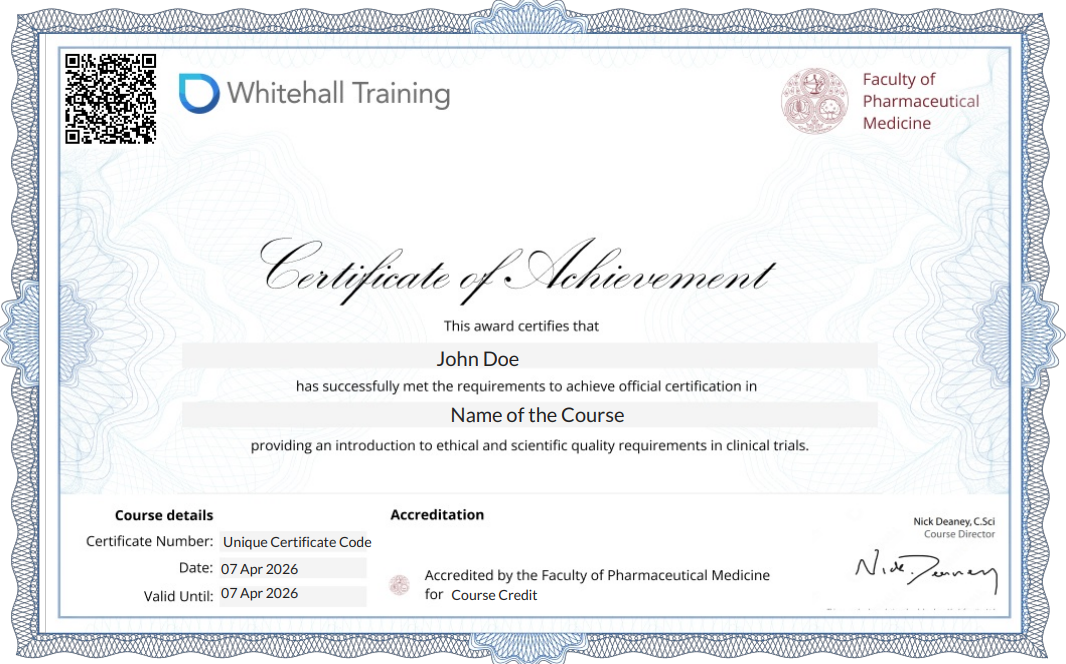
- Final assessment and certificate
- 📘 Bonus: ISO 20916: Good Study Practice for IVD Clinical Performance Studies eBook (Free with purchase)
Our Certified Customers
Learner Rating & Reviews
Frequently Asked Questions
- Apply ISO 20916 and EN ISO 20916:2024 standards to IVD clinical performance studies
- Classify study specimens and apply appropriate risk-based study tiering
- Prepare compliant study protocols, ethics submissions, and consent frameworks
- Differentiate sponsor and principal investigator obligations across study sites
- Ensure data integrity, ALCOA++ compliance, and electronic records security
- Manage safety reporting clocks, serious adverse events, and protocol modifications
- Assemble compliant Clinical Performance Study Reports for regulatory submission
This course is designed for clinical research, regulatory, and quality professionals in the IVD and medical device sector, including:
- Regulatory affairs and quality assurance managers
- Clinical research associates, monitors, and study coordinators
- IVD project managers and clinical performance study managers
- Auditors and compliance specialists evaluating IVD trials
- Principal investigators and laboratory directors conducting performance studies
- CRO and diagnostic industry professionals aligning with EU IVDR requirements
- Master the practical application of ISO 20916 for IVD clinical studies
- Ensure full regulatory compliance with EU IVDR (EU 2017/746) standards
- Mitigate trial risks through proper specimen governance and site monitoring
- Understand safety reporting clocks and protocol modification procedures
- Enhance career credentials with specialized expertise in IVD clinical trials