














ICH GCP R3 is now in English & EU languages. Book Now

Course Syllabus

  1. A GCP története: 1. rész
  2. A GCP története: 2. rész
  3. A GCP története: 3. rész
  4. A GCP története: 4. rész
  5. Mi az a GCP?
  6. Az ICH GCP alapelvei: 1. rész
  7. Az ICH GCP alapelvei: 2. rész
  8. További tanulási pontok
  9. Dokumentáció és verzióellenőrzés
  10. Minőségbiztosítás (QA)
  11. Főbb források: 1. rész
  12. Főbb források: 2. rész

  1. Bevezetés: 1. rész
  2. Bevezetés: 2. rész
  3. Bevezetés: 3. rész
  4. Bevezetés: 4. rész
  5. Bevezetés: 5. rész
  6. Bevezetés: 6. rész
  7. Bevezetés: 7. rész
  8. Bevezetés: 8. rész
  9. Bevezetés: 9. rész
  10. A szabályozó hatóság felelősségi körei
  11. Az IEC felelősségi körei
  12. Alanyok tájékoztatáson alapuló beleegyező nyilatkozatai (ICF) 1. rész
  13. Alanyok tájékoztatáson alapuló beleegyező nyilatkozatai (ICF): 2. rész
  14. Összetétel, funkciók, műveletek, eljárások és nyilvántartások
  15. Az IEC interakciói a szponzorokkal és a vizsgálókkal

  1. Bevezetés
  2. A nyomozó felelőssége
  3. Kutatói képesítések és megállapodások
  4. Megfelelő erőforrások
  5. A vizsgálati alanyok orvosi ellátása: 1. rész
  6. A vizsgálati alanyok orvosi ellátása: 2. rész
  7. Kommunikáció az IRB/IEC-vel
  8. A Jegyzőkönyvnek való megfelelés
  9. Vizsgálati gyógyszerek
  10. Randomizációs eljárások és a vakítás feloldása
  11. Tájékozott beleegyezés: Bevezetés
  12. Tájékozott beleegyezés: A beleegyezésről szóló vita
  13. Tájékozott beleegyezés: Olvasni vagy írni nem tudó alanyok
  14. Tájékozott beleegyezés: Kiskorúak és „értelmileg alkalmatlan” alanyok
  15. Tájékozott beleegyezés: Cselekvőképtelen alanyok
  16. Tájékozott beleegyezés: A beleegyezés frissítése
  17. Feljegyzések és jelentések: Bevezetés
  18. Feljegyzések és jelentések: Tanulmányi helyszín aktái
  19. Nyilvántartások és jelentések: Frissítések és módosítások
  20. Nyilvántartások és jelentések: Forrásdokumentumok
  21. Nyilvántartások és jelentések: Pénzügyi információk
  22. Feljegyzések és jelentések: Az ügynyilvántartó űrlap
  23. Nyilvántartások és jelentések: Adatok rögzítése
  24. A vizsgálat idő előtti befejezése vagy felfüggesztése
  25. A vizsgáló előrehaladási jelentései és zárójelentései
  26. A nyomozó felelőssége

  1. Bevezetés: 1. rész
  2. Bevezetés: 2. rész
  3. Bevezetés: 3. rész
  4. Minőségirányítás: 1. rész
  5. Minőségirányítás: 2. rész
  6. Minőségirányítás: 3. rész
  7. QA és QC (minőségbiztosítás és minőségellenőrzés): Bevezetés
  8. QA és QC (minőségbiztosítás és minőségellenőrzés): Standard működési eljárások
  9. QA és QC (minőségbiztosítás és minőségellenőrzés): megállapodások és szerződések
  10. Szerződéses kutatási szervezetek
  11. Próba tervezés
  12. Próbakezelés: Bevezetés
  13. Próbakezelés: Adatkezelés
  14. Próbakezelés: Elektronikus adatok
  15. Próbakezelés: Nyilvántartás
  16. Nyomozóválasztás: Bevezetés
  17. Nyomozó kiválasztása: Engedélyek
  18. A vizsgáló kiválasztása: Felelősségi körök
  19. Nyomozó kiválasztása: Kártérítés
  20. Finanszírozás
  21. Értesítés/Benyújtás a szabályozó hatóságoknak
  22. IRB/IEC általi felülvizsgálat megerősítése
  23. Információk az IMP-ről
  24. Vizsgálati termékek gyártása, csomagolása, címkézése és kódolása: 1. rész
  25. Vizsgálati termékek gyártása, csomagolása, címkézése és kódolása: 2. rész
  26. Vizsgálati készítmények szállítása és kezelése
  27. Record Access
  28. Adatkezelés I
  29. Adatkezelés II
  30. Adatkezelés III
  31. Adatkezelés IV
  32. Adatkezelés V
  33. Adatkezelés VI
  34. Statisztikai programozás és adatelemzés I
  35. Statisztikai programozás és adatelemzés II
  36. Nyilvántartás vezetése és megőrzése
  37. Audit és ellenőrzés
  38. Meg nem felelés
  39. A vizsgálat idő előtti befejezése vagy felfüggesztése: 1. rész
  40. A vizsgálat idő előtti befejezése vagy felfüggesztése: 2. rész
  41. Klinikai vizsgálati/tanulmányi jelentések
  42. Többközpontú próbák

  1. Bevezetés
  2. Adatgazdálkodás 1. rész
  3. Adatgazdálkodás 2. rész
  4. Fenntartani a vakokat
  5. Adatéletciklus I
  6. Adatéletciklus II
  7. Adatéletciklus III
  8. Adatéletciklus IV
  9. Számítógépes rendszerek I
  10. Számítógépes rendszerek II
  11. Számítógépes rendszerek III
  12. Számítógépes rendszerek IV
  13. Számítógépes rendszerek V
  14. Számítógépes rendszerek VI
  15. Számítógépes rendszerek VII

  1. Bevezetés
  2. Monitor
  3. A monitoring látogatás: 1. rész
  4. A monitoring látogatás: 2. rész
  5. Az IMP ellenőrzése
  6. A protokoll, a módosítások, a szabványos működési eljárások és az útmutató betartása
  7. A tájékozott beleegyezés ellenőrzése
  8. Az esetnyilvántartási űrlap (CRF) és a forrásdokumentumok
  9. Az alany adatok ellenőrzése
  10. A monitoring látogatás lezárása
  11. A monitoring jelentés és terv
  12. Minőségirányítás - Központosított monitoring
  13. Csalás és helytelen magatartás: 1. rész
  14. Csalás és visszaélés: 2. rész

  1. Bevezetés
  2. Nemkívánatos események, gyógyszermellékhatások és feltételezett, feltételezett, nem várt, súlyos mellékhatások
  3. Súlyos nemkívánatos események
  4. SUSAR-ok
  5. Különös érdeklődésre számot tartó mellékhatások
  6. Időszakos biztonsági jelentések

  1. Bevezetés
  2. Protokoll szerkezete és tartalma: 1. rész
  3. Protokoll szerkezete és tartalma: 2. rész
  4. Protokoll szerkezete és tartalma: 3. rész

  1. Bevezetés
  2. A kutatói brosúra szerkezete és tartalma

  1. Bevezetések
  2. Archiválás
  3. A tanulmány előtt bemutatandó dokumentumok
  4. A tanulmány után bemutatandó dokumentumok

  1. Glossary & Abbreviations
  2. EU Guidance Documents
  3. ICH Guidance Documents
  4. US FDA Guidance Documents
  5. GCP Course Printouts
  6. Global Competent Authorities List

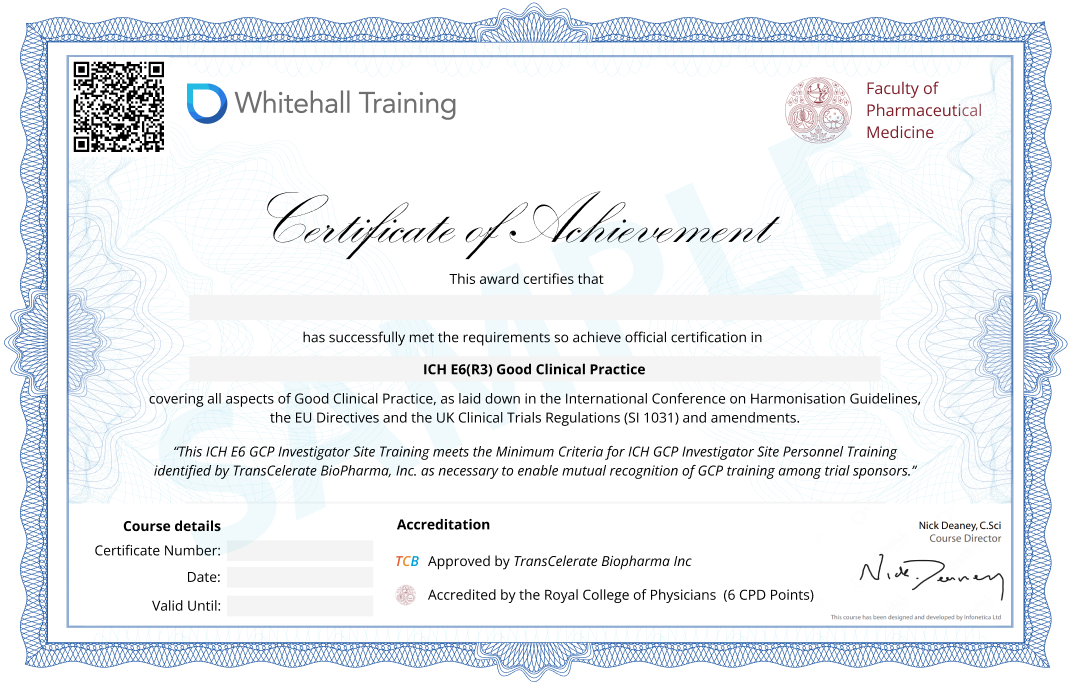
Course Certificate

On course completion, you receive your official ICH-GCP e6(R3) certification, allowing you to participate in clinical trials internationally
course_certificate_icon

Our GCP certified customers

novartis
NHS
takeda
roche
baxter

Testimonials

chat

"I've had the privilege of working with them for the GCP training of my company, and they performance is excellent. Additionally, technical support is very fast and efficient. Big thank you to Whitehall training, specially to Jagruti Patil!"

Clara Frago
Biotechnologist
chat

"Thank you very much for providing me such an exceptional training program!!!!"

Sofia Martaki
Trainee Pharmacist

Good Clinical Practice (GCP) training is an essential educational program that equips researchers and clinical trial professionals with the knowledge of ethical and scientific standards crucial for conducting high-quality clinical trials. This comprehensive training covers the internationally recognized guidelines established by the International Council for Harmonisation (ICH).

The primary goals of GCP training are:

  1. Ensuring the protection of human subjects' rights, safety, and well-being
  2. Maintaining the integrity and reliability of clinical trial data
  3. Promoting consistent, high-quality practices across all aspects of clinical research

Our GCP course delves into these critical areas, providing learners with a solid foundation in the principles and practical applications of Good Clinical Practice.

For researchers interested in participating in clinical trials, GCP certification is a necessity.

For those who are simply interested in improving their understanding of the field, GCP certification is highly valuable due to its:

  1. Ensures compliance with international standards
  2. Enhances research credibility and quality
  3. Protects participant rights and safety
  4. Improves career prospects in clinical research

Our course not only provides certification but also equips you with practical skills to apply GCP principles effectively in your work.

GCP certification is essential for a wide range of professionals in clinical research:

  1. Clinical Trial Investigators: Principal investigators and sub-investigators responsible for trial conduct at research sites.
  2. Clinical Trial Staff: Including research coordinators, study nurses, and other site personnel involved in trial management.
  3. Sponsors and Contract Research Organizations (CROs): Those overseeing trial planning, initiation, and reporting.
  4. Regulatory Authorities: Officials who monitor and evaluate trial compliance.
  5. Institutional Review Boards (IRBs) and Ethics Committees: Members reviewing and approving trial protocols.
  6. Academic and Research Institution Staff: Ensuring adherence to international standards in institutional research.
  7. NIH-Funded Researchers: All investigators and staff involved in NIH-funded clinical trials.

Our course caters to this diverse audience, providing role-specific insights alongside core GCP principles. The course is also valuable for anyone looking to upskill their research abilities and improve their clinical trials operations.

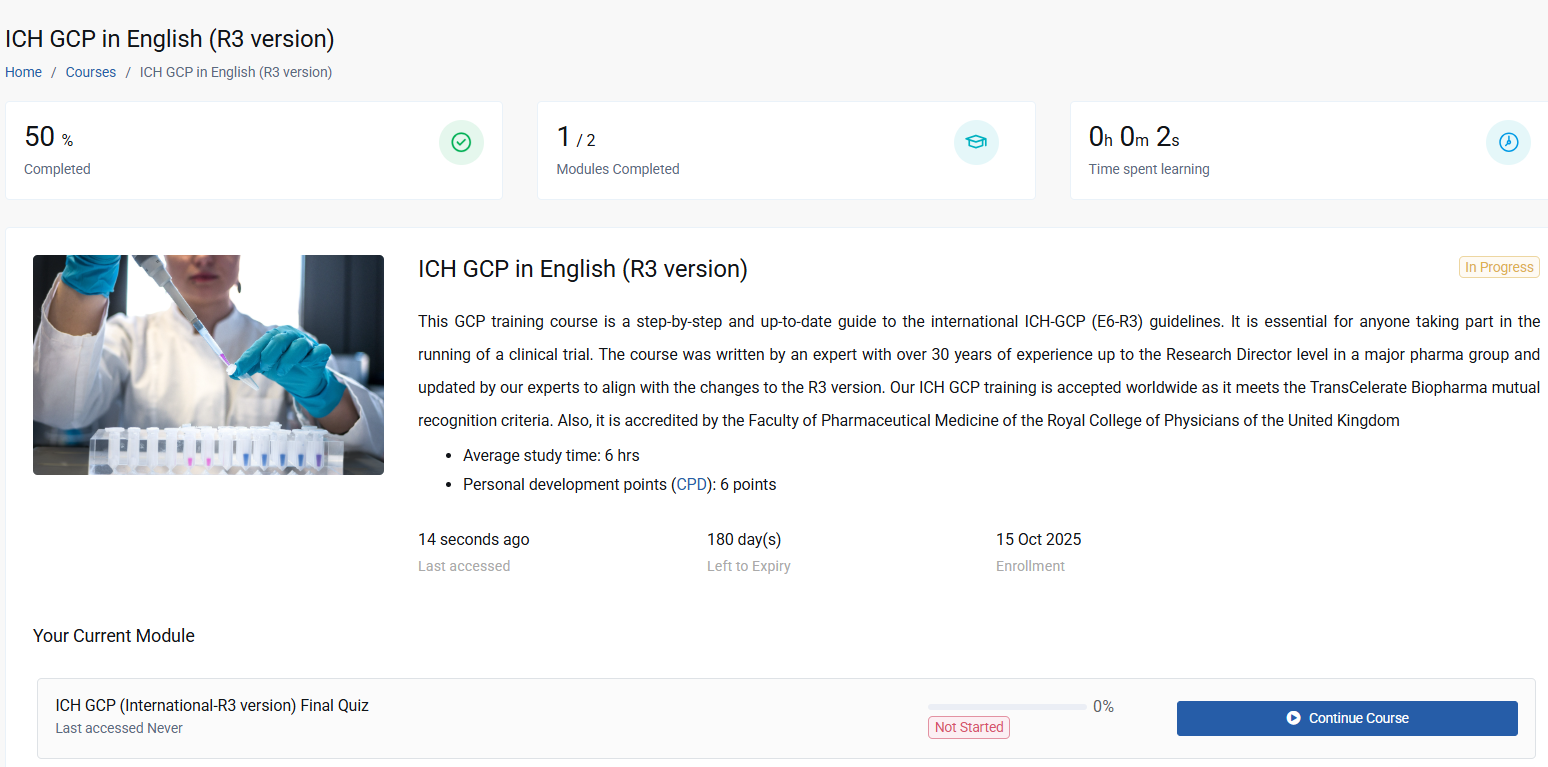
This GCP training course covers the ICH-GCP (E6-R3) international guidelines and meets the training requirement for you to participate in international clinical trials. Multiple language versions are available. This GCP training course is a step-by-step and up-to-date guide to the international ICH-GCP (E6-R3) guidelines. It is essential for anyone taking part in the running of a clinical trial.

The course was written by an expert with over 30 years of experience up to the Research Director level in a major pharma group. Our ICH GCP training is accepted worldwide as it meets the TransCelerate Biopharma mutual recognition criteria. Also, it is accredited by the Faculty of Pharmaceutical Medicine of the Royal College of Physicians of the United Kingdom. Apart from English, the course is available in German, Bulgarian, French, Italian, Japanese, Polish, Portuguese, Russian and Spanish. We also produce regional versions of this course tailored to the specific regulatory frameworks in Australia, the UK, the US, France, Germany and Latin America.

This course features a clear and visually appealing format, allowing for easy cross-referencing to the ICH-GCP E6 document. It offers valuable insights into the practical application of Good Clinical Practice (GCP) based on the author's extensive experience. Furthermore, it is accredited by the Faculty of Pharmaceutical Medicine of the Royal College of Physicians of the United Kingdom and provides participants with the opportunity to earn 6 CPD points.

Yes, our GCP course is accredited by two industry-leading organisations:

  1. TransCelerate Biopharma Inc.: A nonprofit organisation collaborating with 20 major pharmaceutical companies. Their mutual recognition program is considered the gold standard in the field of clinical practice.
  2. The Faculty of Pharmaceutical Medicine at the Royal College of Physicians: The professional membership body for pharmaceutical physicians in the UK, known for setting rigorous standards for research since 1989.

These accreditations ensure our course meets the highest industry and academic standards, offering you a widely recognized certification.

Costs vary depending on the following factors:

  • Accreditation: Is the course approved by official organisations, like TransCelerate?)
  • Certification: Does the course meet the ICH requirements that allows researchers to participate in international clinical trials?
  • Quality of content: Is the course up-to-date, and written by an expert?
  • Access: How long are learners able to access the course?

Whitehall Training’s GCP course is £79 due to its:

  • Accreditation: It is TransCelerate approved, and accredited by the Royal College of Physicians with 6 CPD points.
  • Certification: The course enables users to participate in clinical trials, following the ICH E6(R3) guidelines.
  • Quality of content: Our course is written by our Good Clinical Practice expert, Lucy Parker, who has over a decade of experience directing research across large research institutes such as the NHS.
  • Access: To support the lifelong learning of our researchers, we provide lifetime access to our course resources.

Buying for a team? We offer 10% off orders of 5 licences at checkout. For discounts on larger orders, please get in touch with our team.


While some free GCP training options do exist, they often have these limitations:

  1. Low quality (not accredited) and out-of-date content
  2. No official certification provided, which means researchers are still not able to conduct clinical research

These courses can, however, provide a basic understanding of the principles for those who are just looking for an introduction to Good Clinical Practice and its concepts.

Our comprehensive GCP training program is designed to provide a thorough understanding of the principles and practices essential for conducting ethical, scientifically sound clinical trials. The course structure includes both foundational and advanced modules, ensuring that learners at all levels can benefit from the content.

Key topics covered in the course include:

  1. History and principles of GCP
  2. Roles and responsibilities of investigators, sponsors, and monitors
  3. Ethical considerations and informed consent processes
  4. Protocol design and adherence
  5. Safety reporting and adverse event management
  6. Data integrity and quality management

Our GCP course is designed to ensure that participants not only learn the material but can also apply it effectively in real-world clinical research settings. To this end, the course incorporates various assessment methods throughout:

  1. Ongoing Assessments: Throughout the modules, learners engage with interactive quizzes and case-based scenarios. These help reinforce key concepts and allow participants to gauge their understanding as they progress.

  2. Final Comprehensive Exam: The course culminates in a final exam that thoroughly assesses the learner's grasp of GCP principles and practices. This exam covers all major topics from the course, including:

    • Ethical considerations in clinical research

    • Regulatory requirements and compliance

    • Roles and responsibilities in clinical trials

    • Data integrity and quality management

    • Safety reporting and adverse event handling

  3. Practical Application: Some questions in the final exam are designed to test the learner's ability to apply GCP principles to realistic clinical trial scenarios.

To ensure learners are fully prepared to conduct their trials, successful completion of the final exam is required to obtain GCP certification.

The final exam may be taken an unlimited amount of times, ensuring that learner reach this level and, thereby, become GCP qualified.

Our course is designed to benefit a wide range of professionals involved in clinical research. While a basic understanding of clinical research is helpful, it's not a prerequisite. The course content is carefully structured to accommodate various levels of experience and roles within the clinical trial landscape.

This training is particularly valuable for:

  1. Clinical Research Coordinators

  2. Principal Investigators and Sub-Investigators

  3. Research Nurses

  4. Clinical Trial Managers

  5. Data Managers and Biostatisticians

  6. Regulatory Affairs Professionals

  7. Quality Assurance Specialists

  8. Ethics Committee Members

  9. Pharmacists involved in clinical trials

  10. Sponsors and CRO personnel

Whether you're new to clinical research or looking to refresh and update your knowledge, this course provides comprehensive coverage of GCP principles and their practical application.

Our GCP course is delivered entirely online, offering maximum flexibility and accessibility for learners. This format has several advantages:

  1. Self-paced learning: Participants can progress through the course materials at a pace that suits their individual learning style and schedule. This allows for a deeper engagement with the content without the pressure of keeping up with a classroom.

  2. Convenient access: The course is accessible 24/7 from any device with an internet connection. This means you can learn from your office, home, or while traveling.

ICH is a global initiative that develops guidelines for pharmaceutical research and development, including Good Clinical Practice (GCP). Key points:

  1. ICH brings together regulatory authorities and industry representatives.

  2. It creates internationally recognized standards for clinical trials.

  3. ICH GCP guidelines focus on protecting participants and ensuring data integrity.

  4. These guidelines are periodically updated, with ICH GCP E6(R3) being the latest version.

In order to conduct compliant clinical trials, these ICH guidelines must be adhered to. That’s why we made this course, covering all of the 13 core ICH GCP principles thoroughly, preparing you to conduct research that meets global standards.

ICH Good Clinical Practice E6 (R3) refers to the most recent revision of the Good Clinical Practice guidelines issued by the International Council for Harmonisation of Technical Requirements for Pharmaceuticals for Human Use (ICH). This update, released in 2016, represents a significant evolution in GCP standards, reflecting the changing landscape of clinical research.

Understanding ICH GCP E6 (R3) is crucial for anyone involved in clinical research because:

  • It represents the current global standard for conducting ethical and scientifically sound clinical trials.

  • Compliance with these guidelines is often required by regulatory authorities worldwide.

  • It helps ensure the protection of human subjects and the reliability of trial data.

  • Many sponsors and research organisations expect their staff and partners to be familiar with and adhere to these updated guidelines.

Our GCP course thoroughly covers ICH GCP E6 (R3), ensuring that participants understand these updated guidelines and can apply them effectively in their clinical research activities.

ICH GCP is built on 13 key principles that guide ethical and scientific standards in clinical research. These include:

  1. Ethical conduct

  2. Benefits outweighing risks

  3. Participant rights and safety

  4. Adequate supporting data

  5. Scientifically sound protocols

  6. IRB/IEC approval

  7. Qualified medical supervision

  8. Qualified investigators

  9. Informed consent

  10. Accurate data recording and reporting

  11. Confidentiality

  12. Good manufacturing practices for investigational products

  13. Quality assurance systems

Our course provides in-depth coverage of these principles, ensuring you understand how to apply them in real-world clinical research settings.