














ICH GCP R3 is now in English & EU languages. Book Now

About

The GCP – Selection and Effective Management of Clinical Trial Sites course by Whitehall Training provides a strategic framework for optimizing trial success through data-driven site identification and oversight. Aligned with ICH-GCP E6(R3) standards, it covers the full site lifecycle from feasibility and qualification scoring to initiation and performance management. Key topics include evaluating patient enrollment capabilities, staff qualifications, and facilities to mitigate risks such as delays and data gaps. The curriculum emphasizes proactive site management using CTMS dashboards and root cause analysis to address underperformance and ensure regulatory compliance. Learners gain practical, inspection-ready skills for managing investigator relationships and maintaining data integrity throughout the clinical research process.

PLEASE NOTE: while the curriculum aligns fully with TransCelerate BioPharma Inc. training standards, Whitehall Training cannot independently verify compliance if your previous GCP certification was obtained through another provider.

Course Syllabus

  1. The 7 Key Considerations for Site Selection
  2. Consideration 1: Patient Enrolment Capabilities
  3. Assessing Enrolment Potential — Key Metrics
  4. Consideration 2: Staff Qualification
  5. GCP Training Requirements for Site Staff — ICH E6 R3
  6. Consideration 3: Site and Investigator Commitment
  7. How to Assess Site Commitment — Practical Approaches
  8. Consideration 4: Competing Trials at the Site
  9. Assessing the Competitive Landscape
  10. Consideration 5: Facilities and Equipment
  11. GCP Equipment Requirements — ICH E6(R3) Obligations
  12. Consideration 6: Geographical Location
  13. Global Site Selection — Country Selection Criteria
  14. Consideration 7: Site Costs — Budget and Negotiation

  1. IRB/IEC Requirements for Site Approval
  2. Regulatory Submission Timelines by Region — Comparative Overview
  3. Essential Document Requirements at Site Initiation — The ISF Checklist
  4. ICH E6(R3) Investigator Obligations Before Trial Commencement
  5. Financial Disclosure and Conflict of Interest — FDA Requirements
  6. Site Contracts and Clinical Trial Agreements CTAs
  7. Insurance and Indemnity Requirements for Sites

  1. The Site Initiation Visit (SIV) — Purpose, Agenda and Attendees
  2. SIV Checklist — What Must Be In Place Before First Patient Enrolment
  3. IP Storage and Accountability Setup — Pharmacy Requirements
  4. Laboratory Setup — Central vs Local Lab, Normal Ranges, Accreditation
  5. EDC/eCRF Setup and Training — Site Staff Requirements
  6. Emergency Unblinding Procedures — Site-Level Requirements
  7. Site Staff Delegation Log — ICH E6(R3) Requirement
  8. Regulatory Filing at Site — TMF vs ISF Responsibilities

  1. Module 1 — Key Takeaways
  2. Site Selection Decision Framework — The 7-Factor Scoring Model
  3. High-Performing Site vs Underperforming Site: Key Differentiators

  1. The 5 Strategic Principles — Overview
  2. Strategy 1: Think About Patient Recruitment Before Site Selection
  3. Patient Recruitment Planning — Key Channels and Site Alignment
  4. Matching Site Selection to Recruitment Strategy — Urban vs Rural, Academic vs Community
  5. Strategy 2: Locate Sites with Experience in Your Condition Area
  6. Assessing Prior Trial History and Performance Data
  7. Using Clinical Trial Registries to Identify Experienced Sites
  8. Strategy 3: Find Sites That Use Up-to-Date Technology
  9. Technology Readiness Assessment — What to Check at Feasibility
  10. Strategy 4: Experienced Staff — Beyond the PI
  11. Assessing Coordinator Experience — Key Indicators
  12. The Impact of Staff Turnover on Trial Performance
  13. Strategy 5: Understanding Site Start-Up Cycle Times
  14. Site Start-Up Timeline Benchmarks by Region and Phase

  1. What Makes a Site High-Performing? The 5 Performance Indicators
  2. Site Feasibility — The Formal Feasibility Process
  3. Feasibility Questionnaire Design — What to Ask and What to Verify Independently
  4. Red Flags in Feasibility Responses — When to Proceed with Caution
  5. Site Performance Databases — Sponsor, CRO and CTMS-Based Benchmarking
  6. Enrolment Performance — Metrics That Matter
  7. Site Selection Questionnaires (SSQs) — Structure, Scoring and Red Flags
  8. SSQ Best Practices — Standardisation, Verification and On-Site Confirmation
  9. The Site Qualification Visit (SQV) — Purpose, Agenda and What to Inspect
  10. SQV vs SIV — Understanding the Difference in Purpose and Scope
  11. Scoring and Ranking Sites — Weighted Scoring Matrix
  12. Making the Final Site Selection Decision — Balancing Risk, Performance and Geography

  1. Site Networks and Consortium Models — SMOs, Academic Networks, CRO Site Networks
  2. Site Networks — Advantages vs Risks
  3. Global Investigator Databases — Building and Maintaining Strategic Site Knowledge
  4. CTMS Integration with Site Selection — Centralised Performance Tracking
  5. Emerging Markets in Site Selection — Opportunities, Regulatory Challenges and Risks

  1. Module 2 — Key Takeaways
  2. End-to-End Site Selection Process — Six Steps to Activation
  3. Traditional vs Strategic Site Selection: Outcomes Compared

  1. The 5 Pillars of Effective Site Management
  2. Pillar 1: CTMS — Technology for Clinical Site Management
  3. CTMS Core Features — What Effective Site Management Requires
  4. CTMS Selection Criteria for Sponsor and CRO Use
  5. Pillar 2: Site-Focused Software — The Full Technology Stack
  6. Site-Facing Technology Burden — Avoiding System Overload
  7. Technology Integration — EDC to CTMS to TMF Data Flow
  8. Pillar 3: Central Hub for Clinical Site Management — The Command Centre
  9. Centralised Oversight Model — Risk-Based Monitoring in Practice
  10. Key Performance Indicators (KPIs) for Clinical Sites
  11. Site Risk Scoring — Flagging Underperforming Sites Early
  12. Escalation Pathways — From Central Monitoring to Triggered On-Site Visits
  13. Pillar 4: Remote Monitoring Visits — The ICH E6(R3) Model
  14. Remote Monitoring vs On-Site Monitoring — When Each is Appropriate
  15. Risk-Based Monitoring (RBM) Framework — Critical Data, Processes and Risk Indicators
  16. Remote SDV and SDR — Regulatory Acceptance and Technology Requirements
  17. Conducting an Effective Remote Monitoring Visit — Preparation, Execution, Follow-Up
  18. Monitoring Visit Report (MVR) — GCP Requirements, Content and Timeline
  19. Pillar 5: Proactive Regulatory Communication — FDA, EMA and National Authorities
  20. Safety Reporting Communication — IND Safety Reports and Site Notification Timelines

  1. The Sponsor's Duty to Support Investigators — ICH E6(R3) Section 5 Obligations
  2. Site Support Toolkit — Protocol Clarifications, Training Materials, Recruitment Support
  3. Enrolment Rescue Strategies — When Sites Fall Behind Target
  4. Managing Protocol Deviations at Site — Detection, Root Cause, CAPA, Retraining
  5. Site Staff Changes — Sub-Investigator Additions, Coordinator Turnover, Delegation Log Updates
  6. Managing IP Accountability Issues — Discrepancies, Excursions, Destruction
  7. Laboratory Issues in Site Management — Out-of-Range Results, Accreditation, Central Lab
  8. Site Communication Best Practices — Scheduled Calls, Escalation, Partnership

  1. Site Close-Out Visit (COV) — Purpose, Agenda and GCP Requirements
  2. COV Checklist — IP, Queries, Data Lock, Document Review
  3. Archiving Obligations — ICH E6(R3) Retention Periods and Responsibilities
  4. Electronic Archiving — eTMF Standards, ALCOA+ Compliance and Audit Trails
  5. Common Close-Out Failures and How to Prevent Them

  1. Module 3 — Key Takeaways

  1. The 4 Challenge Categories — Overview
  2. Category 1: Common Issues and Challenges — Systemic Problems in Site Management
  3. Protocol Complexity as a Site Burden — Eligibility, Visit Schedules, Procedures
  4. Budget and Payment Delays — Impact on Site Performance and Motivation
  5. Regulatory Environment Complexity — Multi-Country Submissions and Requirements
  6. Category 2: Participant-Related Factors — Why Patients Don't Enrol or Stay
  7. Patient Recruitment Barriers — Awareness, Eligibility, and Access
  8. Informed Consent Challenges — Literacy, Language, and Fear
  9. Retention Challenges — Dropout, Lost to Follow-Up, and Competing Treatments
  10. Diversity and Inclusion in Clinical Trials — FDA and EMA Requirements
  11. Digital Recruitment — Social Media, Registries, and AI-Assisted Patient Identification
  12. Category 3: Contextual and Environmental Factors — Geography, Economy, Culture
  13. Economic and Social Climate of the Host Country
  14. Cultural Factors in Site Selection — Trust, Community Engagement, and Communication
  15. Geopolitical Risks — Sanctions, Travel Restrictions, and Data Transfer Regulations
  16. Infrastructure Challenges in Emerging Markets
  17. Category 4: Research-Related Factors — Protocol, IP, and Competing Trials
  18. Protocol Design as a Barrier — Eligibility, Visit Burden, and Complexity
  19. Investigational Product Challenges — Administration, Storage, and Supply
  20. Competing Trials at Sites — Patient Dilution and Staff Distraction

  1. Identifying Clinical Barriers — Therapeutic Area Complexity and Rare Disease Challenges
  2. Common Site Selection Mistake 1: Selecting Sites Based on Relationships, Not Data
  3. Common Site Selection Mistake 2: Overestimating Patient Availability Without Verification
  4. Common Site Selection Mistake 3: Ignoring Site Start-Up Cycle Time History
  5. Common Site Selection Mistake 4: Underestimating Regulatory Timelines in New Countries
  6. Common Site Selection Mistake 5: Failing to Assess Staff Turnover and Succession Planning

  1. The Performance Improvement Framework — Assess, Plan, Implement, Monitor
  2. Bringing a Substandard Site to Standard — The Rescue Intervention Model
  3. Root Cause Analysis for Site Underperformance — 5-Why Analysis Applied
  4. Site Performance Improvement Process — Six Steps
  5. Technology-Enabled Performance Improvement — Dashboards, Analytics, AI Forecasting
  6. Site Training and Capacity Building — GCP Refresher, Protocol, EDC, and Upskilling
  7. Regulatory Body Communication as a Performance Tool — Proactive FDA/EMA Dialogue
  8. Building Long-Term Site Relationships — Recognition, Feedback, and Investigator Programmes

  1. Complete Course Key Takeaways — All 4 Modules

Our Certified Customers

novartis
NHS
takeda
roche
baxter

Learner Rating & Reviews

4.7
Average Rating
536 global ratings
87.0%
5.0%
3.0%
3.0%
2.0%
RC

Working with Whitehall training for the last two years of partnership has been a very successful experience – I have fast access to all the GCP course...

SM

I have finalised the demo for the ICH-GCP E6 R3 refresher course. Overall, I liked the content and the interface. I also want to thank Whitehall Train...

Frequently Asked Questions

The GCP – Selection and Effective Management of Clinical Trial Sites course provides a strategic approach to identifying and managing high-performing research sites. It focuses on data-driven site selection, feasibility assessment, and effective oversight throughout the site lifecycle. Learners gain insights into performance management and regulatory compliance aligned with ICH-GCP E6(R3) standards.

You will explore key topics such as the site lifecycle, data-driven feasibility, and critical factors for site selection. The course covers site initiation, performance management, and handling underperformance using root cause analysis. It also emphasizes maintaining inspection-ready oversight in compliance with ICH-GCP E6(R3) and global standards.

This course is ideal for professionals involved in clinical trial site selection and management, including:


  • Clinical Research Associates CRAs
  • Clinical Trial Managers and Project Managers
  • Clinical Research Associates (CRAs)
  • Sponsor and CRO Personnel
  • Principal Investigators and Site Management Staff
  • Feasibility and Site Selection Specialists
  • Regulatory and Quality Assurance Professionals
  • Anyone seeking to enhance skills in site selection, feasibility, and performance management in clinical trials.

  • Comprehensive understanding of clinical trial site selection and management
  • Aligned with ICH-GCP E6 (R3) and global regulatory expectations
  • Practical frameworks for feasibility assessment and performance management
  • Enhanced skills in identifying and managing high-performing research sites
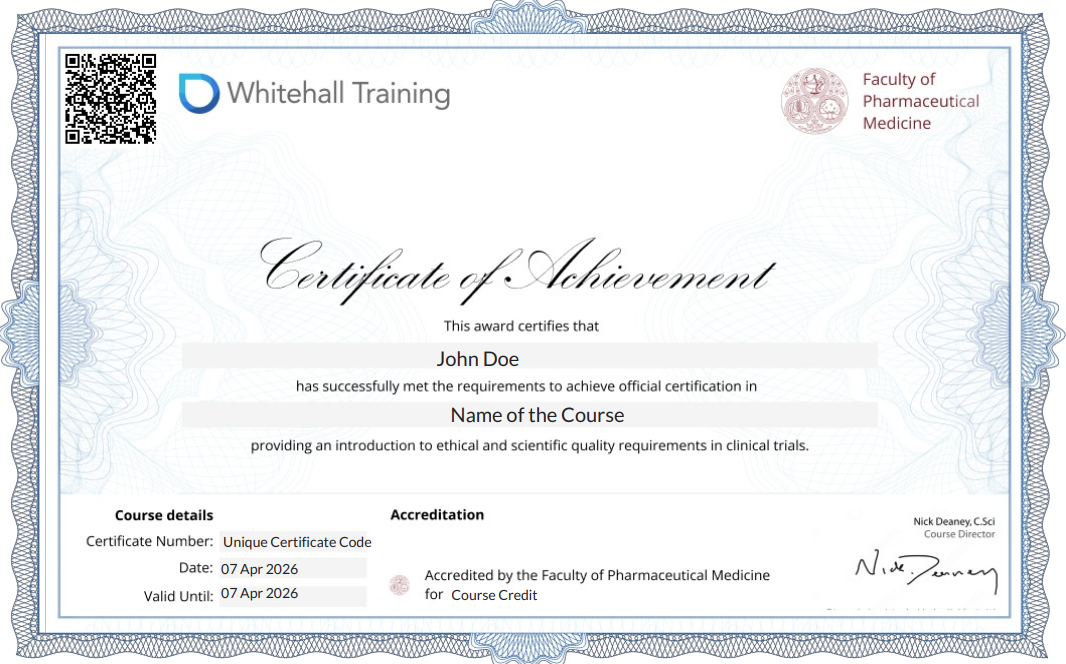
  • Certificate issued upon successful completion