














ICH GCP R3 is now in English & EU languages. Book Now

Course Syllabus

  1. La historia de GCP: Parte 1
  2. La historia de GCP: Parte 2
  3. La historia de GCP: Parte 3
  4. La historia de GCP: Parte 4
  5. ¿Qué es GCP?
  6. Los principios de ICH GCP: Parte 1
  7. Los principios de ICH GCP: Parte 2
  8. Puntos de aprendizaje adicionales
  9. Documentación y control de versiones
  10. Control de calidad (QA)
  11. Recursos clave: Parte 1
  12. Recursos clave: Parte 2

  1. Introducción: Parte 1
  2. Introducción: Parte 2
  3. Introducción: Parte 3
  4. Introducción: Parte 4
  5. Introducción: Parte 5
  6. Introducción: Parte 6
  7. Introducción: Parte 7
  8. Introducción: Parte 8
  9. Introducción: Parte 9
  10. Responsabilidades de la Autoridad Reguladora
  11. Responsabilidades del IEC
  12. Formularios de Consentimiento Informado del Sujeto (ICF) Parte 1
  13. Formularios de Consentimiento Informado del Sujeto (ICF): Parte 2
  14. Composición, Funciones, Operaciones, Procedimientos y Registros
  15. Interacciones del IEC con Patrocinadores e Investigadores

  1. Introducción
  2. Responsabilidades del investigador
  3. Cualificaciones y acuerdos del investigador
  4. Recursos adecuados
  5. Atención médica a los sujetos del ensayo: Parte 1
  6. Atención médica a los sujetos del ensayo: Parte 2
  7. Comunicación con el Comité de Ética de Investigación (CRI)/Comité de Ética de Investigación (CEI)
  8. Cumplimiento del protocolo
  9. Medicamentos en investigación
  10. Procedimientos de aleatorización y desenmascaramiento
  11. Consentimiento informado: Introducción
  12. Consentimiento informado: Discusión sobre el consentimiento
  13. Consentimiento informado: Sujetos que no saben leer ni escribir
  14. Consentimiento informado: Menores y sujetos con discapacidad mental
  15. Consentimiento informado: Sujetos con discapacidad mental
  16. Consentimiento informado: Actualización del consentimiento
  17. Documentos e informes: Introducción
  18. Documentos e informes: Archivos del centro de estudio
  19. Documentos e informes: Actualizaciones y cambios
  20. Documentos e informes: Documentos fuente
  21. Documentos e informes: Información financiera Información
  22. Documentos e informes: Formulario de consentimiento informado
  23. Documentos e informes: Registro de casos
  24. Documentos e informes: Registro de datos de los sujetos
  25. Terminación anticipada o suspensión de un estudio
  26. Informes de progreso e informes finales del investigador
  27. Responsabilidades del investigador

  1. Introducción: Parte 1
  2. Introducción: Parte 2
  3. Introducción: Parte 3
  4. Gestión de la Calidad: Parte 1
  5. Gestión de la Calidad: Parte 2
  6. Gestión de la Calidad - Parte 3
  7. QA y QC (Garantía y Control de Calidad): Introducción
  8. QA y QC (Garantía y Control de Calidad): Procedimientos Operativos Estándar
  9. QA y QC (Garantía y Control de Calidad): Acuerdos y Contratos
  10. Organizaciones de Investigación por Contrato
  11. Diseño del Estudio
  12. Gestión del Estudio: Introducción
  13. Gestión del Estudio: Gestión de Datos
  14. Gestión del Estudio: Datos Electrónicos
  15. Gestión del Estudio: Retención de Registros
  16. Selección del Investigador: Introducción
  17. Selección del Investigador: Autorizaciones
  18. Selección del Investigador: Responsabilidades
  19. Selección del Investigador: Remuneración
  20. Financiación
  21. Notificación/Presentación a las Autoridades Reguladoras
  22. Confirmación de la Revisión del Comité de Ética de Investigación (CRI)/Comité de Ética de Investigación (CEI)
  23. Información del IMP
  24. Fabricación, Envasado, Etiquetado y Codificación de Productos en Investigación: Parte 1
  25. Fabricación, Envasado, Etiquetado y Codificación de Productos en Investigación: Parte 2
  26. Suministro y Manejo de Productos en Investigación
  27. Acceso a los Registros
  28. Gestión de Datos I
  29. Gestión de Datos II
  30. Gestión de Datos III
  31. Gestión de Datos IV
  32. Gestión de Datos V
  33. Gestión de Datos VI
  34. Programación Estadística y Análisis de Datos I
  35. Programación Estadística y Análisis de Datos II
  36. Retención y Archivo de Datos
  37. Auditoría e Inspección
  38. Incumplimiento
  39. Terminación o Suspensión Anticipada de un Ensayo Clínico: Parte 1
  40. Terminación o Suspensión Anticipada de un Ensayo Clínico: Parte 2
  41. Informes de Estudios Clínicos
  42. Estudios Multicéntricos

  1. Introducción
  2. Gobernanza de Datos - Parte 1
  3. Gobernanza de Datos - Parte 2
  4. Mantenimiento de la Ciega
  5. Ciclo de Vida de los Datos I
  6. Ciclo de Vida de los Datos II
  7. Ciclo de Vida de los Datos III
  8. Ciclo de Vida de los Datos IV
  9. Sistemas de Información I
  10. Sistemas de Información II
  11. Sistemas de Información III
  12. Sistemas de Información IV
  13. Sistemas de Información V
  14. Sistemas de Información VI
  15. Sistemas de Información VII

  1. Introducción
  2. Monitorización
  3. La visita de monitorización: Parte 1
  4. La visita de monitorización: Parte 2
  5. Verificación del PMI
  6. Cumplimiento del protocolo, las enmiendas, los procedimientos operativos estándar y las directrices
  7. Verificación del consentimiento informado
  8. El formulario de registro de caso (CRF) y los documentos fuente
  9. Verificación de los datos del sujeto
  10. Cierre de la visita de monitorización
  11. El informe y el plan de monitorización
  12. Gestión de la calidad: monitorización centralizada
  13. Fraude y mala conducta: Parte 1
  14. Fraude y mala conducta: Parte 2

  1. Introducción
  2. Eventos adversos, reacciones adversas a medicamentos y reacciones adversas graves (SUSAR)
  3. Eventos adversos graves (SUSAR)
  4. Eventos adversos de especial preocupación
  5. Informes periódicos de seguridad

  1. Introducción
  2. Estructura y contenido del protocolo: Parte 1
  3. Estructura y contenido del protocolo: Parte 2
  4. Estructura y contenido del protocolo: Parte 3

  1. Introducción
  2. Estructura y contenido del folleto del investigador

  1. Presentaciones
  2. Presentación
  3. Documentos que deben presentarse antes del estudio
  4. Documentos que deben presentarse después del estudio

  1. Glosario y abreviaturas
  2. Documentos de orientación de la UE
  3. Documentos de orientación de la ICH
  4. Documentos de orientación de la FDA de EE. UU.
  5. Lista de autoridades competentes mundiales

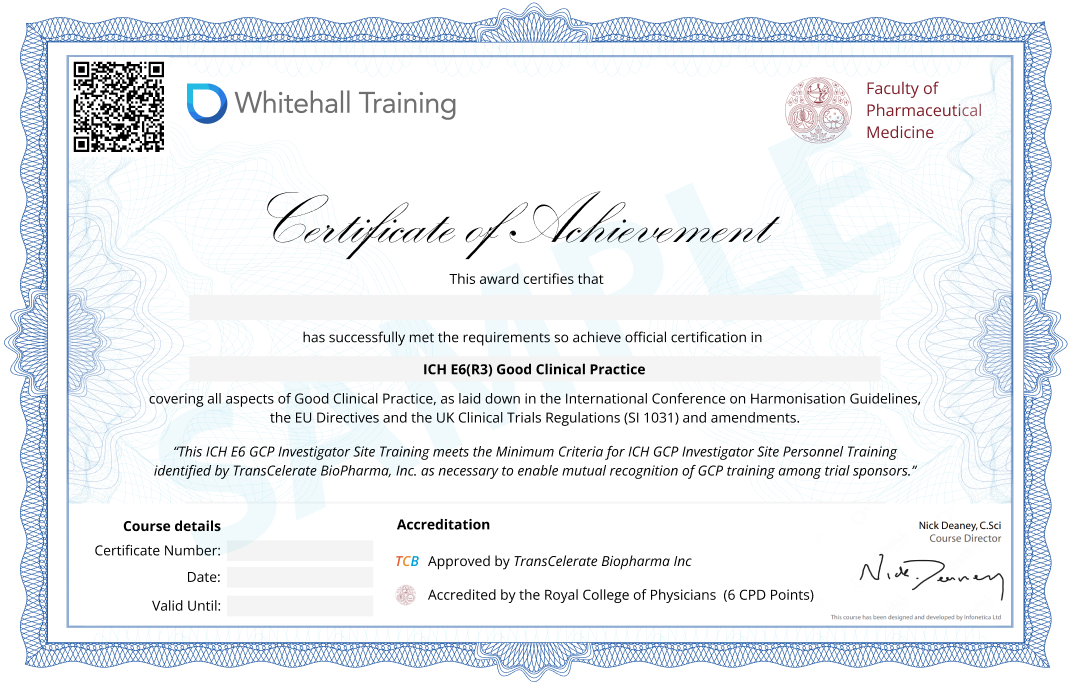
Course Certificate

On course completion, you receive your official ICH-GCP e6(R3) certification, allowing you to participate in clinical trials internationally
course_certificate_icon

Our GCP certified customers

novartis
NHS
takeda
roche
baxter

Testimonials

chat

"I've had the privilege of working with them for the GCP training of my company, and they performance is excellent. Additionally, technical support is very fast and efficient. Big thank you to Whitehall training, specially to Jagruti Patil!"

Clara Frago
Biotechnologist
chat

"Thank you very much for providing me such an exceptional training program!!!!"

Sofia Martaki
Trainee Pharmacist

Good Clinical Practice (GCP) training is a vital educational programme designed to arm researchers and clinical trial professionals with essential knowledge of ethical and scientific standards. These standards are crucial for executing high-quality clinical trials. The training encompasses the globally acknowledged guidelines set forth by the International Council for Harmonisation (ICH).

The key objectives of GCP training include:

  • Safeguarding the rights, safety, and welfare of human participants
  • Upholding the accuracy and reliability of data collected during clinical trials
  • Fostering uniform, superior practices across all facets of clinical research

Whitehall Training's Good Clinical Practice Course thoroughly explores these critical areas. Our comprehensive programme equips learners with a robust understanding of GCP principles and their practical implementation in real-world clinical research scenarios. By completing this course, participants gain the necessary skills to conduct clinical trials that meet the highest standards of ethical and scientific rigour.

Absolutely. For those involved in clinical trials, GCP certification isn’t just valuable—it’s essential. But even if you’re not directly participating in trials, obtaining GCP certification offers numerous benefits:

  • It demonstrates your commitment to upholding global research standards
  • Your research gains added credibility and quality assurance
  • You’ll be better equipped to safeguard the rights and wellbeing of study participants
  • Your career opportunities in the clinical research sector may expand significantly

Our Whitehall Training Good Clinical Practice Course goes beyond mere certification. We provide you with practical, hands-on knowledge that you can immediately apply in your professional endeavours. By mastering GCP principles through our course, you’ll be well-prepared to navigate the complexities of clinical research with confidence and expertise.

Good Clinical Practice (GCP) certification is crucial for a broad spectrum of individuals working in clinical research:

  • Lead Researchers and Co-investigators: These are the primary and supporting scientists responsible for overseeing and conducting trials at research facilities.
  • On-site Trial Team: This includes study coordinators, research nurses, and other personnel involved in the day-to-day management of clinical trials.
  • Trial Sponsors and Research Organisations: Professionals who manage the overall planning, commencement, and documentation of clinical studies.
  • Regulatory Bodies: Officials tasked with supervising and assessing trial compliance with established standards.
  • Ethics Committees: Groups responsible for reviewing and approving proposed trial protocols to ensure ethical conduct.
  • University and Research Centre Staff: Individuals ensuring that institutional research aligns with international benchmarks.
  • Researchers Funded by National Health Organisations: All scientists and support staff engaged in publicly funded clinical trials.

Our comprehensive GCP course is designed to meet the needs of this varied audience, offering both universal principles and role-specific guidance. Additionally, it serves as an excellent resource for those aiming to enhance their research capabilities and refine their approach to clinical trial operations. The Whitehall Training Good Clinical Practice Course provides tailored content to address the unique requirements of each of these professional groups, ensuring that all participants gain the knowledge necessary for their specific roles in the clinical research process.

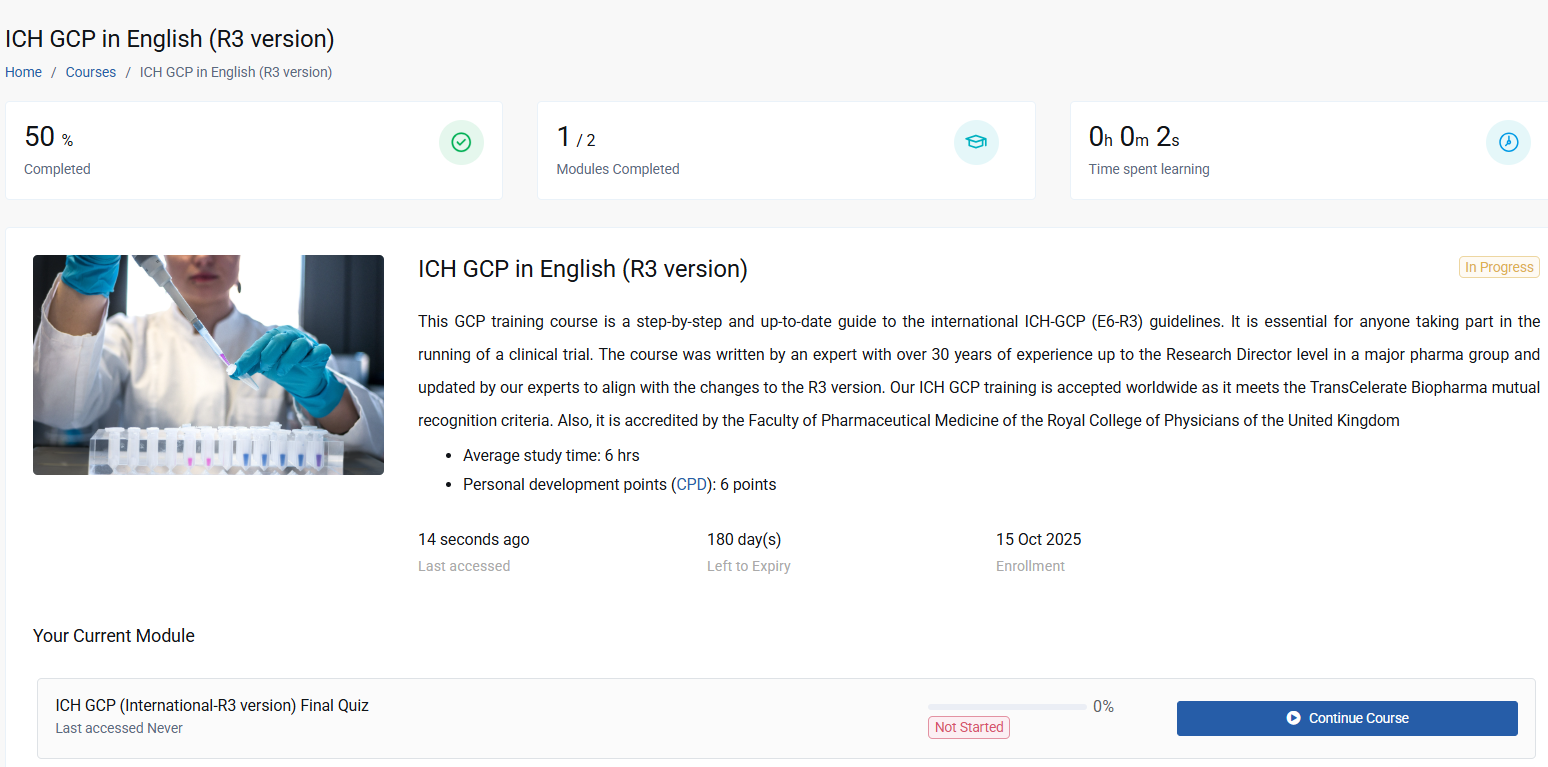
Our Good Clinical Practice (GCP) course is designed to provide comprehensive coverage of the ICH-GCP (E6-R3) international guidelines, ensuring you meet the necessary training requirements for participation in international clinical trials. We offer this course in multiple languages to cater to a diverse audience.

This course serves as a detailed, step-by-step guide to the most recent ICH-GCP (E6-R3) guidelines, making it an indispensable resource for anyone involved in clinical trial management. The content has been meticulously crafted by an industry veteran with over three decades of experience, including a tenure as Research Director at a leading pharmaceutical company.

We’re proud to offer a course that’s accredited by the Faculty of Pharmaceutical Medicine of the Royal College of Physicians of the United Kingdom. This accreditation underscores the quality and relevance of our training material. To accommodate our global learners, we’ve made the course available in ten languages: English, German, Bulgarian, French, Italian, Japanese, Polish, Portuguese, Russian, and Spanish. Additionally, we’ve developed region-specific versions tailored to the regulatory frameworks of Australia, the UK, the US, France, Germany, and Latin America.

Our course stands out for its user-friendly design and clear visual presentation. This format allows for easy navigation and reference to the ICH-GCP E6 document. Drawing from the author’s extensive industry experience, the course offers practical insights into the application of GCP principles.

Upon completion, participants can earn 6 Continuing Professional Development (CPD) points, further enhancing the value of this training programme.

Indeed, our GCP course has received certification from the Faculty of Pharmaceutical Medicine at the Royal College of Physicians. This prestigious body, established in 1989, is renowned for its role in setting stringent research standards and serves as the professional membership organisation for pharmaceutical physicians across the United Kingdom.

The certification bestowed upon our course is a testament to its quality and relevance. It signifies that our programme meets exacting industry and academic criteria, providing you with a qualification that is widely acknowledged and respected within the field. By completing this certified course, you can be confident that you’re receiving training that aligns with the most current and rigorous standards in pharmaceutical research and practice.

The price of GCP certification can fluctuate based on several key factors:

  • Endorsement: Has the course received approval from official bodies?
  • Validity: Does the training meet ICH standards, allowing researchers to engage in global clinical studies?
  • Content quality: Is the material current and authored by an industry expert?
  • Duration of access: For how long can students utilise the course materials?

Our Whitehall Training GCP course is priced at £79, reflecting its high value across these areas:

  • Endorsement: The Royal College of Physicians has accredited our course, awarding it 6 CPD points.
  • Validity: Upon completion, researchers are equipped to participate in clinical trials, in line with ICH E6(R3) guidelines.
  • Content quality: Lucy Parker, our GCP specialist with over ten years’ experience leading research at major institutions like the NHS, has crafted the course content.
  • Duration of access: We support ongoing professional development by offering unlimited access to course materials.

For group purchases, we offer a 10% discount when buying 5 licences at checkout. If you’re interested in larger group discounts, please reach out to our team for a tailored quote.


Indeed, some free GCP training options can be found online. However, it’s important to be aware of their potential drawbacks:

  • The content may be of lower quality, lacking accreditation and potentially outdated
  • These courses typically don’t offer official certification, which is often required for conducting clinical research

Our GCP course offers a comprehensive exploration of the essential principles and practices required for conducting ethical and scientifically robust clinical trials. With a curriculum that caters to both newcomers and seasoned professionals, the programme is structured to accommodate various levels of expertise.

The course delves into a range of crucial subjects, including:

  • The origins and fundamental tenets of GCP
  • Key stakeholder duties: investigators, sponsors, and monitors
  • Ethics in clinical trials and obtaining informed consent
  • Creating and adhering to trial protocols
  • Managing safety reports and adverse events
  • Ensuring data quality and integrity
  • Navigating regulatory landscapes and authority interactions
  • Maintaining crucial documentation and records
  • Proper handling of investigational medicinal products
  • Best practices in site management and monitoring

To ensure an engaging and effective learning experience, we employ a variety of interactive e-learning techniques, such as:

  • In-depth educational content
  • Authentic case studies and situational analyses
  • Engaging knowledge assessments and quizzes
  • Practical illustrations and industry-leading practices
  • Reflective exercises and real-world applications

This carefully crafted approach ensures that participants not only grasp the theoretical aspects of GCP but also gain practical insights that can be directly applied in their professional roles.

Securing your Good Clinical Practice certificate is a simple, two-stage procedure:

  1. Work through the interactive educational content of the course.
  2. Successfully complete the online assessment at the end.

Feeling apprehensive about the GCP test? There's no need to worry. The examination is merely a formality to confirm your readiness for research participation. In the unlikely event that you don't pass on your first attempt, you can easily brush up on any areas you're unsure of using our comprehensive resource library, and then have another go at the exam.

Our Whitehall Training Good Clinical Practice Course is designed to make this process as smooth and informative as possible, ensuring you're well-prepared for both the exam and your future role in clinical research.

Our Good Clinical Practice course is structured to ensure participants not only absorb the material but can also implement it effectively in real-world clinical research environments. To achieve this, we've incorporated various evaluation methods throughout the learning journey:

  • Continuous Learning Checks: As you progress through the modules, you'll encounter interactive quizzes and practical scenarios. These elements serve to reinforce key concepts and allow you to measure your understanding along the way.
  • Comprehensive Final Evaluation: The course concludes with an in-depth assessment that thoroughly examines your grasp of GCP principles and practices. This evaluation covers all major areas from the course, including:
    • Ethical considerations within clinical studies
    • Regulatory compliance and requirements
    • Responsibilities and roles in clinical trials
    • Quality management and data integrity
    • Adverse event handling and safety reporting
  • Real-world Application: Some questions in the final evaluation are crafted to test your ability to apply GCP principles to realistic clinical trial situations.

To ensure you're fully equipped to conduct trials, successfully completing the final evaluation is necessary to obtain your GCP certification.

We understand that everyone learns at their own pace, which is why you can take the final evaluation as many times as needed. This approach ensures that all learners can achieve the required standard and become GCP qualified.

Our Good Clinical Practice (GCP) course is tailored to accommodate a broad spectrum of professionals engaged in clinical research. Whilst prior knowledge of clinical research can be advantageous, it's not essential for enrolment. We've carefully crafted the course content to suit various levels of expertise and different roles within the clinical trial field.

This training programme is particularly beneficial for:

  • Clinical Research Coordinators
  • Principal and Sub-Investigators
  • Research Nurses
  • Clinical Trial Managers
  • Data Managers and Biostatisticians
  • Regulatory Affairs Specialists
  • Quality Assurance Experts
  • Ethics Committee Members
  • Pharmacists involved in clinical studies
  • Sponsor and Contract Research Organisation (CRO) staff

The course is suitable for both newcomers to clinical research and seasoned professionals seeking to update their knowledge. It offers a comprehensive overview of GCP principles and their practical implementation in clinical trials. The content is structured to ensure that learners at all levels can grasp and apply the concepts effectively, making it an ideal choice regardless of your current level of experience in the field.

Indeed, our Good Clinical Practice course is fully available via the internet, providing learners with unparalleled convenience and adaptability. This digital format offers numerous benefits:

  • Personalised learning speed: Students can navigate through the course content at a rhythm that best suits their individual needs and timetable. This approach fosters a more thorough understanding of the material without the constraints often associated with traditional classroom settings.
  • Round-the-clock availability: The course can be accessed at any time, from any internet-connected device. Whether you're at your workplace, in the comfort of your home, or even whilst on the move, the course materials are always at your fingertips.

The International Council for Harmonisation, or ICH, plays a crucial role in shaping the landscape of pharmaceutical research and development worldwide. This organisation is at the forefront of establishing globally recognised guidelines, including those for Good Clinical Practice (GCP). Here's what you need to know:

  • ICH acts as a collaborative platform, uniting regulatory bodies and pharmaceutical industry experts.
  • It develops internationally accepted standards that govern the conduct of clinical trials.
  • The ICH GCP guidelines are designed with two primary objectives: safeguarding trial participants and ensuring the reliability of clinical data.
  • These guidelines undergo regular revisions to stay current, with ICH GCP E6(R3) being the most recent iteration.

Adhering to these ICH guidelines is non-negotiable for anyone involved in clinical research. That's precisely why we've crafted our Good Clinical Practice course. We provide comprehensive coverage of all 13 fundamental ICH GCP principles, equipping you with the knowledge and skills necessary to conduct research that meets stringent global requirements. Our aim is to ensure you're fully prepared to navigate the complexities of clinical trials in accordance with these internationally recognised standards.

ICH Good Clinical Practice E6 (R3) represents the latest iteration of the Good Clinical Practice guidelines, published in 2016 by the International Council for Harmonisation of Technical Requirements for Pharmaceuticals for Human Use. This update marks a significant progression in GCP standards, adapting to the evolving landscape of clinical research.

It's essential for clinical research professionals to be well-versed in ICH GCP E6 (R3) for several reasons:

  • It sets the current worldwide benchmark for conducting ethical and scientifically rigorous clinical trials.
  • Regulatory bodies across the globe often mandate adherence to these guidelines.
  • It plays a crucial role in safeguarding study participants and ensuring the integrity of trial results.
  • Many research institutions and pharmaceutical companies expect their teams and collaborators to be knowledgeable about and compliant with these updated standards.

The Whitehall Training Good Clinical Practice Course offers comprehensive coverage of ICH GCP E6 (R3). Our programme ensures that learners gain a thorough understanding of these revised guidelines and can effectively implement them in their clinical research endeavours. By focusing on the most up-to-date standards, we equip participants with the knowledge needed to excel in the current clinical research environment.

The International Council for Harmonisation (ICH) Good Clinical Practice (GCP) guidelines are founded on 13 essential principles that serve as the cornerstone for ethical and scientific standards in clinical research. These crucial principles encompass:

  1. Conducting research ethically
  2. Ensuring benefits surpass risks
  3. Safeguarding participants' rights and wellbeing
  4. Providing sufficient supporting evidence
  5. Developing scientifically robust protocols
  6. Obtaining IRB/IEC approval
  7. Ensuring qualified medical oversight
  8. Engaging competent investigators
  9. Securing informed consent
  10. Maintaining precise data documentation and reporting
  11. Upholding confidentiality
  12. Adhering to good manufacturing practices for investigational products
  13. Implementing quality assurance systems

Our Whitehall Training Good Clinical Practice Course offers comprehensive instruction on these principles, equipping you with the knowledge to effectively implement them in practical clinical research scenarios. Through our course, you'll gain a thorough understanding of how these principles shape the landscape of clinical trials and contribute to the integrity of research outcomes.