
Buy the GCP R3 course & get a FREE eBook— your complete ICH-GCP R3 reference guide. Book Now →

  • Preclinical & Laboratory Foundations Learning Path
  • Phase I – First-in-Human Trials Learning Path
  • Phase II & III – Efficacy & Pivotal Trials Learning Path
  • Clinical Trials Foundation PathNew
  • Regulatory Submission & Approval

About

Diversity, Equity and Inclusion in Clinical Trials training provides the knowledge and practical skills required to design, conduct, and oversee clinical trials that are representative, inclusive, and accessible to the populations intended to benefit from the investigational product. Learners gain an understanding of the scientific, ethical, regulatory, and operational principles that support equitable participant selection, inclusive study design, representative recruitment strategies, and the reduction of barriers to participation across diverse populations.
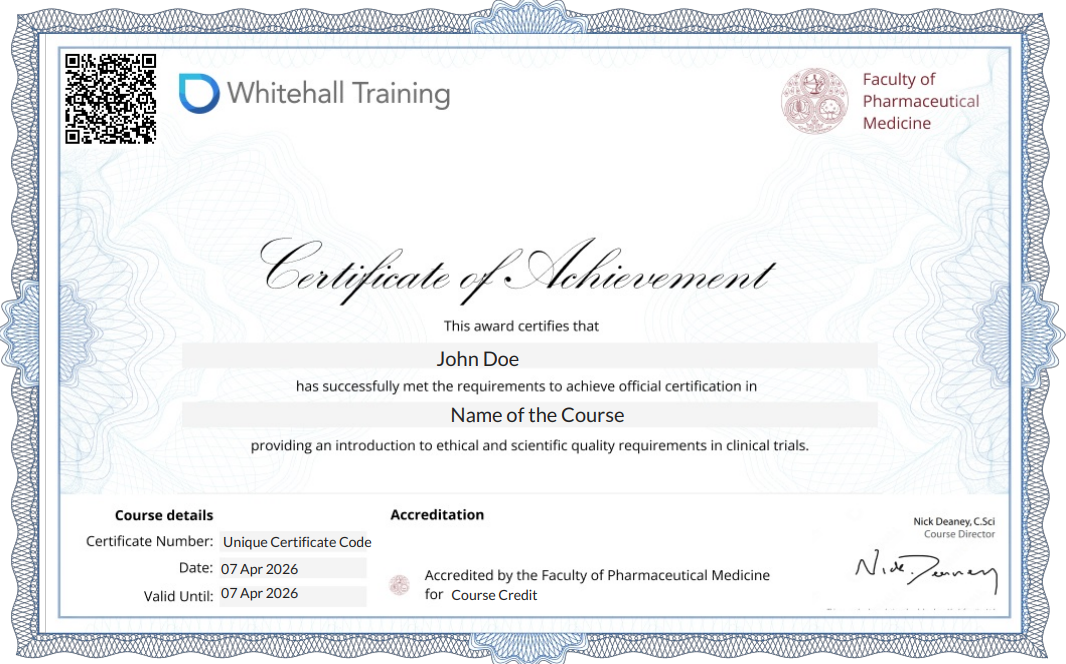
This Diversity, Equity and Inclusion in Clinical Trials Course & Certification covers trial representativeness, inclusion planning, participant recruitment and retention, under-served populations, demographic data collection, eligibility criteria assessment, site selection, community engagement, decentralised trial considerations, subgroup analysis, regulatory expectations, and global guidance from FDA, ICH, HRA, NIHR, and EU frameworks. Upon successful completion, learners receive a certification demonstrating their understanding of diversity, equity, inclusion, representativeness, and inclusive clinical trial design and conduct.

Who Should Enrol?

  • Clinical Research and Clinical Operations Professionals
  • Principal Investigators, Study Coordinators, and Research Nurses
  • Regulatory Affairs and Compliance Professionals
  • Biostatistics and Data Management Professionals
  • Quality Assurance and GCP Professionals
  • Pharmaceutical, Biotechnology, CRO, and Life Sciences Professionals
📢 Every purchase also includes our FREE companion Diversity, Equity and Inclusion in Clinical Trials eBook, designed to help you apply principles in real-world clinical trial practices.

What you will learn

Understand the principles of diversity, equity and inclusion (DEI) in clinical trials and their importance in generating evidence that is relevant to the populations who will ultimately use medicinal products.

Learn how to design, plan and conduct inclusive clinical research by addressing barriers to participation, representative participant selection, eligibility criteria, site selection, recruitment strategies, retention, and community engagement.

Develop knowledge of global regulatory expectations and guidance from the FDA, MHRA, HRA, NIHR, ICH E6(R3), ICH E8(R1), ICH E7, and the EU Clinical Trials Regulation, including diversity plans, inclusion frameworks, and under-served populations.

Gain understanding of demographic data collection, race and ethnicity standards, socioeconomic measures, subgroup analyses, decentralised trial considerations, and the interpretation of diversity-related evidence.

Course Syllabus

  1. Representation is a generalisability problem before it is anything else
  2. The United States duty: live in statute, dormant in effect
  3. The United Kingdom choice of guidance over legislation
  4. Race is a poor proxy for ancestry, and no substitute for a genotype
  5. Eligibility criteria do most of the excluding
  6. The fictional Ashcombe Therapeutics case study

  1. 1.1 The argument, stated precisely
  2. 1.2 Documented differences by ancestry
  3. 1.3 Documented differences by sex
  4. 1.4 Where the claim has been overstated
  5. 1.5 Under-representation relative to disease burden

  1. 2.1 The statute: FDORA and section 505(z)
  2. 2.2 What a diversity action plan must contain
  3. 2.3 The commencement problem
  4. 2.4 The earlier framework, still current
  5. 2.5 What to do while the duty is dormant

  1. 3.1 Guidance rather than legislation
  2. 3.2 NIHR INCLUDE and the funding condition
  3. 3.3 The HRA route
  4. 3.4 The Equality Act and the public sector duty
  5. 3.5 What the clinical trials regulations do not say

  1. 4.1 What the Clinical Trials Regulation actually says
  2. 4.2 Specific populations in EU guidance
  3. 4.3 ACT EU and the European workplan
  4. 4.4 The ICH layer that reaches all three regions
  5. 4.5 Running one programme across three regions

  1. 5.1 Under-served is study-specific, not a fixed list
  2. 5.2 Ethnicity, mistrust and the historical harms
  3. 5.3 Sex, pregnancy and lactation
  4. 5.4 Age, frailty and multimorbidity
  5. 5.5 Disability, mental illness and learning disability
  6. 5.6 Deprivation, geography and language

  1. 6.1 Eligibility criteria as the primary mechanism
  2. 6.2 Justifying or removing each criterion
  3. 6.3 Site selection as an exclusion mechanism
  4. 6.4 Visit burden, travel and time
  5. 6.5 Decentralisation and the digital counter-risk
  6. 6.6 Building it into the protocol, not a separate document

  1. 7.1 Self-identification as the collection standard
  2. 7.2 Two categorisation standards that do not map
  3. 7.3 Sex assigned at birth and gender identity
  4. 7.4 Socioeconomic position and geography
  5. 7.5 Missing, not stated and categories that cannot be pooled
  6. 7.6 Reporting enrolment demographics

  1. 8.1 Description and inference are different acts
  2. 8.2 Multiplicity, power and the harm of over-claiming
  3. 8.3 Pre-specification, estimands and ICH E9(R1)
  4. 8.4 When a difference reaches the product label
  5. 8.5 Metrics that show whether inclusion worked
  6. 8.6 Ownership, flow-down and accountability that lasts

  1. The decision points, in the order they arise on a programme
  2. The eight recurring failures and the control that prevents each
  3. Assigned ownership rather than assumed ownership
  4. A system, not a commitment
  5. Keeping pace with requirements that are genuinely moving
  6. Course completion

  1. 📘 Bonus: Diversity, Equity and Inclusion in Clinical Trials eBook (Free with purchase)

Our Certified Customers

novartis
NHS
takeda
roche
baxter

Learner Rating & Reviews

4.7
★★★★★★
Average Rating
536 global ratings
★★★★★
87.0%
★★★★★
5.0%
★★★★★
3.0%
★★★★★
3.0%
★★★★★
2.0%
RC

Working with Whitehall training for the last two years of partnership has been a very successful experience – I have fast access to all the GCP course...

SM

I have finalised the demo for the ICH-GCP E6 R3 refresher course. Overall, I liked the content and the interface. I also want to thank Whitehall Train...

Frequently Asked Questions

  • Clinical Research, Clinical Operations & Study Management Professionals
  • Regulatory Affairs, Ethics & Research Governance Professionals
  • Principal Investigators, Research Nurses & Clinical Site Teams
  • Patient Engagement, Recruitment & Community Outreach Teams
  • Pharmaceutical, Biotechnology & Medical Device Professionals
  • CROs, Sponsors, Quality Assurance & GCP Compliance Professionals

This module builds a foundational understanding of diversity, equity, and inclusion (DEI) in clinical trials, focusing on representative participant selection, inclusive study design, equitable recruitment, and reducing barriers to participation. This module covers regulatory expectations, demographic data, under-served populations, recruitment strategies, and inclusive trial practices to support ethical, scientifically robust, and generalisable clinical research.


  • Developed by clinical research, regulatory, ethics, and GCP experts
  • Practical, real-world focus aligned with global clinical trial diversity and inclusion expectations
  • Covers inclusive trial design, representative recruitment, under-served populations, and participant engagement
  • Suitable for professionals across pharmaceuticals, biotechnology, CROs, medical devices, and clinical research
  • Designed to support ethical research, regulatory readiness, equitable participation, and generalisable clinical evidence