















SM
Clara Fargo
EBMT Clinical Research Quality Assurance Coordinator
I have finalised the demo for the ICH-GCP E6 R3 refresher course. Overall, I liked the content and the interface. I also want to thank Whitehall Train...
 AI Clinical
 New
New
 Clinical Practice
 Pharmacovigilance
 Manufacturing
 Laboratory Practice
 Distribution
 Medical Devices
 Regulatory Affairs
 Research Compliance
 Health & Safety
 Quality Assurance
 Biostatistics
 Trending
 Pharmaceutical MedicineNew
 All Bundles








 New
New 91% Recommended
 Updated 2026
 6 hours
 213 active users
 6 points
Your Study Basket
1 x Good Clinical Practice: adapted for the US (English) R3 version
| Total | |



Secure Payment Service

Rest assured we use secure processes to protect your payment.
Secured by:




The Good Clinical Practice (GCP): Adapted for the US (English) R3 Course & Certification provides essential training on the latest ICH-GCP E6(R3) guidelines, with a focus on U.S. regulatory expectations. The course helps clinical research professionals understand how global GCP principles align with FDA requirements while ensuring participant safety, data integrity, and ethical conduct in clinical trials.
This course covers key updates in ICH-GCP E6(R3), including core principles, risk-based quality management, investigator and sponsor responsibilities, informed consent, safety reporting, essential documentation, and inspection readiness. It also highlights how GCP principles are applied within the U.S. clinical research environment.
Upon completion, learners receive an industry-recognized certification demonstrating their understanding of ICH-GCP E6(R3) and U.S.-aligned clinical research standards.
Understand key ICH GCP E6(R3) principles, ethical requirements, participant safety, and roles of regulatory authorities and Independent Ethics Committees (IECs), including FDA-specific expectations in the United States.
Learn investigator, sponsor, and monitor responsibilities in ensuring compliant clinical trial conduct under ICH GCP and FDA regulatory requirements.
Apply risk-based quality management, data governance, and safety reporting requirements aligned with both ICH E6(R3) and US FDA regulations.
Gain knowledge of clinical trial protocols, Investigator’s Brochure (IB), essential documents, and inspection readiness for FDA audits and regulatory compliance.





Good Clinical Practice (GCP) training is a vital educational programme designed to arm researchers and clinical trial professionals with essential knowledge of ethical and scientific standards. These standards are crucial for executing high-quality clinical trials. The training encompasses the globally acknowledged guidelines set forth by the International Council for Harmonisation (ICH).
The key objectives of GCP training include:
Whitehall Training's Good Clinical Practice Course thoroughly explores these critical areas. Our comprehensive programme equips learners with a robust understanding of GCP principles and their practical implementation in real-world clinical research scenarios. By completing this course, participants gain the necessary skills to conduct clinical trials that meet the highest standards of ethical and scientific rigour.
Absolutely. For those involved in clinical trials, GCP certification isn’t just valuable—it’s essential. But even if you’re not directly participating in trials, obtaining GCP certification offers numerous benefits:
Our Whitehall Training Good Clinical Practice Course goes beyond mere certification. We provide you with practical, hands-on knowledge that you can immediately apply in your professional endeavours. By mastering GCP principles through our course, you’ll be well-prepared to navigate the complexities of clinical research with confidence and expertise.
Good Clinical Practice (GCP) certification is crucial for a broad spectrum of individuals working in clinical research:
Our comprehensive GCP course is designed to meet the needs of this varied audience, offering both universal principles and role-specific guidance. Additionally, it serves as an excellent resource for those aiming to enhance their research capabilities and refine their approach to clinical trial operations. The Whitehall Training Good Clinical Practice Course provides tailored content to address the unique requirements of each of these professional groups, ensuring that all participants gain the knowledge necessary for their specific roles in the clinical research process.
Our Good Clinical Practice (GCP) course is designed to provide comprehensive coverage of the ICH-GCP (E6-R3) international guidelines, ensuring you meet the necessary training requirements for participation in international clinical trials. We offer this course in multiple languages to cater to a diverse audience.
This course serves as a detailed, step-by-step guide to the most recent ICH-GCP (E6-R3) guidelines, making it an indispensable resource for anyone involved in clinical trial management. The content has been meticulously crafted by an industry veteran with over three decades of experience, including a tenure as Research Director at a leading pharmaceutical company.
We’re proud to offer a course that’s accredited by the Faculty of Pharmaceutical Medicine of the Royal College of Physicians of the United Kingdom. This accreditation underscores the quality and relevance of our training material. To accommodate our global learners, we’ve made the course available in ten languages: English, German, Bulgarian, French, Italian, Japanese, Polish, Portuguese, Russian, and Spanish. Additionally, we’ve developed region-specific versions tailored to the regulatory frameworks of Australia, the UK, the US, France, Germany, and Latin America.
Our course stands out for its user-friendly design and clear visual presentation. This format allows for easy navigation and reference to the ICH-GCP E6 document. Drawing from the author’s extensive industry experience, the course offers practical insights into the application of GCP principles.
Upon completion, participants can earn 6 Continuing Professional Development (CPD) points, further enhancing the value of this training programme.
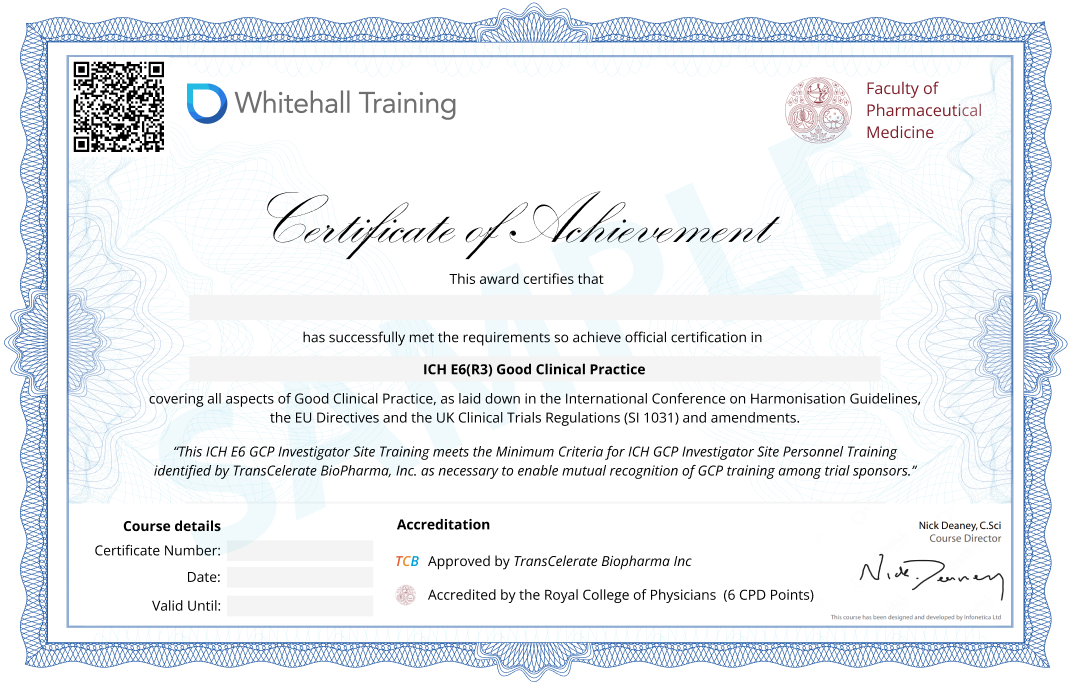
Indeed, our GCP course has received certification from the Faculty of Pharmaceutical Medicine at the Royal College of Physicians. This prestigious body, established in 1989, is renowned for its role in setting stringent research standards and serves as the professional membership organisation for pharmaceutical physicians across the United Kingdom.
The certification bestowed upon our course is a testament to its quality and relevance. It signifies that our programme meets exacting industry and academic criteria, providing you with a qualification that is widely acknowledged and respected within the field. By completing this certified course, you can be confident that you’re receiving training that aligns with the most current and rigorous standards in pharmaceutical research and practice.
The price of GCP certification can fluctuate based on several key factors:
Our Whitehall Training GCP course is priced, reflecting its high value across these areas:
For group purchases, we offer a 10% discount when buying 5 licences at checkout. If you’re interested in larger group discounts, please reach out to our team for a tailored quote.