

















SM
Clara Fargo
EBMT Clinical Research Quality Assurance Coordinator
I have finalised the demo for the ICH-GCP E6 R3 refresher course. Overall, I liked the content and the interface. I also want to thank Whitehall Train...
 AI Clinical
 New
New
 Clinical Practice
 Pharmacovigilance
 Manufacturing
 Laboratory Practice
 Distribution
 Medical Devices
 Regulatory Affairs
 Research Compliance
 Health & Safety
 Quality Assurance
 Biostatistics
 Trending
 Pharmaceutical MedicineNew
 All Bundles







 New
New 96% Recommended
 Updated 2026
 1 hour
 179 active users
 3 points
Your Study Basket
1 x Clinical Study Coordinator Level 1
| Total | |



Secure Payment Service

Rest assured we use secure processes to protect your payment.
Secured by:




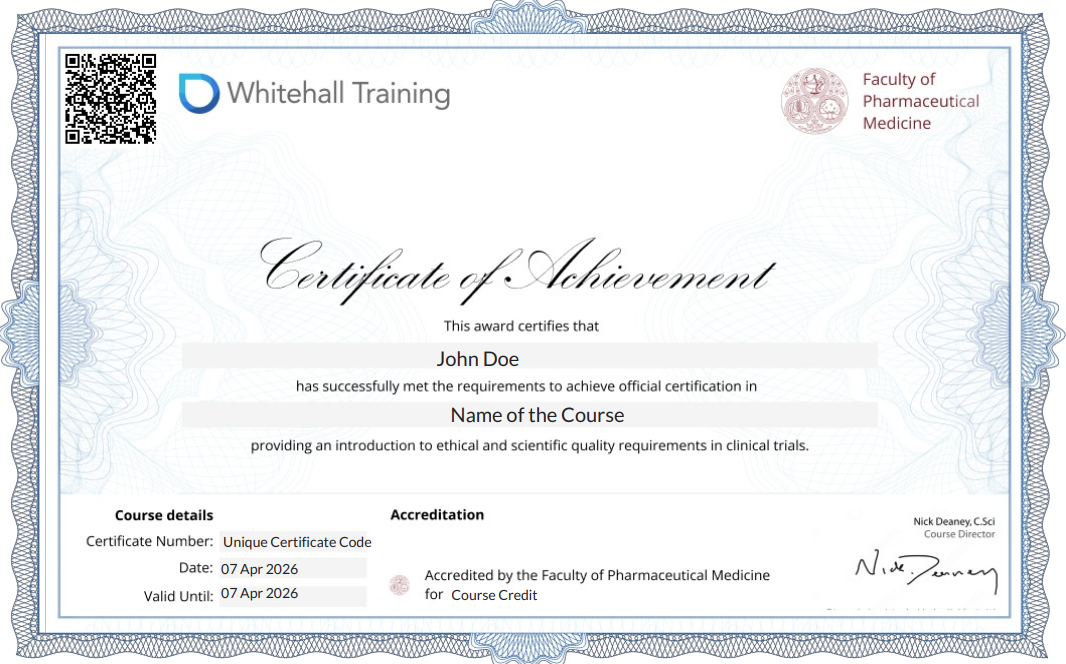
The Clinical Study Coordinator Level 1 Course is designed to provide foundational knowledge of clinical research operations and the essential responsibilities of a study coordinator at the clinical trial site. It introduces the core principles of Good Clinical Practice (GCP), clinical trial conduct, and day-to-day site management activities required to support high-quality and compliant research.
This course covers key areas such as study start-up activities, participant recruitment and screening, informed consent process, source documentation, data entry into case report forms (CRFs), adverse event reporting, and coordination with investigators, sponsors, and study monitors. It also emphasizes regulatory compliance, essential documentation, and basic quality and safety requirements in clinical trials. Upon completion, learners will receive a certification demonstrating their readiness to contribute effectively as a Clinical Study Coordinator at the entry level.
Understand the fundamentals of Good Clinical Practice (GCP), including ICH E6 (R3) principles, regulatory framework, documentation requirements, and roles of key stakeholders in clinical trials.
Learn essential site-level responsibilities, including investigator oversight, informed consent process, protocol compliance, IMP handling, and proper maintenance of study documents and source records.
Gain knowledge of clinical trial operations such as sponsor and monitor responsibilities, CRO interactions, monitoring activities, data governance, safety reporting, and adherence to ALCOA+ data integrity principles.
Develop practical awareness of trial execution risks, including protocol deviations, audit findings, essential record management, and inspection readiness to ensure compliance and participant safety.





This course is ideal for individuals who want to begin or advance a career in clinical research, including:




 Best Seller