
 New
New


 Trending











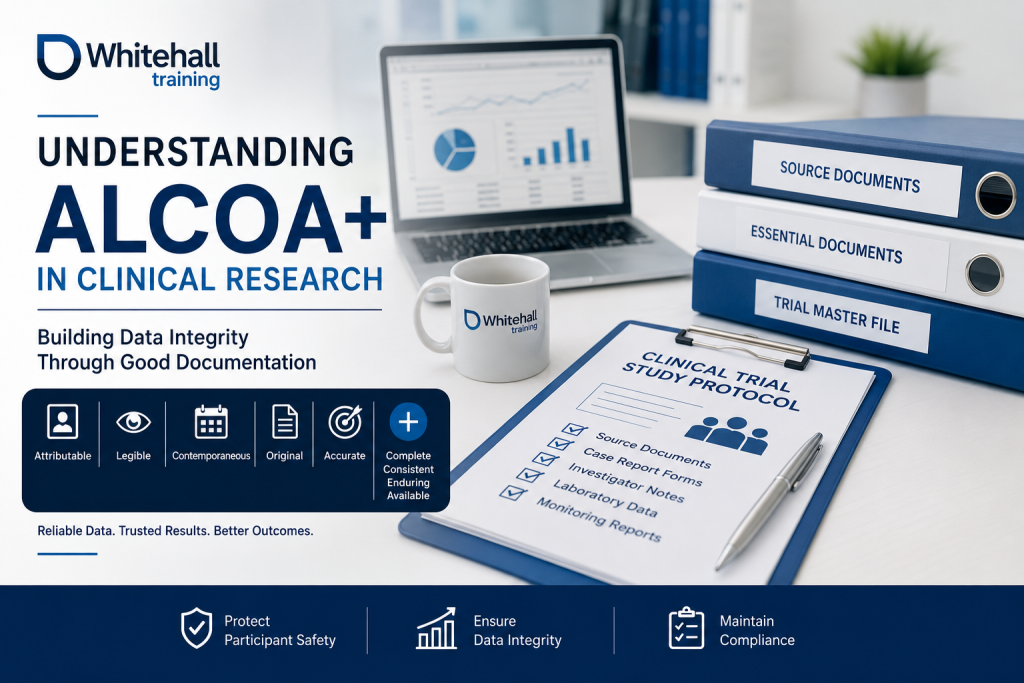
Understanding ALCOA+ in Clinical Research: Building Data Integrity Through Good Documentation
Introduction
Clinical trials generate thousands of records throughout the study lifecycle, including informed consent forms, source documents, laboratory reports, electronic case report forms (eCRFs), monitoring reports, and regulatory documentation. These records form the evidence used to evaluate the safety, efficacy, and quality of investigational products.
The reliability of clinical trial outcomes depends not only on the data collected but also on the integrity of the documentation supporting it. Incomplete, inaccurate, or poorly maintained records can compromise participant safety, delay regulatory approvals, and result in inspection findings.
To help maintain high-quality data, regulatory authorities continue to emphasise the ALCOA+ principles, a globally recognised framework for ensuring data integrity in clinical research.
What is ALCOA+?
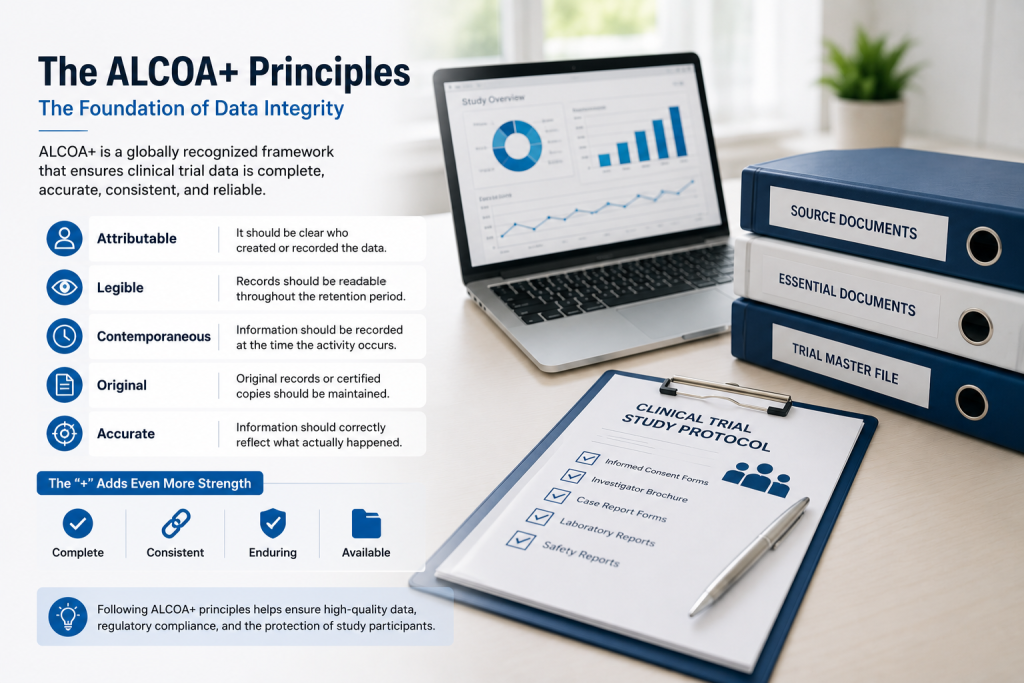
ALCOA+ is a framework that defines the characteristics of high-quality clinical research documentation.
Every clinical trial record should be:
- Attributable – It should be clear who created or recorded the information.
- Legible – Documentation should remain readable throughout the required retention period.
- Contemporaneous – Information should be recorded at the time the activity occurs.
- Original – Original records or certified copies should be maintained.
- Accurate – Information should correctly reflect the activity performed.
The “+” extends these principles by ensuring records are also:
- Complete
- Consistent
- Enduring
- Available
Together, these principles help ensure clinical trial data remains reliable, traceable, and suitable for regulatory review.
Why is ALCOA+ Important?
Regulatory authorities rely on clinical trial data when evaluating the safety and effectiveness of investigational medicinal products.
Poor documentation may lead to:
- Inspection findings
- Increased data queries
- Protocol deviations
- Delays in regulatory submissions
- Reduced confidence in study results
Applying ALCOA+ principles consistently helps protect:
- Participant safety
- Data integrity
- Regulatory compliance
- Sponsor credibility
- Inspection readiness
Regulatory Expectations
The importance of ALCOA+ is reflected in several international regulatory guidelines.
These include:
- ICH GCP E6(R3), which emphasises reliable documentation, quality management, and risk-based oversight throughout clinical trials.
- FDA Guidance on Data Integrity, which highlights the importance of complete, accurate, and trustworthy records.
- MHRA GxP Data Integrity Guidance, reinforcing expectations for maintaining reliable documentation across regulated activities.
- EMA Good Clinical Practice expectations, supporting data quality and participant protection throughout the clinical trial lifecycle.
Although each authority uses different wording, they all share the same expectation: clinical trial data must be complete, accurate, traceable, and reliable.
ALCOA+ in Practice
Consider a routine monitoring visit conducted by a Clinical Research Associate (CRA).
During source data verification, the CRA identifies that a participant attended a scheduled follow-up visit outside the protocol-defined visit window. The visit has been entered into the eCRF, but the reason for the delay has not been documented in the participant’s source records.
To maintain compliance and data integrity, the CRA should:
- Confirm why the visit occurred outside the permitted window.
- Ensure the protocol deviation is documented appropriately.
- Assess whether participant safety or study endpoints have been affected.
- Verify that sponsor reporting procedures have been followed.
- Confirm any corrective actions have been implemented by the study site.
Applying ALCOA+ principles throughout this process helps ensure the clinical trial remains inspection-ready while maintaining confidence in the study data.
Common Documentation Challenges
Some of the most frequently observed documentation issues during monitoring visits and regulatory inspections include:
- Missing signatures or initials
- Illegible handwritten entries
- Backdated documentation
- Incorrect correction methods
- Missing source documentation
- Inconsistent dates across study records
- Poor documentation of protocol deviations
Many of these issues can be prevented through consistent application of ALCOA+ principles and ongoing Good Clinical Practice training.
Best Practices for Maintaining Data Integrity
Clinical research teams can strengthen documentation quality by:
- Recording study activities immediately after they occur.
- Following approved procedures for corrections and amendments.
- Maintaining clear and traceable source documentation.
- Reviewing documentation before monitoring visits.
- Providing regular GCP and documentation training.
- Encouraging continuous quality improvement across study teams.
Conclusion
High-quality clinical research depends on trustworthy data.
The ALCOA+ principles provide a practical framework for ensuring documentation remains complete, accurate, and inspection-ready throughout the clinical trial lifecycle.
By embedding these principles into everyday clinical research activities, organisations can strengthen regulatory compliance, improve data quality, and support better outcomes for both participants and sponsors.
Continue Your Professional Development
Develop a deeper understanding of Good Clinical Practice, protocol compliance, and clinical trial quality management through Whitehall Training’s professional courses:
Implementing ICH GCP E6(R3)
https://www.whitehalltraining.com/good-clinical-practice/english-r3-version
ICH GCP E6(R3) Refresher
https://www.whitehalltraining.com/good-clinical-practice/r3-version-refresher
Clinical Research Associate (CRA) Essentials
https://www.whitehalltraining.com/good-clinical-practice/r3-cra
Clinical Research Associate (CRA) Learning Path
https://www.whitehalltraining.com/learning-path/cra-guide
Explore our full Clinical Research and Good Clinical Practice portfolio:
https://www.whitehalltraining.com/good-clinical-practice/
