
 New
New










Why Risk-Based Monitoring Is Reshaping CRA Responsibilities in 2026
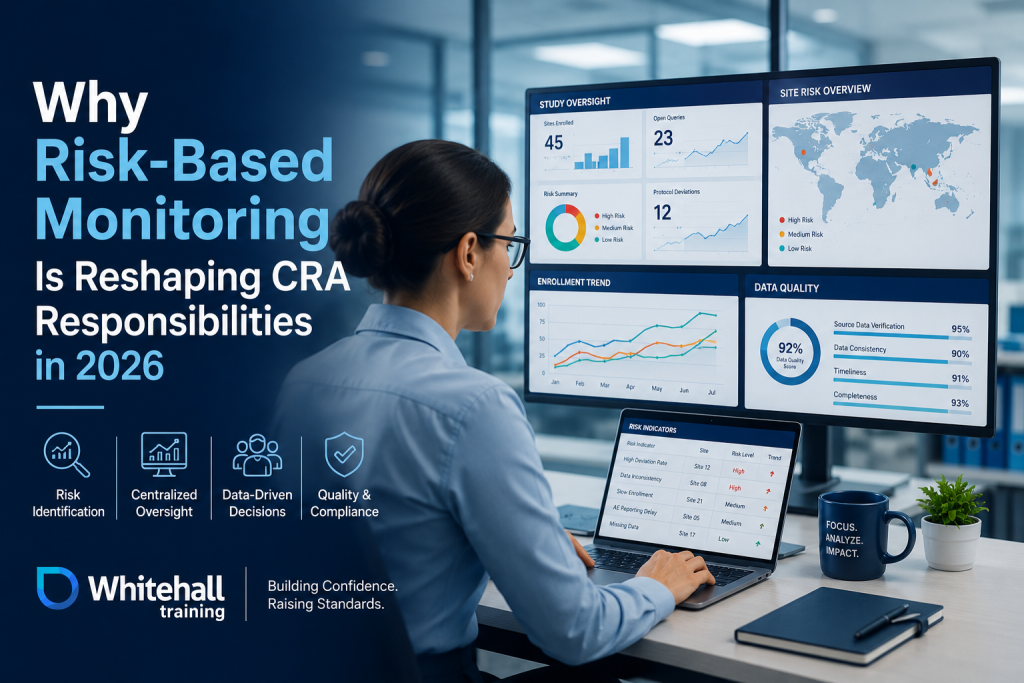
Clinical trial monitoring continues to evolve as sponsors and CROs increasingly adopt risk-based approaches to oversight.
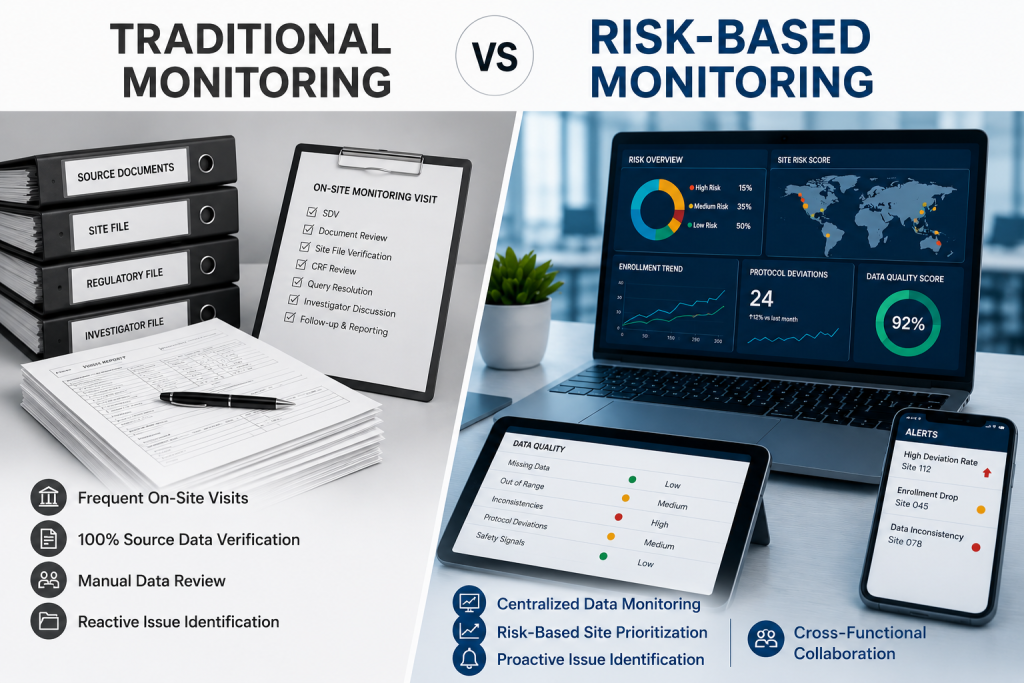
Traditional monitoring models that relied heavily on frequent on-site visits and 100% source data verification are gradually being replaced by more centralized, data-driven strategies.
As a result, the responsibilities of Clinical Research Associates (CRAs) are also changing.
In 2026, CRAs are expected to manage far more than routine site visits and documentation review. Modern clinical trials now require stronger analytical oversight, technology awareness, remote collaboration, and risk-based decision-making.
The Shift Toward Risk-Based Monitoring
Risk-Based Monitoring (RBM) was introduced to improve trial efficiency while maintaining patient safety and data integrity.
Rather than applying equal monitoring intensity across all sites and data points, RBM focuses oversight on areas that present the highest operational or clinical risk.
This includes:
- critical data points
- patient safety indicators
- protocol deviation trends
- site performance metrics
- enrollment abnormalities
- centralized data review findings
The increasing use of RBM reflects the growing complexity of decentralized and technology-enabled clinical trials.
How CRA Responsibilities Are Changing
Under traditional monitoring models, CRA responsibilities focused heavily on:
- routine site visits
- source document verification
- regulatory document review
- investigator site file checks
- query resolution
While these activities remain important, RBM has expanded the role significantly.
Modern CRA responsibilities increasingly include:
- remote oversight activities
- centralized data review collaboration
- trend identification
- site risk assessment
- vendor coordination
- technology platform oversight
- risk escalation management
CRAs are now expected to interpret operational signals rather than simply review documentation.
Increased Reliance on Centralized Monitoring
Many sponsors now combine on-site monitoring with centralized monitoring teams that review:
- real-time study data
- protocol deviation patterns
- missing data trends
- unusual enrollment activity
- electronic system alerts
This model allows organizations to identify issues earlier and prioritize monitoring resources more effectively.
As a result, CRAs increasingly work alongside:
- centralized monitoring teams
- data managers
- quality specialists
- risk management personnel
- decentralized trial vendors
Cross-functional collaboration has become a critical part of modern monitoring operations.
The Impact of Decentralized Clinical Trials
The expansion of decentralized clinical trial models has accelerated the adoption of RBM strategies.
Remote visits, wearable technologies, electronic consent platforms, and home healthcare providers create new oversight challenges that cannot always be managed through traditional monitoring methods alone.
CRAs must now evaluate:
- remote data reliability
- digital platform compliance
- vendor oversight processes
- remote patient activity documentation
- electronic system traceability
Monitoring responsibilities increasingly extend beyond physical investigator sites.
Technology Skills Are Becoming Essential
Modern clinical research environments rely heavily on:
- electronic data capture systems
- risk dashboards
- remote monitoring tools
- cloud-based trial platforms
- AI-assisted analytics
- digital quality management systems
As monitoring models evolve, CRAs are expected to become more comfortable interpreting centralized data outputs and technology-generated risk indicators.
Operational understanding of digital trial infrastructure is becoming increasingly valuable.
Operational Challenges Associated With RBM
Although RBM offers efficiency advantages, implementation also introduces operational complexity.
Organizations may face challenges involving:
- inconsistent risk assessment approaches
- communication gaps between centralized and field teams
- technology integration limitations
- vendor coordination difficulties
- staff adaptation to new monitoring models
For CRAs, balancing remote oversight with effective site relationships remains an ongoing challenge.
Regulatory Expectations Continue To Evolve
Global regulatory agencies increasingly support risk-based approaches when supported by appropriate quality management systems and documented oversight strategies.
However, regulators still expect sponsors and CROs to demonstrate:
- adequate trial oversight
- data reliability
- patient protection
- effective issue escalation
- documented risk management processes
RBM does not reduce compliance expectations. Instead, it changes how oversight is applied.
The Future of CRA Roles
The CRA role is not disappearing.
Instead, it is becoming more analytical, technology-focused, and operationally strategic.
Future CRA responsibilities will likely place greater emphasis on:
- data interpretation
- proactive risk identification
- centralized oversight collaboration
- decentralized trial management
- quality-focused decision-making
Professionals who adapt to evolving monitoring models may become increasingly valuable in modern clinical trial operations.
Related Learning
Whitehall Training offers clinical research and GCP learning solutions designed to support professionals adapting to modern monitoring and oversight expectations.
Good Clinical Practice (GCP) Courses
https://www.whitehalltraining.com/good-clinical-practice
Clinical Research Learning Paths
https://www.whitehalltraining.com/learning-paths
Conclusion
Risk-Based Monitoring is continuing to reshape clinical trial oversight across the industry.
As decentralized trials, digital systems, and centralized monitoring strategies expand, CRA responsibilities are evolving beyond traditional site monitoring activities.
Organizations that successfully combine risk-based oversight, technology integration, and operational collaboration will be better positioned to maintain trial quality, compliance, and efficiency in the evolving clinical research landscape.
