















SM
Clara Fargo
EBMT Clinical Research Quality Assurance Coordinator
I have finalised the demo for the ICH-GCP E6 R3 refresher course. Overall, I liked the content and the interface. I also want to thank Whitehall Train...
 AI Clinical
 New
New
 Clinical Practice
 Pharmacovigilance
 Manufacturing
 Laboratory Practice
 Distribution
 Medical Devices
 Regulatory Affairs
 Research Compliance
 Health & Safety
 Quality Assurance
 Biostatistics
 Trending
 Pharmaceutical MedicineNew
 All Bundles








 New
New 97% Recommended
 Updated 2026
 3 hours
 163 active users
 3 points
Your Study Basket
1 x AI in Pharmacovigilance Signal Detection and Management (ML and NLP)
| Total | |



Secure Payment Service

Rest assured we use secure processes to protect your payment.
Secured by:




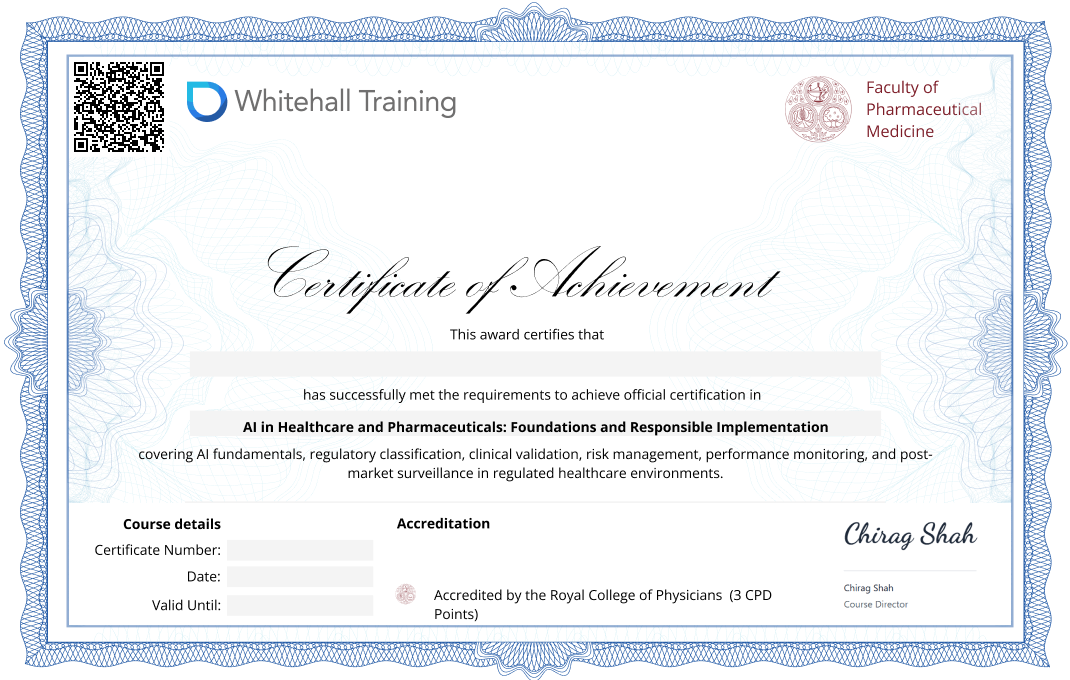
AI in Pharmacovigilance Signal Detection and Management (ML and NLP) training provides a practical overview of applying Artificial Intelligence, Machine Learning, and Natural Language Processing to pharmacovigilance signal detection and management while maintaining scientific rigor, human oversight, data integrity, and regulatory compliance.
This AI in Pharmacovigilance Signal Detection and Management Course & Certification provides essential knowledge on AI-assisted signal detection, machine learning-based signal triage and prioritization, disproportionality analysis, NLP-based extraction from safety narratives, automated coding, data quality, model performance, validation, bias, explainability, human-in-the-loop review, signal validation, clinical assessment, model monitoring, change control, documentation, and AI governance. Learners will understand how AI outputs should be interpreted as candidate signals or predictions rather than evidence of causality, and how human reviewers remain accountable for validation, assessment, prioritization, and signal-management decisions. Upon successful completion, learners receive a certification demonstrating their understanding of responsible and compliant use of AI, ML, and NLP in pharmacovigilance signal detection and management.

Understand the fundamentals of Artificial Intelligence (AI), Machine Learning (ML), and Natural Language Processing (NLP) and how they can be applied to pharmacovigilance signal detection and management within a GVP-compliant environment.

Learn how AI and ML support signal triage, candidate ranking, disproportionality analysis, prioritization, and detection of potential safety signals, while understanding model performance, data quality, bias, and the limitations of automated outputs.

Develop practical knowledge of NLP applications in pharmacovigilance, including safety narrative extraction, negation and ambiguity handling, automated coding, case-level review, human-in-the-loop validation, and the distinction between AI predictions and confirmed safety signals.

Gain an understanding of AI validation, explainability, model monitoring, change control, documentation, data confidentiality, audit trails, human accountability, and regulatory expectations for using AI-assisted approaches in pharmacovigilance signal management.






 Best Seller