










I have finalised the demo for the ICH-GCP E6 R3 refresher course. Overall, I liked the content and the interface. I also want to thank Whitehall Train...
About
AI/ML-Based Software as a Medical Device (SaMD) training provides a practical overview of the regulatory, clinical, technical, quality and lifecycle principles used to develop, validate, deploy and monitor AI-enabled medical software. It helps learners understand how AI/ML systems are classified and regulated, how clinical and performance evidence is generated, how data quality and representativeness affect model performance, and how risks associated with bias, drift, human oversight and model changes are managed.
This AI/ML-Based Software as a Medical Device Course & Certification covers the EU AI Act, EU MDR requirements for software and AI-enabled medical devices, FDA regulatory pathways, Predetermined Change Control Plans (PCCP), AI-enabled device software functions, Good Machine Learning Practice (GMLP), clinical validation, representative datasets, bias and performance monitoring, patient-level train/test splitting, human oversight, transparency, post-market surveillance and AI/ML lifecycle management. The course also addresses risk management and quality-system principles under ISO 14971, IEC 62304, ISO 13485, IEC 62366 and ISO/IEC 42001, and explains how regulatory, clinical and technical documentation supports auditability and ongoing compliance. Upon successful completion, learners receive a certification demonstrating their understanding of AI/ML-based medical software principles and their application across EU and US regulatory environments.
- Medical Device Regulatory Affairs Professionals
- Software as a Medical Device (SaMD) and AI/ML Professionals
- Clinical Research and Clinical Evaluation Professionals
- Quality Assurance and Quality Management Professionals
- AI/ML Engineers and Data Scientists working with medical devices
- Medical Device Software Developers and Product Teams
- Risk Management, Compliance and Post-Market Surveillance Professionals
- Anyone involved in developing, validating, regulating, monitoring or maintaining AI/ML-based medical devices
What you will learn
Understand the fundamentals of AI/ML-Based Software as a Medical Device (SaMD), including intended use, AI-enabled device software functions, medical-device classification, lifecycle management, and the role of AI/ML in clinical decision support.
Learn the key requirements of the EU AI Act and EU MDR for high-risk AI-enabled medical devices, including risk management, data governance, technical documentation, transparency, human oversight, conformity assessment, and post-market monitoring.
Develop practical knowledge of FDA requirements for AI-enabled device software functions, including 510(k), De Novo and PMA pathways, Predetermined Change Control Plans (PCCP), model modifications, performance criteria, and lifecycle monitoring.
Gain an understanding of Good Machine Learning Practice (GMLP), representative data, bias and data drift, clinical validation, patient-level data splitting, performance evaluation, risk management, human oversight, and the application of ISO 14971, IEC 62304, ISO 13485, IEC 62366 and ISO/IEC 42001 principles.

Course Syllabus
- Software as a medical device and when it is AI/ML-based
- Intended use / intended purpose as the master key
- MDR Rule 11 classification (NovaSight DR Class IIb)
- Assistive vs autonomous; where the EU AI Act attaches
- The EU and US regulatory map
- How MDR and the EU AI Act interact for one device
- ISO/IEC 42001 as the governance layer
- What must be done twice vs reused
- High-risk obligations (Articles 9-15, 17)
- Annex I product-embedded vs Annex III standalone routes
- Current and deferred timelines under the Digital Omnibus
- Not yet in application — building evidence now
- AI-enabled device software functions (AI-DSF)
- 510(k), De Novo and PMA pathways
- The role of the Predetermined Change Control Plan
- EU vs US change control
- Description of Modifications, Modification Protocol, Impact Assessment
- The joint FDA/Health Canada/MHRA guiding principles
- A fully worked PCCP for NovaSight DR
- Inside vs outside the PCCP
- The 10 GMLP guiding principles
- The ML lifecycle
- Representative data and training-test independence
- Human-AI team performance and deployed-model monitoring
- EU AI Act Article 10 data governance
- Sources of dataset bias
- Representativeness vs the intended-use population
- A worked bias/representativeness review
- Sensitivity, specificity, PPV/NPV and confidence intervals
- Overfitting, generalisability and clinically relevant testing
- The locked pivotal validation and confusion matrix
- Human-AI team performance and ungradable handling
- The ISO 14971 risk-management process
- AI-specific hazards: bias, drift, generalisability, overfitting, automation bias
- Hazard-cause-control analysis for an AI device
- Residual risk and benefit-risk
- IEC 62366 usability and automation bias
- EU AI Act Article 13 transparency and Article 14 human oversight
- Transparency guiding principles and AI-device labelling
- Designing the user interface and oversight
- MDR post-market surveillance and PMCF
- Data drift vs concept drift and action limits
- Vigilance and serious-incident reporting
- A drift scenario and the inside/outside-PCCP decision
- MDR technical documentation and EU AI Act Articles 11, 12, 17
- ISO 13485 integrated with ISO/IEC 42001
- Assembling the lifecycle technical file
- Inspection and audit readiness
- The two spines that ran through this course
- REG vs GP vs AI — the tag system revisited
- The NovaSight DR capstone journey
- What has to be done twice vs once — EU and US
- 📘 Bonus: AI/ML-Based Software as a Medical Device eBook (Free with purchase)
Course Benefits

Get our exclusive eBook with every purchase - a complete companion guide to the course, yours to keep forever
Gain Continuing Professional Development (CPD) Points, accredited by The Faculty of Pharmaceutical Medicine of the Royal College of Physicians of the United Kingdom. These can be used to count towards the distance learning element of any scheme that comes under the umbrella of The Academy of Medical Royal Colleges or any other scheme for which there is mutual recognition.
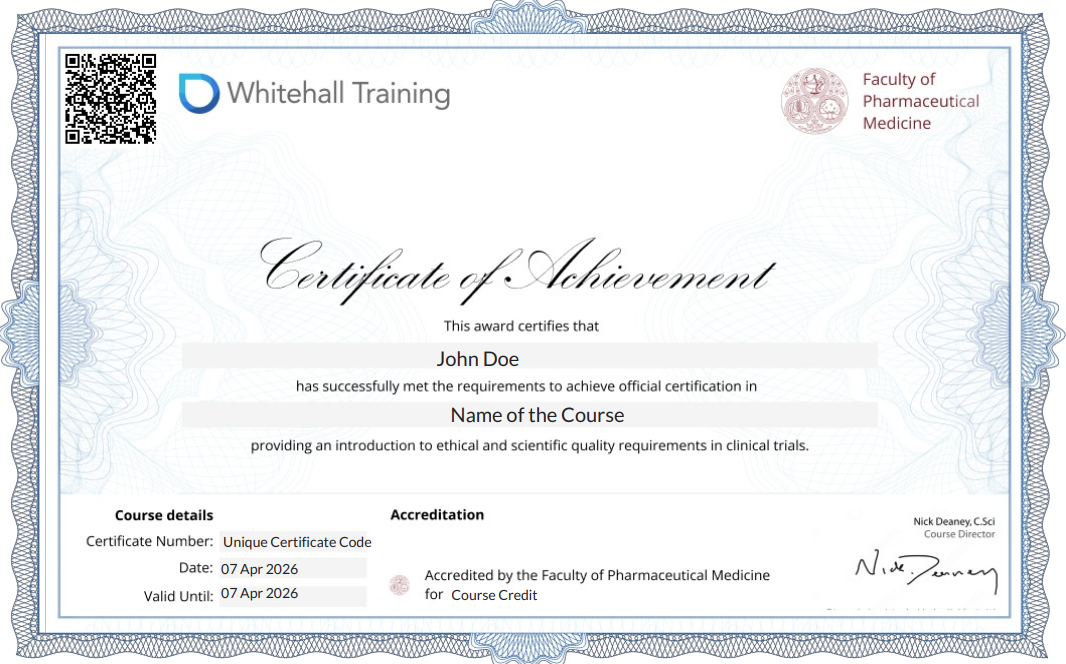
Receive a personal certificate to show your subject knowledge on course completion.
You get excellent value through our cost-effective prices. We can also offer you group discounts on larger purchases.
The course saves you time through the convenience of online availability. This lets you complete the interactive course at your own comfort.
You will stay up to date with changes to the EU AI Act (Regulation (EU) 2024/1689) and the 2026 Digital Omnibus deferred timelines, EU MDR/IVDR and MDCG guidance, FDA guidance on Predetermined Change Control Plans and AI-enabled device software functions, the FDA/Health Canada/MHRA Good Machine Learning Practice and PCCP guiding principles, and the ISO/IEC and IEC standards (ISO 14971, IEC 62304, IEC 62366, ISO 13485, ISO/IEC 42001), as our training courses are constantly monitored, reviewed and updated.
The course content has been developed by medical-device regulatory, quality and AI/ML practitioners to ensure learners can classify, validate, govern and monitor AI/ML Software as a Medical Device to current regulatory and good-practice standards across the EU and US.