














ICH GCP R3 is now in English & EU languages. Book Now
  • Preclinical & Laboratory Foundations
  • Phase I – First-in-Human Trials
  • Phase II & III – Efficacy & Pivotal Trials
  • Clinical Trials Foundation PathNew
  • Regulatory Submission & Approval
Preclinical & Laboratory Foundations - courses at £229
  • Good Laboratory Practice (GLP)
  • 21 CFR Part 58 — Good Laboratory Practice (GLP) for Nonclinical Laboratories
  • OSHA Laboratory Safety Training
  • Laboratory Management Systems ISO/IEC 17025:2017
  • Computer System Validation - Validation, Data Integrity & Compliance (GAMP 5 & Annex 11)
  • Qualification Validation Training
  • Cleaning Validation
  • ISO 9001:2015 - Quality Management System for Pharmaceuticals

About

Advanced Medical Device Lifecycle, Clinical Investigations & Risk Management is a comprehensive program designed to provide professionals with a deep understanding of the complete medical device journey—from concept and design through clinical evaluation, regulatory approval, commercialization, and post-market surveillance. The course is aligned with key international standards including ISO 14971, ISO 14155, IEC 62366-1, and current regulatory expectations for digital and connected medical devices.
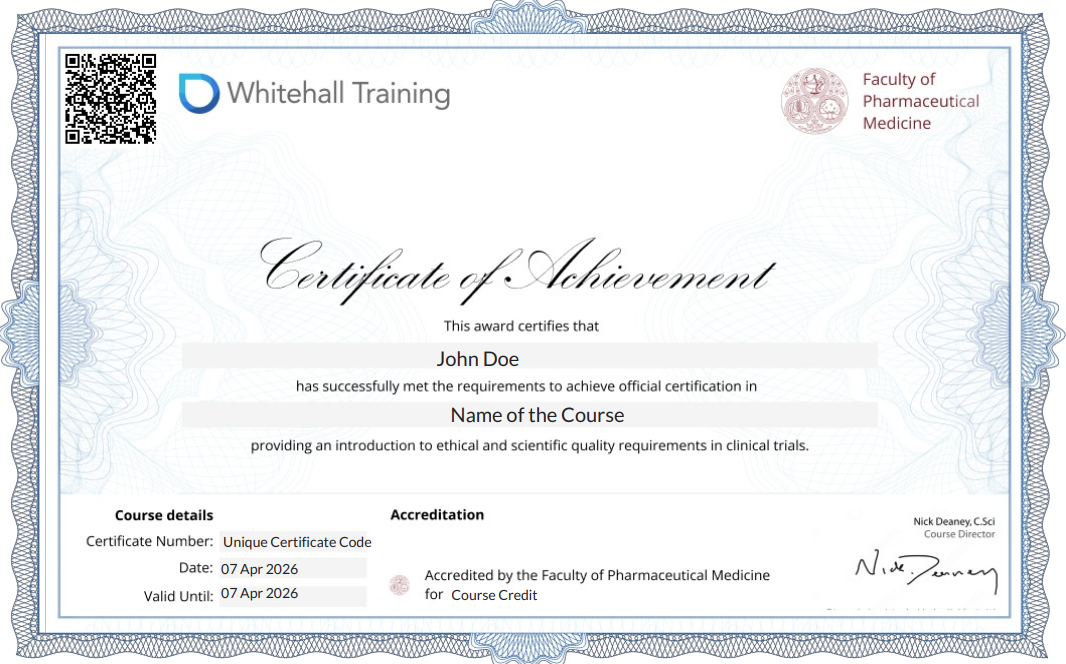
This Advanced Medical Device Lifecycle, Clinical Investigations & Risk Management Course & Certification provides practical training in device development, risk management, clinical investigations, data integrity, human factors engineering, cybersecurity, ethics, inspection readiness, and market access strategy. Upon completion, participants receive certification demonstrating competency in medical device lifecycle management and regulatory best practices.

Who Should Enrol?

  • Medical Device Regulatory Affairs, Quality Assurance, and Compliance Professionals.
  • Clinical Affairs, Clinical Research, and Clinical Investigation Personnel.
  • Medical Device Engineers, Product Development Teams, and Risk Management Specialists.
  • Digital Health, Cybersecurity, and Human Factors Engineering Professionals.
  • Entry-level professionals and consultants seeking certification in medical device lifecycle management and regulatory compliance.

What you will learn

Understand the complete medical device lifecycle, including design controls, development, regulatory approval, commercialization, and post-market activities.

Learn risk management and clinical investigation requirements under ISO 14971 and ISO 14155, including safety evaluation, risk controls, and clinical evidence generation.

Develop knowledge of data integrity, digital systems, cybersecurity, human factors engineering, and patient-centered device design.

Gain expertise in audit readiness, regulatory inspections, ethics, privacy requirements, and market access strategies for medical devices.

Course Syllabus

  1. The Medical Device Lifecycle: Six Core Phases
  2. Phase 1–2: Concept, Intended Purpose & Design Inputs
  3. Design & Development: What MDR Demands
  4. Phase 3: Verification, Validation & Evidence Generation
  5. MDR Conformity Assessment: Which Route for Each Device Class?
  6. The CE Marking Process: End-to-End
  7. Post-Market Obligations: MDR's Most Demanding Phase
  8. The 'Golden Thread': Clinical Evidence Across the Lifecycle
  9. Post-Market Feedback Loops: Keeping the Lifecycle Current
  10. MDR Technical Documentation: Document Architecture
  11. ISO 13485:2016 and EU MDR: How They Align

  1. ISO 14971:2019: The Risk Management Process
  2. The Risk Management Plan: What It Must Contain
  3. Hazard Identification: Systematic Techniques
  4. Risk Estimation: Probability, Severity, and the Risk Matrix
  5. Risk Matrix: ALARP Framework for Medical Device Risk Evaluation
  6. Risk Control: The Mandatory Hierarchy
  7. Residual Risk Evaluation: ALARP and the Benefit-Risk Test
  8. ISO 14971 + EU MDR: Points of Integration
  9. ISO 14971 in Clinical Investigations: The Annex H Framework
  10. Post-Production Risk Monitoring: ISO 14971 Clause 10

  1. ISO 14155: The GCP Standard for Medical Device Investigations
  2. ISO 14155:2020 vs. 2026: Critical Changes at a Glance
  3. Study Design: Selecting the Right Architecture
  4. Feasibility Studies: First-in-Human and Pilot Investigations
  5. Sample Size Calculation: Getting It Right the First Time
  6. The Estimand Framework: Annex K of ISO 14155:2026
  7. Clinical Investigation Plan (CIP): The Master Document
  8. CIP Mandatory Content: Sections 1–5 (ISO 14155:2026 Annex A)
  9. CIP Mandatory Content: Sections 6–12 (ISO 14155:2026 Annex A)
  10. Investigator Selection, Qualification & Delegation
  11. Site Activation: The Regulatory Green Light Checklist
  12. Adverse Events in Device Investigations: Definitions & Hierarchy
  13. Safety Reporting Timelines: ISO 14155:2026
  14. Clinical Events Committees (CECs): ISO 14155:2026 Mandate
  15. Data Monitoring Committees (DMCs): Governance Upgrade
  16. Site Monitoring: Types, Objectives & Remote Monitoring
  17. Source Document Verification (SDV): The Reconstruction Test
  18. Protocol Deviations: Types, Impact & Management
  19. Clinical Evaluation Report (CER): The Evidence Synthesis
  20. Decentralized Clinical Trials (DCTs): ISO 14155:2026 Guidance

  1. ALCOA+: The Data Integrity Foundation
  2. Electronic Data Capture (EDC) Systems: Selection & Validation
  3. Data Management Plan: What It Must Cover
  4. Common Data Integrity Violations: Inspector Findings
  5. Real-World Evidence (RWE) and Synthetic Control Arms: Data Quality Requirements

  1. IEC 62366-1: The Usability Engineering Framework
  2. User Research: The Foundation of Usability Engineering
  3. Critical Task Analysis: Identifying What Could Kill
  4. The PCA Model: Root Cause Analysis of Use Errors
  5. Formative vs. Summative Evaluation: Roles and Design
  6. Summative Validation Pitfalls: The Top 5 NB Rejection Causes
  7. Usability Engineering File (UEF): Contents & Inspection Readiness
  8. Informed Consent Process: GCP Requirements Under ISO 14155:2026
  9. Clinical Trial Registration and Results Reporting
  10. Clinical Study Report (CSR): Structure and Content
  11. Electronic Master File (eTMF): Principles and Inspection Readiness
  12. Data Governance Framework: Roles and Responsibilities
  13. Audit Trail Analysis: What Inspectors Look For
  14. Formative Evaluation: How to Run an Effective Session
  15. Human Factors in Risk Management Integration
  16. IEC 62366-1 Post-Market: The Lifecycle Obligation
  17. Substantial Modifications: When CIP Changes Require CA Re-approval
  18. GDPR in Clinical Investigations: Key Obligations
  19. Central Lab and Imaging Core Lab: Data Governance
  20. Statistical Analysis Plan (SAP): Locking Before Unblinding

  1. Why Cybersecurity = Patient Safety
  2. MDCG 2019-16 Rev.1: The EU Cybersecurity Framework for Devices
  3. Software Bill of Materials (SBOM): The Inventory of Trust
  4. Threat Modelling: STRIDE Methodology for Medical Devices
  5. Defense-in-Depth: Security Architecture for Connected Devices
  6. Post-Market Cybersecurity Plan: Testing and Disclosure
  7. Cybersecurity Requirements: EU MDCG 2019-16 vs. FDA 2023 Guidance
  8. Cybersecurity in Clinical Investigations: CIP Requirements

  1. The Declaration of Helsinki: Governing Principles for Device Research
  2. Equipoise and Research Ethics: When Is a Study Ethical?
  3. Informed Consent: Standards and Special Situations
  4. GDPR in Clinical Investigations: Practical Obligations
  5. Conflicts of Interest and Research Integrity
  6. Patient Safety Culture: Beyond Regulatory Compliance

  1. The Inspection Landscape: FDA BIMO vs. NB GCP Audit
  2. Hosting Strategy: Front Room vs. War Room
  3. The BIMO Checklist: What FDA Inspectors Actually Scrutinise
  4. Common MDR Non-Conformities: What NB Auditors Find
  5. Responding to Form 483 / Non-Conformities: The 6-Step CAPA Framework
  6. CAPA Response Quality: Adequate vs. Inadequate Examples
  7. Pre-Inspection Mock Audit: How to Run It
  8. Post-Inspection Management: After the Inspector Leaves
  9. EU AI Act: High-Risk AI in Medical Devices
  10. SaMD Classification and Clinical Evidence: MDCG 2020-5
  11. Cybersecurity Case Study: Connected Infusion Pump Attack Scenario
  12. Research Ethics Committees: Submission, Review, and Response
  13. Patient Engagement and Patient-Reported Outcomes
  14. Research Ethics Case Study: The Vulnerable Population Challenge
  15. Trial Master File (TMF) Completeness: Inspection Readiness
  16. MDR Surveillance Audits: What Changes After CE Marking
  17. Quality Management System Audit: MDR Article 10(9)
  18. Inspection Scenario Simulation: 'Reconstruct Subject 015'
  19. Preparing Your Team: Inspection Communication Training
  20. NB Qualification and Selection: Choosing the Right Partner
  21. Inspection Readiness: The Annual Internal Audit Programme

  1. EU CE Marking: The Complete Pathway
  2. Notified Body Assessment: Technical Documentation Requirements
  3. FDA Regulatory Pathways: 510(k), PMA, and De Novo
  4. FDA Submission Types: Quick Reference
  5. MHRA and the UKCA Mark: Post-Brexit UK Regulatory Pathway
  6. PMDA (Japan): Registration and Clinical Data Requirements
  7. Health Canada and TGA: Canada and Australia Pathways
  8. Scientific Advice and Pre-Submission Meetings: Strategic Value
  9. Global Regulatory Pathway Comparison: CE, FDA, MHRA, PMDA
  10. Global Regulatory Strategy: Sequencing and Evidence Sharing
  11. MDD-to-MDR Transition: Clinical Evidence Challenges
  12. Regulatory Intelligence: Staying Current
  13. EU MDR Article 78: Unannounced Audits and Manufacturer Obligations
  14. EUDAMED: Registration Obligations and Practical Management
  15. Unique Device Identification (UDI): Lifecycle Management
  16. Regulatory Strategy for SMEs vs. Large Manufacturers
  17. Risk-Based Regulatory Strategy: Prioritising Your Compliance Investment
  18. Labelling and Instructions for Use (IFU): MDR Requirements
  19. Post-Market Surveillance Strategy: From Data to Action
  20. Regulatory Affairs Career Development: The ADP Pathway
  21. Building Your Inspection Readiness Toolkit

Our Certified Customers

novartis
NHS
takeda
roche
baxter

Learner Rating & Reviews

4.7
Average Rating
536 global ratings
87.0%
5.0%
3.0%
3.0%
2.0%
RC

Working with Whitehall training for the last two years of partnership has been a very successful experience – I have fast access to all the GCP course...

SM

I have finalised the demo for the ICH-GCP E6 R3 refresher course. Overall, I liked the content and the interface. I also want to thank Whitehall Train...

Frequently Asked Questions

This course provides advanced knowledge of medical device lifecycle management, clinical investigations, and risk management. It explains how medical devices are developed, evaluated, approved, and monitored while ensuring compliance with international regulatory standards, patient safety requirements, and quality expectations across global healthcare environments.

In this course, you will learn how to:
  • Understand the complete medical device lifecycle from development to post-market activities
  • Apply ISO 14971 risk management principles for medical devices
  • Understand ISO 14155 requirements for clinical investigations
  • Manage data integrity and digital systems in medical device environments
  • Identify cybersecurity challenges and compliance requirements for connected devices
  • Apply human factors and usability engineering principles to improve patient safety
  • Prepare for audits, inspections, and regulatory submissions
  • Understand ethics, privacy, and global regulatory expectations for medical devices

This course is ideal for individuals who want to build or advance a career in medical devices, clinical investigations, and regulatory compliance, including:

  • Medical device professionals seeking advanced regulatory knowledge
  • Clinical research and clinical investigation professionals
  • Quality assurance and regulatory affairs professionals
  • Professionals working in pharmaceutical, biotech, CRO, or medical device companies
  • Engineers and healthcare professionals interested in device safety and compliance
  • Anyone seeking advanced understanding of medical device regulations and risk management
Basic knowledge of medical devices, clinical research, or healthcare regulations is helpful but not mandatory.

  • Develop advanced understanding of medical device lifecycle management
  • Strengthen knowledge of global regulatory and compliance requirements
  • Improve skills in risk management and clinical investigation processes
  • Enhance inspection readiness and audit preparedness
  • Understand cybersecurity, usability, and patient safety considerations
  • Build practical knowledge for careers in medical devices and regulatory affairs