














I have finalised the demo for the ICH-GCP E6 R3 refresher course. Overall, I liked the content and the interface. I also want to thank Whitehall Train...
About
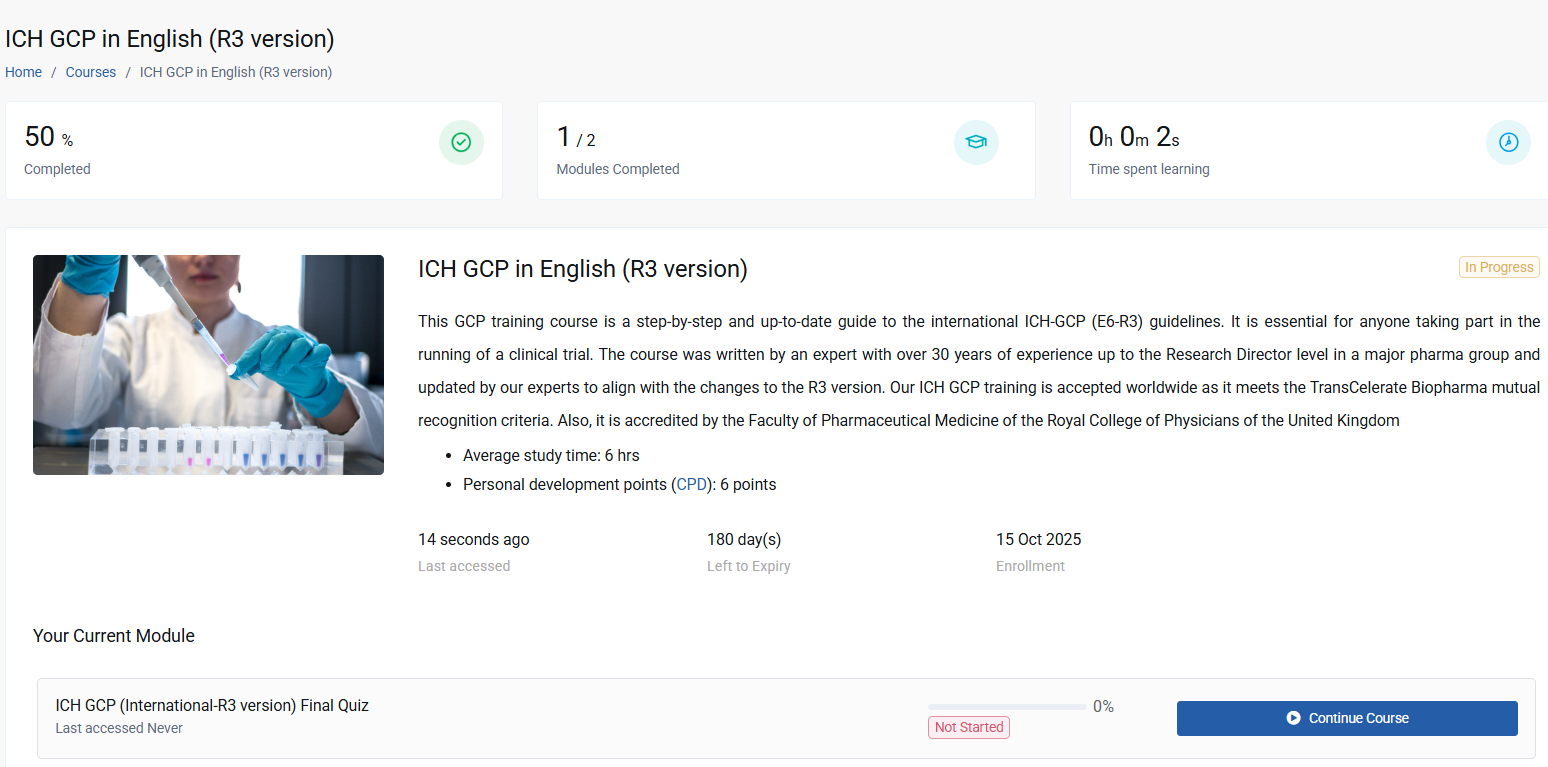
Written by an expert with over 30 years of experience up to the Research Director level in a major pharma group, this GCP training course covers the ICH-GCP (E6-R2) international guidelines and meets the training requirement for you to participate in international clinical trials.
Course Syllabus
- Introduction
- What is GCP?
- Why is ICH GCP Important?
- The Principles of ICH GCP
- Additional Learning Points
- Documentation and Version Control
- Quality Assurance (QA)
- Key Resources
- Introduction
- Responsibilities of the CA
- Responsibilities of the IEC
- Subject Informed Consent Forms (ICF): Part 1
- Subject Informed Consent Forms (ICF): Part 2
- Composition, Functions, Operations, Procedures, and Records
- Introduction
- Investigator Responsibilities
- Investigator Qualifications and Agreements
- Adequate Resources
- Medical Care of Trial Subjects: Part 1
- Medical Care of Trial Subjects: Part 2
- Communication with IRB/IEC
- Compliance with the Protocol
- Investigational Medicinal Products
- Randomisation Procedures and Un-blinding
- Informed Consent of Trial Participants
- Informed Consent of Trial Participants: The Consent Discussion
- Informed Consent of Trial Participants: Obtaining Consent Subjects Who Cannot Read or Write
- Informed Consent of Trial Participants: Obtaining Consent of Minors and “Mentally Incompetent” Subjects
- Informed Consent of Trial Participants: Obtaining Consent and Incapacitated Subjects
- Informed Consent of Trial Participants: Updating Consent
- Records and Reports: Introduction
- Records and Reports: Study Site Files
- Records and Reports: Updates & Amendments
- Records and Reports: Source Documents
- Records and Reports: Financial Information
- Records and Reports: The Case Record Form
- Records and Reports: Recording Subject Data
- Premature Termination or Suspension of a Trial
- Progress Reports and Final Reports by Investigator
- Archiving
- Introduction
- Quality Management: Part 1
- Quality Management: Part 2
- QA and QC (Quality Assurance and Quality Control)
- QA and QC (Quality Assurance and Quality Control): Standard Operating Procedures
- QA and QC (Quality Assurance and Quality Control): Agreements and Contracts
- Contract Research Organisations
- Trial Design
- Trial Management: Part 1
- Trial Management: Part 2
- Data Handling: Part 1
- Data Handling: Part 2 – Electronic Data Processing System
- Record Keeping
- Investigator Selection: Introduction
- Investigator Selection: Permissions
- Investigator Selection: Responsibilities
- Investigator Selection: Compensation
- Financing
- Notification/ Submission to Regulatory Authorities
- Gaining CA Approval in the EU
- Confirmation of Review by IRB/IEC
- Information on IMP
- Manufacturing, Packaging, Labelling, and Coding Investigational Products: Part 1
- Manufacturing, Packaging, Labelling, and Coding Investigational Products: Part 2
- Supplying and Handling Investigational Products
- Record Access
- Audit and Inspection
- Noncompliance
- Premature Termination or Suspension of a Trial
- Clinical Trial/Study Reports
- Multicentre Trials
- Introduction
- Monitoring: Part 1
- Monitoring: Part 2 – Monitor Responsibilities
- Monitoring: Part 3 - The Monitoring Visit
- Monitoring: Part 4 – Verification of Investigational Medicinal Products (IMP)
- Complying with the Protocol, Amendments, SOP and Guidance
- Verifying Informed Consent
- The Case Record Form (CRF) and Source Documents
- Verifying Subject Data
- Errors
- Closing out the Monitoring Visit
- The Monitoring Report & Plan
- Quality Management - Centralised Monitoring
- Fraud and Misconduct
- Introduction
- Adverse Drug Reaction Reports: Part 1 – Adverse Events (AEs)
- Adverse Drug Reaction Reports: Part 2 – Serious Adverse Events
- Adverse Drug Reaction Reports: Part 3 – Suspected Unexpected Serious Adverse Reactions (SUSARs)
- Adverse Drug Reaction Reports: Part 4 – Adverse Events of Special Interest
- Adverse Drug Reaction Reports: Part 5 – Periodic Safety Reports
- Adverse Drug Reaction Reports: Part 6 – Reporting Decision Tree
- Introduction
- Protocol Structure and Content
- Introduction
- Investigator Brochure Structure and Content
- Introduction
- Essential Documents
- Archiving
- Documents to be Present Pre-Study
- Documents to be Present During the Study
- Documents to be Present Post-Study
- Glossary & Abbreviations
- Useful Reference Documents List
Our GCP certified customers
Learner Rating & Reviews
Frequently Asked Questions
Good Clinical Practice (GCP) training is a fundamental educational programme designed to provide researchers and clinical trial professionals with a thorough understanding of the ethical and scientific standards essential for conducting top-tier clinical trials. This comprehensive course covers the globally recognised guidelines set forth by the International Council for Harmonisation (ICH).
The key objectives of GCP training include:
- Safeguarding the rights, safety, and well-being of human participants
- Upholding the accuracy and reliability of clinical trial data
- Fostering uniform, high-calibre practices across all facets of clinical research
Whitehall Training's Good Clinical Practice Course thoroughly explores these crucial areas, offering learners a robust grounding in both the theoretical principles and practical applications of Good Clinical Practice. Our course ensures that participants are well-equipped to meet the stringent standards required in modern clinical research settings.
For those looking to take part in clinical trials as researchers, GCP certification is an essential requirement.
If you're keen to broaden your knowledge of the clinical research field, obtaining GCP certification is incredibly worthwhile for several reasons:
- It guarantees adherence to globally recognised standards
- It boosts the credibility and calibre of your research
- It safeguards the rights and well-being of trial participants
- It opens up more career opportunities within clinical research
The Whitehall Training Good Clinical Practice Course not only offers certification but also imparts practical knowledge, enabling you to effectively implement GCP principles in your daily work.
Good Clinical Practice (GCP) certification is crucial for a broad spectrum of individuals working in clinical research:
- Lead and Co-Investigators: Those with primary responsibility for overseeing and conducting clinical trials at research facilities.
- On-site Trial Team: This includes research assistants, clinical nurses, and other personnel involved in the day-to-day management of trials.
- Trial Sponsors and Research Organisations: Professionals responsible for the planning, initiation, and documentation of clinical studies.
- Regulatory Body Representatives: Individuals tasked with monitoring and assessing compliance with trial protocols and regulations.
- Ethics Committees and Review Boards: Members involved in the ethical evaluation and approval of trial procedures.
- Research Institution Personnel: Those ensuring that institutional research aligns with international GCP standards.
- Researchers Funded by National Bodies: All staff and investigators participating in nationally funded clinical studies.
The Whitehall Training Good Clinical Practice Course is designed to meet the needs of this varied audience, offering both universal GCP principles and role-specific guidance. It’s also an excellent resource for anyone seeking to enhance their research capabilities and streamline their clinical trial processes.
Our Good Clinical Practice training programme thoroughly covers the ICH-GCP (E6-R2) international guidelines, fulfilling the training requirements for participation in global clinical trials. This comprehensive course serves as an up-to-date, step-by-step guide to the latest ICH-GCP (E6-R2) guidelines, making it indispensable for anyone involved in clinical trial management.
The course content has been developed by a seasoned professional boasting over three decades of experience, including a role as Research Director in a leading pharmaceutical company. It has received accreditation from the Faculty of Pharmaceutical Medicine of the Royal College of Physicians of the United Kingdom. To cater to a diverse audience, we offer the course in multiple languages, including English, German, Bulgarian, French, Italian, Japanese, Polish, Portuguese, Russian and Spanish. Additionally, we have crafted region-specific versions tailored to the regulatory frameworks of Australia, the UK, the US, France, Germany and Latin America.
Our GCP training programme stands out for its user-friendly design and visually engaging format, which facilitates easy cross-referencing with the ICH-GCP E6 document. Drawing from the author's wealth of experience, the course provides valuable insights into the practical implementation of Good Clinical Practice principles. As an added benefit, participants can earn 6 CPD points upon successful completion of this accredited programme.
Indeed, our Good Clinical Practice (GCP) course has received endorsement from a prestigious medical organisation. The Faculty of Pharmaceutical Medicine at the Royal College of Physicians has given its seal of approval to our training programme. This body, established in 1989, is renowned for its commitment to upholding stringent research standards and serves as the primary professional association for pharmaceutical physicians in the United Kingdom.
The endorsement from such a respected institution underscores the quality and relevance of our course content. It provides assurance that the training we offer aligns with current industry best practices and academic expectations. Consequently, upon completion of our GCP course, you'll receive a certificate that is widely acknowledged within the pharmaceutical and clinical research sectors.
The price of GCP certification can vary based on several key factors:
- Official endorsement: Has the course received approval from recognised bodies?
- International compliance: Does the training satisfy ICH standards, enabling participation in global clinical studies?
- Content excellence: Is the material current and crafted by industry professionals?
- Duration of availability: For how long can students access the course materials?
Whitehall Training's Good Clinical Practice course is priced at £79, reflecting its:
- Official endorsement: The Royal College of Physicians has accredited it, awarding 6 CPD points.
- International compliance: Upon completion, researchers are equipped to engage in clinical trials, adhering to ICH E6(R2) guidelines.
- Content excellence: Our GCP expert, Lucy Parker, who boasts over ten years of experience leading research at major institutions like the NHS, has developed the course content.
- Duration of availability: We support continuous learning by offering indefinite access to course resources.
For group bookings, we provide a 10% discount on orders of 5 licences at checkout. If you're interested in larger group discounts, please contact our team directly.