














Buy the GCP R3 course & get a FREE eBook— your complete ICH-GCP R3 reference guide. Book Now →

  • Preclinical & Laboratory Foundations Learning Path
  • Phase I – First-in-Human Trials Learning Path
  • Phase II & III – Efficacy & Pivotal Trials Learning Path
  • Clinical Trials Foundation PathNew
  • Regulatory Submission & Approval

About

Generative AI training provides a practical overview of the principles and practices required to use AI safely and effectively in regulatory and medical writing. It helps learners understand how AI can support drafting, summarisation, document review, consistency checks, and other writing activities while maintaining human oversight and accountability.
This Generative AI for Regulatory and Medical Writing Course & Certification covers prompt engineering, hallucination and fabrication risks, source verification, retrieval-augmented generation (RAG), AI-assisted regulatory and medical writing, data privacy, quality control, traceability, AI-use disclosure, and audit-ready documentation. The course also covers practical applications across Clinical Study Reports, safety narratives, PBRERs/PSURs, informed consent forms, lay summaries, CMC and labelling content, and regulatory responses. Upon successful completion, learners receive a certification demonstrating their understanding of responsible and controlled use of Generative AI in regulated life-sciences writing.

Who Should Enrol?

  • Regulatory Affairs and Regulatory Writing Professionals
  • Medical Writers and Medical Affairs Professionals
  • Clinical Research and Clinical Development Professionals
  • Pharmacovigilance and Drug Safety Professionals
  • Quality Assurance and Compliance Professionals
  • Clinical Research Associates (CRAs)
  • Biostatistics and Data Management Professionals
  • Anyone involved in preparing, reviewing, or approving regulatory and medical documents
📢 Every purchase also includes our FREE companion Generative AI for Regulatory and Medical Writing eBook, designed to help you apply principles in real-world pharmaceutical medicine settings.

What you will learn

Understand the fundamentals of Generative AI, including prompting, context windows, hallucinations, source grounding, and retrieval-augmented generation (RAG).

Learn how to apply AI safely to regulatory and medical writing tasks, including CSRs, safety narratives, PBRERs/PSURs, lay summaries, CMC, labelling, and regulatory responses.

Develop skills in verifying AI-generated content, identifying fabricated facts and references, checking source traceability, maintaining scientific balance, and resolving content gaps.

Gain an understanding of AI governance, data privacy, human accountability, quality control, AI-use disclosure, audit trails, SOPs, and applicable regulatory and industry expectations.


Course Syllabus

  1. Families of regulated documents and their governing standards
  2. Quality attributes of good regulated writing
  3. Where AI adds value; where human authorship stays non-negotiable
  4. A conceptual AI-assisted drafting workflow

  1. Next-token prediction: a non-hype mental model
  2. Tokens, the context window and the training cut-off
  3. Why models hallucinate; non-determinism and temperature
  4. Capabilities and limits for a regulated writer

  1. Role, task, sources, format, constraints
  2. Providing context and the '[GAP], do not estimate' rule
  3. Good vs poor prompts for the same task
  4. What RAG is and grounded, checkable drafting

  1. The enterprise-vs-public tooling rule and a confidentiality decision aid
  2. GDPR and special-category patient data
  3. Copyright/IP risk in inputs and outputs
  4. ALCOA+ and good documentation for AI-assisted work

  1. Synopses, protocols, ICFs and CSRs to ICH E6(R3)/E3
  2. Faithful numbers and structure from the source pack
  3. Before/after with a change-rationale log
  4. Judgement points the writer must retain

  1. Case narratives, PBRER/PSUR, DSUR and signal summaries
  2. Detecting fabricated clinical detail and false causality
  3. Reconciling aggregate-report numbers
  4. Disproportionality is not causation; honest uncertainty

  1. Briefing documents, responses to questions, M4 summaries, labelling
  2. Keeping strategy and commitments human
  3. No invented specifications, precedents or claims
  4. A well-engineered response-to-questions prompt

  1. ICMJE, Good Publication Practice and EU CTR lay summaries
  2. Readability without distortion or spin
  3. AI is never an author; disclosure of AI use
  4. Bias, balance and the integrity line

  1. The QC mindset: unverified until traced
  2. A claim-by-claim fact-check method
  3. Fabricated citations and numbers
  4. Bias, balance and the QC checklist

  1. Why AI use needs governance and an SOP
  2. Roles and the human-in-the-loop workflow
  3. Acceptance criteria for AI-generated content
  4. Disclosure and 'what AI must not do unsupervised'

  1. The current regulatory position; no AI exemption
  2. EU AI Act Article 50 transparency (from 2 Aug 2026)
  3. EMA reflection paper and FDA draft guidance
  4. Inspection readiness: show the record, not just say it

  1. The end-to-end scope-prompt-draft-verify-approve loop
  2. Tooling, the source pack, templates and the prompt library
  3. Metrics that measure quality and control, not just speed
  4. The capstone: draft, fact-check, correct, log and disclose

  1. The AI-assisted writing method in one view
  2. The rules that never bend
  3. By document type - a quick recap
  4. Your toolkit and learning path
  5. Course Summary

  1. 📘 Bonus: Generative AI for Regulatory and Medical Writing eBook (Free with purchase)

Course Benefits

Benefits ebook icon
Free eBook

Get our exclusive eBook with every purchase - a complete companion guide to the course, yours to keep forever

Benefits cpd_points icon
CPD Points

Gain Continuing Professional Development (CPD) Points, accredited by The Faculty of Pharmaceutical Medicine of the Royal College of Physicians of the United Kingdom. These can be used to count towards the distance learning element of any scheme that comes under the umbrella of The Academy of Medical Royal Colleges or any other scheme for which there is mutual recognition.

Benefits certification icon
Certification

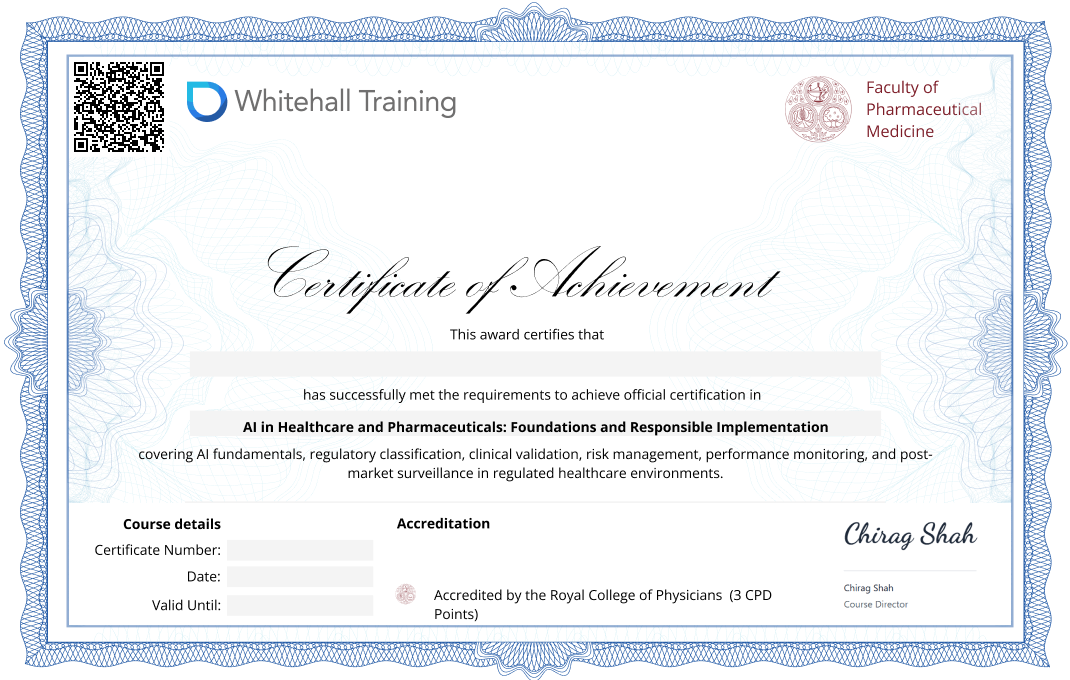
Receive a personal certificate to show your subject knowledge on course completion.

Benefits affordable icon
Affordable

You get excellent value through our cost-effective prices. We can also offer you group discounts on larger purchases.

Benefits flexible icon
Flexibility

The course saves you time through the convenience of online availability. This lets you complete the interactive course at your own comfort.

Benefits up_to_date icon
Keep Up to Date

You will stay up to date with the evolving position on AI-assisted writing - the EU AI Act (including Article 50 transparency obligations), the EMA reflection paper on AI in the medicinal-product lifecycle, FDA draft guidance on AI to support regulatory decision-making, and the standing ICH, EU GVP, GDPR, ALCOA+, ICMJE and Good Publication Practice requirements - as our training courses are constantly monitored, reviewed and updated.

Benefits industry_experts icon
Learn from Industry Experts

The course content has been developed by medical-writing, regulatory-writing and generative-AI practitioners to ensure learners can use AI to draft and quality-check regulated documents responsibly, while keeping accuracy, traceability, confidentiality and author accountability firmly with qualified humans.


Our Certified Customers

novartis
NHS
takeda
roche
dhl

Learner Rating & Reviews

4.7
Average Rating
536 global ratings
87.0%
5.0%
3.0%
3.0%
2.0%
RC

Working with Whitehall training for the last two years of partnership has been a very successful experience – I have fast access to all the GCP course...

SM

I have finalised the demo for the ICH-GCP E6 R3 refresher course. Overall, I liked the content and the interface. I also want to thank Whitehall Train...