














Buy the GCP R3 course & get a FREE eBook— your complete ICH-GCP R3 reference guide. Book Now →

  • Preclinical & Laboratory Foundations Learning Path
  • Phase I – First-in-Human Trials Learning Path
  • Phase II & III – Efficacy & Pivotal Trials Learning Path
  • Clinical Trials Foundation PathNew
  • Regulatory Submission & Approval

About

IVDR for the Laboratory training provides the knowledge and practical skills required to understand, navigate, and apply EU IVDR requirements within laboratory environments. Learners gain an understanding of the regulatory, quality, clinical, performance, and compliance principles that support appropriate IVD use, in-house device governance, performance studies, and ongoing IVDR compliance.
This IVDR for the Laboratory Course & Certification covers IVDR scope and classification, Article 5(5) in-house IVD requirements, CE-marked and legacy devices, EN ISO 15189, quality management systems, manufacturer and economic operator obligations, performance studies, companion diagnostics, analytical and clinical performance, technical documentation, vigilance, post-market surveillance, corrective actions, competent authority oversight, and inspection readiness. Upon successful completion, learners receive a certification demonstrating their understanding of IVDR requirements, laboratory responsibilities, in-house IVD governance, performance study obligations, quality systems, and regulatory compliance.

Who Should Enrol?

  • Laboratory and In Vitro Diagnostic Professionals
  • Regulatory Affairs and IVDR Compliance Professionals
  • Quality Assurance and Quality Management Professionals
  • Laboratory Directors, Managers, and Technical Personnel
  • Medical Device, Clinical Research, and Performance Study Professionals
  • Pharmaceutical, Biotechnology, CRO, and Life Sciences Professionals
  • Inspection Readiness and Laboratory Accreditation Professionals
📢 Every purchase also includes our FREE companion IVDR for the Laboratory eBook, designed to help you apply principles in real-world laboratory operations.

What you will learn

Understand the principles of EU IVDR requirements for laboratories, including IVD classification, risk-based controls, in-house devices, economic operator responsibilities, and regulatory requirements that influence laboratory operations and market access.

Learn how to navigate IVDR classification, conformity assessment, legacy device transitions, performance studies, companion diagnostics, and the requirements for CE-marked and in-house IVDs.

Develop practical approaches for managing Article 5(5) in-house devices, performance study obligations, technical documentation, clinical and analytical performance evidence, vigilance, postmarket surveillance, and regulatory interactions throughout the IVD lifecycle.

Gain understanding of laboratory quality and compliance expectations, including EN ISO 15189, IVDR quality management requirements, manufacturer obligations, competent authority oversight, corrective actions, incident reporting, and inspection readiness.

Course Syllabus

  1. Every course on this regulation is written for somebody else
  2. Who this course is for
  3. Four hats, and you may be wearing more than one
  4. What you will be able to do
  5. Regulation, guidance, national law and proposal
  6. The running case study
  7. Four things to unlearn before Module 1
  8. What this course deliberately does not teach

  1. The four hats: user, in-house manufacturer, study site, economic operator
  2. What the regulation does not ask of a laboratory, and who teaches the rest
  3. The health institution definition, and why it has no determinate European answer
  4. One group, two legal entities, and the exemption only one can claim
  5. When a laboratory becomes a manufacturer without deciding to
  6. Classification, only as far as a laboratory needs it
  7. What is settled law, what is guidance, and what is only proposed

  1. What Article 5(5) exempts, and the requirements it leaves in force
  2. The conditions that have applied since May 2024, one at a time
  3. The equivalence condition, and the date most published material gets wrong
  4. Why an accreditation certificate is not the quality management system required
  5. The justification file: what is written down, and by whom
  6. Transfer, group structures and the other legal entity
  7. Where national law fills the gap, and two Member States that have

  1. Article 110 as amended, and why there are two different clocks
  2. The dates that actually apply, class by class
  3. What a signed written agreement does and does not mean
  4. Notified body capacity, in the Commission's own published figures
  5. Discontinuation: what the survey evidence supports, and what it does not
  6. The advance notice you are entitled to, and how to lose it
  7. Building the register that tells you which assays are exposed

  1. Why a device used in a performance study is not put into service
  2. The study taxonomy, and which studies need what
  3. The leftover specimen boundary, and the guidance that narrowed it
  4. The investigator provision, and what laboratory medicine qualifies you for
  5. The facilities provision, and the intended-use setting test
  6. Devices without a CE mark inside a working laboratory
  7. The reporting clock that belongs to the site

  1. What makes a device a companion diagnostic, and the classification rule
  2. The medicines regulator's part in the conformity assessment
  3. What a laboratory running a companion diagnostic must show
  4. Selecting trial participants, and the article that transfers obligations
  5. Vigilance from the user's side, and the national layer on top
  6. The European database, and what a laboratory has to do in it
  7. The simplification proposal: what it would change, and why it is not law

  1. The four roles restated
  2. The five errors that cost the most
  3. Proposed is not law: the one discipline to keep
  4. A sixty-day plan, and six things to re-check
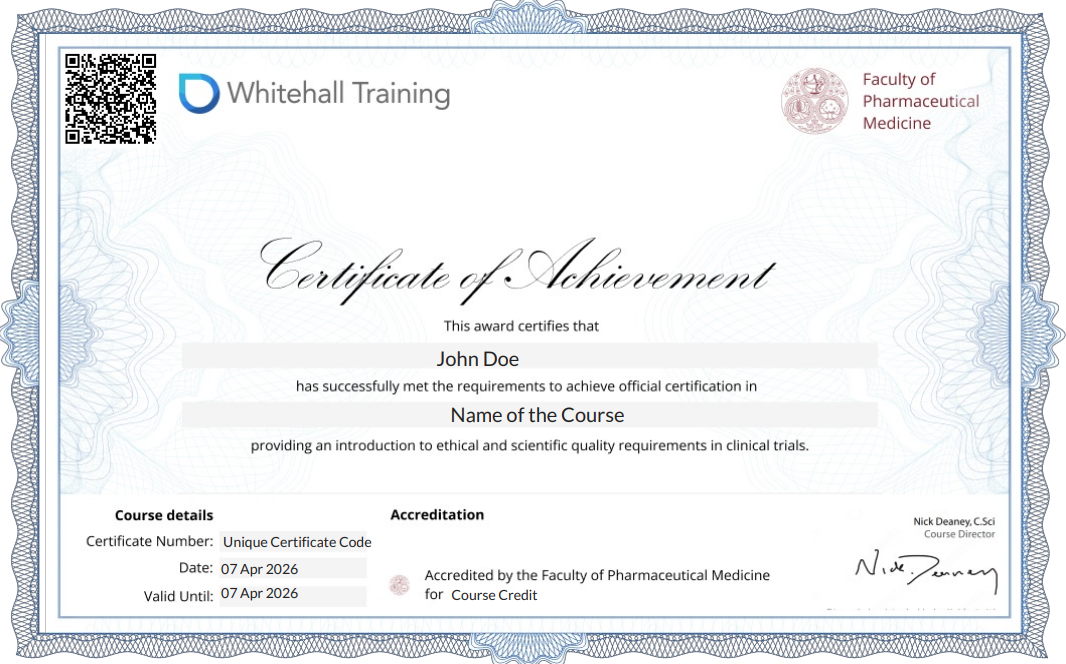
  5. Certificate of completion

  1. 📘 Bonus: IVDR for the Laboratory eBook (Free with purchase)

Our Certified Customers

novartis
NHS
takeda
roche
baxter

Learner Rating & Reviews

4.7
Average Rating
536 global ratings
87.0%
5.0%
3.0%
3.0%
2.0%
RC

Working with Whitehall training for the last two years of partnership has been a very successful experience – I have fast access to all the GCP course...

SM

I have finalised the demo for the ICH-GCP E6 R3 refresher course. Overall, I liked the content and the interface. I also want to thank Whitehall Train...

Frequently Asked Questions

  • Regulatory Affairs, IVDR Compliance & Quality Professionals
  • Medical Laboratory Directors, Managers & Technical Teams
  • IVD Manufacturers, Product Development & Regulatory Professionals
  • Clinical Research, Performance Study & Clinical Affairs Professionals
  • Quality Assurance, ISO 15189 & Laboratory Accreditation Teams
  • Pharmaceutical, Biotechnology, CROs & Life Sciences Professionals

This module builds a foundational understanding of EU IVDR requirements for laboratories, focusing on IVD classification, regulatory strategy, in-house devices, laboratory quality systems, and compliance requirements. This module covers Article 5(5) in-house IVDs, CE-marked and legacy devices, EN ISO 15189, performance studies, companion diagnostics, analytical and clinical performance, technical documentation, vigilance, postmarket surveillance, and competent authority oversight to support effective IVDR compliance and laboratory operations.


  • Developed by IVDR, laboratory, regulatory, quality, clinical, and medical device compliance experts
  • Practical, real-world focus aligned with EU IVDR, laboratory quality, and regulatory compliance expectations
  • Covers IVD classification, Article 5(5) in-house devices, EN ISO 15189, performance studies, companion diagnostics, legacy devices, vigilance, and postmarket requirements
  • Suitable for professionals across laboratories, medical devices, pharmaceuticals, biotechnology, CROs, and life sciences
  • Designed to support effective IVDR compliance, in-house device governance, laboratory quality systems, performance study management, and inspection readiness