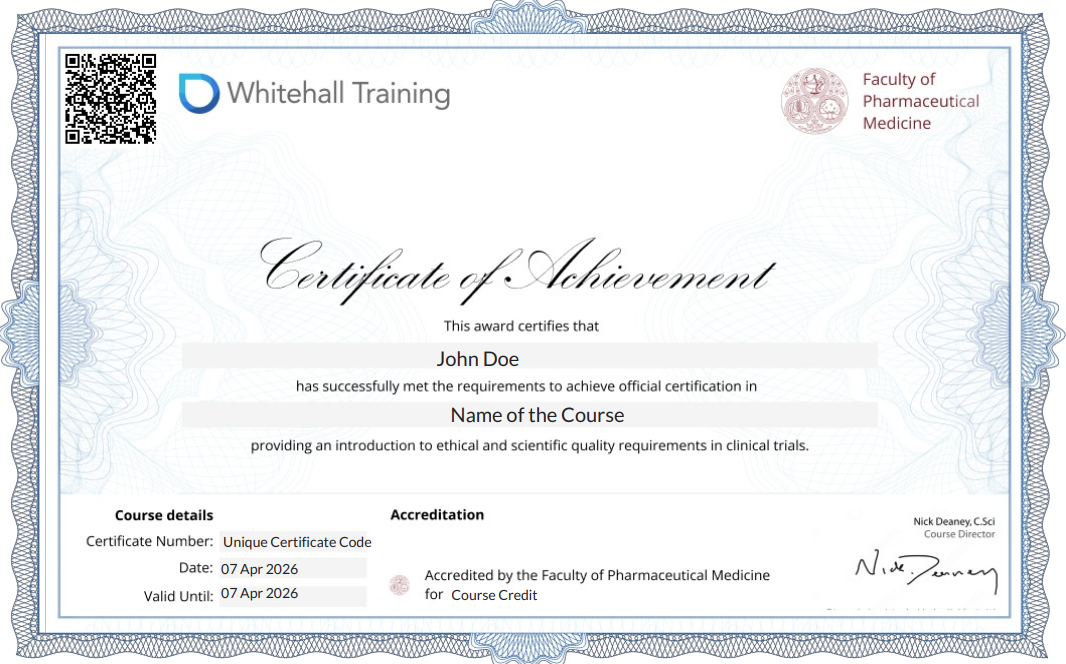














I have finalised the demo for the ICH-GCP E6 R3 refresher course. Overall, I liked the content and the interface. I also want to thank Whitehall Train...
About
Agile Medical Device Software Development training provides an overview of applying Agile methodologies within regulated medical device software environments while ensuring product safety, quality, and regulatory compliance. It helps learners understand how Agile practices align with medical device software lifecycle requirements, including IEC 62304, risk management, traceability, verification, validation, and release management.
This Agile Medical Device Software Development Course & Certification provides essential knowledge on Agile lifecycle models, software requirements, user stories, acceptance criteria, sprint planning, risk-based development, software verification, continuous integration, testing evidence, configuration management, change control, documentation practices, and regulatory expectations. Upon successful completion, learners receive a certification demonstrating their understanding of Agile approaches for developing compliant and reliable medical device software.
- Medical Device Software Developers and Engineers
- Software Quality Assurance and Verification Engineers
- Agile Project Managers, Scrum Masters, and Product Owners
- Regulatory Affairs and Quality Management Professionals
- Risk Management and Systems Engineering Teams
- Software Test Engineers and Validation Specialists
- Engineering Managers and Technical Leads
- Anyone involved in developing, managing, or auditing medical device software projects
What you will learn
Understand Agile principles and how they can be applied within regulated medical device software development environments while maintaining compliance with standards such as IEC 62304.
Learn requirements management, user stories, acceptance criteria, traceability, risk-based development, and the roles and responsibilities of Agile teams in developing safe medical device software.
Develop knowledge of Agile lifecycle activities, verification and validation, continuous integration, automated testing, configuration management, change control, and release practices.
Gain understanding of regulatory documentation, audit readiness, software tool assurance, compliance controls, and best practices for implementing Agile methods in medical device software projects.

Course Syllabus
- Agile values and principles, read as preferences under tension
- Iterative, incremental and the difference between them
- Why Agile genuinely helps medical-device software
- Where regulators and auditors actually get nervous
- Agile is not a compliance strategy — the failure mode this course prevents
- Technical debt and compliance debt
- PulsePath today: two-week sprints, quarterly releases and ten problems
- What a Technical Information Report is — guidance, not a standard, not law
- The layered model: project, release, increment and story layers
- Product documentation and conformity documentation held apart
- Progressive documentation, and why retrospective documentation is falsification
- Definition of Ready: what must be true before work starts
- Definition of Done: where compliance lives or dies
- Converting design inputs into backlog items without losing the design input
- Scoping an Agile process for your own organisation
- Scrum: roles, events, artefacts and what it assumes
- Kanban: flow, WIP limits, pull and explicit policies
- Hybrids, and the honest reasons teams build them
- Stakeholders: who is in the room, and who signs
- Team acceptance is not formal quality approval
- Choosing a framework against your product, risk, team and market
- Documenting the choice — the process you follow must be the process you wrote down
- IEC 62304 is lifecycle-model agnostic — it mandates neither waterfall nor Agile
- The clause structure, and where each clause happens in an iterative lifecycle
- Design inputs, outputs, review, verification, validation and transfer
- Mapping design controls onto sprint, release and project layers
- Writing an Agile software-development plan that an auditor can follow
- Sprint completion is not product release — the single most dangerous confusion
- Software safety classes A, B and C in an Agile team
- Mapping PulsePath: the matrix, and the gaps it exposes
- The regulated product backlog: the columns nobody adds until it is too late
- User stories, technical stories, enablers and acceptance criteria
- Requirements traceability, forwards and backwards, maintained as you go
- Risk-management activities inside the sprint, not after it
- Risk controls as backlog items — and verifying their effectiveness
- Emergent versus intentional architecture; the architecture runway
- Architecture decision records and the safety rationale
- Usability and cybersecurity work in an iterative lifecycle
- Configuration management, baselines and reproducible builds
- Review versus approval, and the meaning of a signature
- Electronic signatures and 21 CFR Part 11 in a backlog tool
- Why no tool is 'Part 11 compliant' in the abstract
- Software tools: intended use, risk and the assurance that follows
- FDA Computer Software Assurance — the toolchain, NOT device software functions
- Leveraging vendor evidence and digital records instead of manual paperwork
- Assuring the PulsePath toolchain: Cadence, Vault SCM, Forge Pipeline, Verifio
- Sprint-level verification: what is verified, and what the record must show
- Regression testing driven by change impact, not by ritual
- Independent testing and the outsourced testing supplier
- Continuous integration under control — CI is not continuous release
- Pipelines, artefact repositories and evidence you can reproduce
- Defects, problem reports and escaped defects
- Cybersecurity activities in the sprint; SBOM and vulnerability response
- Preparing an increment for release — and stopping short of releasing it
- Controlling changes to requirements and to software
- The release gate as a quality-system act, with its own evidence and approval
- Hotfixes, maintenance backlogs and post-market obligations
- Audit-ready evidence, produced progressively
- Metrics that tell you something true: cycle time, escaped defects, evidence completeness
- Metrics that do harm: velocity as a target, and what it does to a team
- Agile suppliers and outsourced teams
- The six audit findings, the ten problems, and designing your own procedure
- The four disciplines, revisited
- The Agile compliance lifecycle in one page
- The 26 templates and how to deploy them
- Common Agile compliance failures and how to avoid them
- Building your organisation-specific procedure
- 📘 Bonus: Agile Medical Device Software Development eBook (Free with purchase)