














I have finalised the demo for the ICH-GCP E6 R3 refresher course. Overall, I liked the content and the interface. I also want to thank Whitehall Train...
About
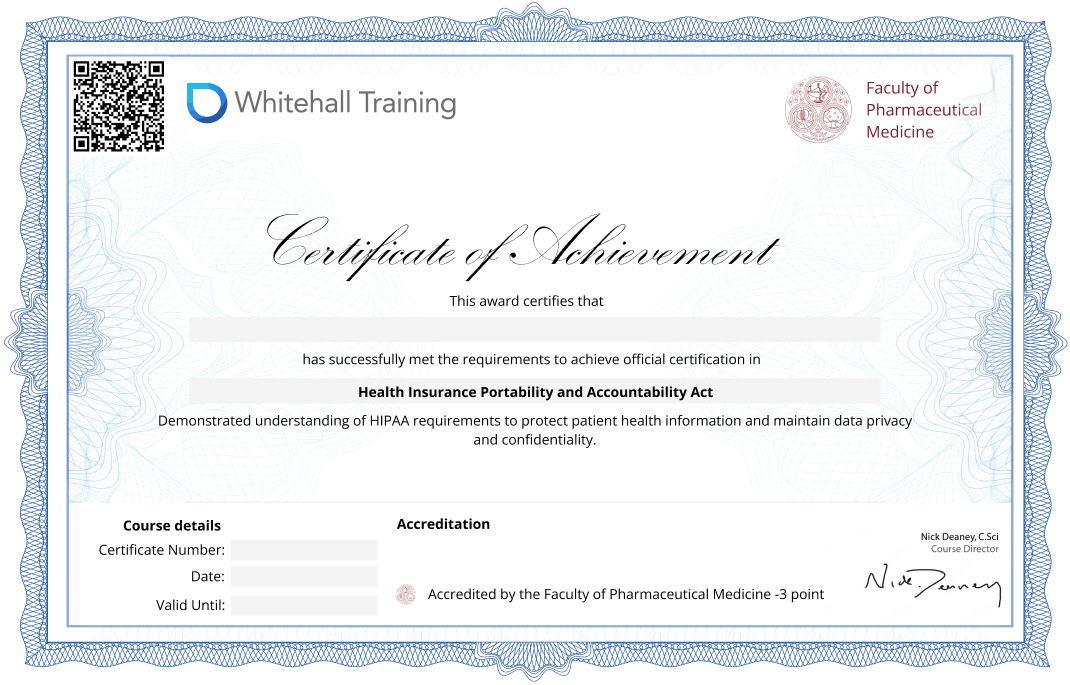
This course provides a clear and practical understanding of the Health Insurance Portability and Accountability Act (HIPAA) and its role in protecting sensitive patient health information. Designed for healthcare professionals, clinical researchers, and organizations handling patient data, the course explains the key requirements for safeguarding Protected Health Information (PHI).
Participants will learn the core components of HIPAA, including the Privacy Rule, Security Rule, and Breach Notification Rule, and how these regulations apply in real-world healthcare and research environments. The course also explores best practices for maintaining patient confidentiality, secure data handling, and preventing unauthorized access to health information.
Through practical examples and regulatory insights, learners will gain the knowledge needed to ensure compliance, reduce risk, and maintain trust when managing health data.
By the end of the course, participants will understand their responsibilities under HIPAA and how to implement effective data protection practices in their daily work.
Course Syllabus
- Health Insurance Portability and Accountability Act
- The Regulatory Architecture and Jurisdictions of Research Privacy
- Identifying and Overseeing Protected Health Information (PHI) in Research
- Understanding the Fundamentals of the Health Insurance Portability and Accountability Act (HIPAA)
- A key component of the Health Insurance Portability and Accountability Act (HIPAA) is the Privacy Rule.
- The Security Rule is an integral part of HIPAA.
- Standardized codes are required by HIPAA.
- HIPAA Set of Rules
- Protected Health Information (PHI)
- Digital Medical Records
- The Phrase PHI
- Safeguarding ePHI
- The Mechanisms of Encryption
- Introduction to the Health Insurance Portability and Accountability Act (HIPAA) Privacy Rule
- Organizations Covered
- The Connection Between Business Associates and Covered Entities
- Preventing Potential Flaws or Security Concerns
- The Functions and Obligations of Business Associates and Covered Entities
- Security Rule: Administrative Protections
- Safeguarding Covered Entities from Security Vulnerabilities
- Establishing and Executing Security Protocols
- Ensuring Data Security
- Protected Entities
- Security and Privacy
- Infractions of HIPAA
- Procedures for Security
- Resulting Effects
- Measures Taken by Enforcement
- Violations Notified to the OCR
- OCR Encourages Compliance
- HIPAA and EHRs, or electronic health records
- EHRs' importance
- Conclusion
- EHRs and HIPAA: How They Apply
- HIPAA Compliance Best Practices
- Comprehensive Risk Analysis
- Rules and Guidelines
- Employee Training's Significance
- Compliance Manager or Group
- Synopsis of the lesson
- Emerging Challenges
- In Summary
- Further Information on the Health Insurance Port-ability and Accountability Act (HIPAA) Privacy Rule
- Protected Health Information
- Managerial Controls
- To Avoid Significant Penalties
- Overview of the HIPAA Security Rule
- Security Measures for Electronic Protected Health Information (ePHI)
- Protecting Electronic Protected Health Information (ePHI)
- Protecting the Availability and Integrity of Electronic Protected Health Information (ePHI)
- Importance of the HIPAA Security Rule
- According to the provisions of the Enforcement Rule
- Overview of the HIPAA Enforcement Rule
- The OCR can resolve compliance issues
- Willful and deliberate disregard
- Protected Health Information (PHI): Definition and Management in Research
- Managing Research Data: The 18 HIPAA Identifiers
- Permissions, Waivers, and Authorization in Research
- HIPAA Security Rule Compliance in Alignment with 21 CFR Part 11
- Mapping HIPAA Security Safeguards to Clinical Research Operations
- Operationalizing Decentralized (DCT) and Digital Trials
- Emerging Risks: Big Data, AI, and Tracking Technologies
- Global Data Flow Considerations under HIPAA and GDPR Integration
- HIPAA vs. GDPR: A Comparative Analysis in Clinical Research
- Breach Notification, Enforcement, and Preparing for Audits
- Tier Structure for HIPAA Violation Penalties (2024–2025 Values)
- Supporting Documentation and Inspection Readiness Guidance
- Audit Preparation and Training Records
- Scenario-Based Learning and Decision-Making Simulations
- Professional Training Design and Accreditation Considerations
- Certification and Credibility Factors
- Advanced Stretch Content: Leadership in Research Privacy
- Module Overview
- Module Outcomes
- Comprehending the HIPAA Minimum Necessary Requirement
- Best Practices for Using, Storing, and Eliminating PHI
- Safe Storage of PHI (1/2)
- Safe Storage of PHI (2/2)
- Designing a HIPAA Compliance Strategy
- Module Recap
- Module Outcomes
- HIPAA Violation Risk Categories
- Unauthorized Viewing or Retrieval of PHI (1/2)
- Unauthorized Viewing or Retrieval of PHI (2/2)
- Post-Breach Assessment & Remediation Strategy
- Evaluate the Extent and Organizational Impact
- HIPAA Enforcement Governance & Agency Roles
- Primary Enforcement Rule Standards
- Module Recap
- Advanced Research Permissions and Workflows
- Specialized Research Permissions
- Revocation Workflows
- Modern Digital Research and Decentralized Trials
- Decentralized Clinical Trials (DCTs): Privacy Risk Mitigation
- Global Privacy and AI Integration
- Global Privacy and AI Integration – AI and Genomic Data in Clinical Research
- Operational Tools and Inspection Readiness
- Quality Assurance and Engagement Strategies
Our Certified Customers
Learner Rating & Reviews
Frequently Asked Questions
This course is designed for professionals who handle or have access to patient health information and need to understand the requirements of HIPAA compliance. It is particularly relevant for:
- Healthcare professionals such as doctors, nurses, and medical administrators
- Clinical research and clinical trial professionals
- Pharmaceutical and biotechnology industry personnel
- Health information management and medical records staff
- Data protection, compliance, and quality professionals
- IT professionals working with healthcare data systems
- Students and early-career professionals entering the healthcare or life sciences field
- Anyone involved in the collection, use, storage, or management of Protected Health Information (PHI) will benefit from understanding HIPAA principles and compliance requirements.