














ICH GCP R3 is now in English & EU languages. Book Now

About

Written by an expert with over 30 years of experience up to the Research Director level in a major pharma group, this GCP training course covers the ICH-GCP (E6-R2) international guidelines, along with the additional policies that are essential for practice in the UK.
Upon completion, learners meets the training requirement to participate in international clinical trials

Course Syllabus

  1. The History of GCP: Part 1 – What is Good Clinical Practice?
  2. The History of GCP: Part 2 - The Nuremburg Code
  3. The History of GCP: Part 3 - The Declaration of Helsinki
  4. The History of GCP: Part 4 - The International Conference on Harmonisation (ICH)
  5. The History of GCP: Part 5 - E6(R2)
  6. What is GCP?
  7. Why should we have GCP? (A quick quiz)
  8. The Basic Principles of FDA and ICH GCP: Part 1
  9. The Basic Principles of FDA and ICH GCP: Part 2
  10. The Basic Principles of FDA and ICH GCP: Part 3
  11. The Basic Principles of FDA and ICH GCP: Part 4
  12. The Basic Principles of FDA and ICH GCP: Part 5
  13. The Basic Principles of FDA and ICH GCP: Part 6
  14. The 13 Basic Principles of ICH GCP: Part 1
  15. The 13 Basic Principles of ICH GCP: Part 2
  16. The 13 Basic Principles of ICH GCP: Part 3
  17. Key ICH Guidelines listed on the FDA’s website
  18. Compliance Guidance Manuals
  19. Certificate of Confidentiality
  20. FDA Inspections: Part 1
  21. FDA Inspections: Part 2
  22. FDA Inspections: Part 3 - The FDA's BIMO Program
  23. US/EMEA GCP Inspection Agreement
  24. FDA GCP Compliance
  25. Impact of ICH GCP in the US
  26. FDA Acceptance of Foreign Studies: Part 1
  27. FDA Acceptance of Foreign Studies: Part 2
  28. FDA Acceptance of Foreign Studies: Part 3
  29. FDA Acceptance of Foreign Studies: Part 4
  30. Some General Points
  31. FDA GCP Regulation: Part 1
  32. FDA GCP Regulation: Part 2
  33. Important Practical Considerations: Part 1
  34. Important Practical Considerations: Part 2
  35. Other Resources
  36. Introduction to GCP - Webinar

  1. Introduction
  2. GCP During the Pandemic
  3. Responsibilities of the CA
  4. Responsibility of the IRB/IEC: Part 1
  5. Responsibility of the IRB/IEC: Part 2
  6. Responsibility of the IRB/IEC: Part 3
  7. Subject Informed Consent Forms (ICF): Part 1
  8. Subject Informed Consent Forms (ICF): Part 2
  9. Subject Informed Consent Forms (ICF): Part 3
  10. Subject Informed Consent Forms (ICF): Part 4
  11. Subject Informed Consent Forms (ICF): Part 5
  12. Subject Informed Consent Forms (ICF): Part 6
  13. IRB/IEC Composition, Functions, Operations, Procedures and Records: Part 1
  14. IRB/IEC Composition, Functions, Operations, Procedures and Records: Part 2
  15. IRB/IEC interactions with Sponsors and Investigators
  16. FDA’s IRB requirements: Part 1
  17. FDA’s IRB requirements: Part 2
  18. FDA’s IRB requirements: Part 3 – Structure
  19. FDA’s IRB requirements: Part 4 - Function
  20. FDA’s IRB requirements: Part 5
  21. Exceptions to Requirement for Obtaining Informed Consent
  22. Revised guidance on reporting IRB non-compliance: Part 1
  23. OHRP Reporting Guidance I
  24. Revised guidance on reporting IRB non-compliance: Part 2
  25. OHRP Reporting Guidance II
  26. Revised guidance on reporting IRB non-compliance: Part 3 - OHRP Reporting Guidance III
  27. Revised guidance on reporting IRB non-compliance: Part 4
  28. Revised guidance on reporting IRB non-compliance: Part 5
  29. Revised guidance on reporting IRB non-compliance: Part 6
  30. Revised guidance on reporting IRB non-compliance: Part 7

  1. Introduction
  2. What is an Investigator?
  3. FDA Investigator Responsibilities: Part 1
  4. FDA Investigator Responsibilities: Part 2
  5. FDA Investigator Responsibilities: Part 3
  6. FDA Investigator Responsibilities: Part 4
  7. Selecting Investigators and Monitors
  8. Recordkeeping and Record Retention: Part 1
  9. Recordkeeping and Record Retention: Part 2
  10. Disposition of Investigational Drug: Part 1
  11. Disposition of Investigational Drug: Part 2
  12. Control of the Investigational Drug: Part 1
  13. Control of the Investigational Drug: Part 2
  14. Investigator Records and Reports: Part 1 - Trial Master File
  15. Investigator Records and Reports: Part 2 - Trial Master File
  16. Investigator Records and Reports: Part 3 - Trial Master File
  17. Investigator Records and Reports: Part 4 - Study Site Files I
  18. Investigator Records and Reports: Part 5 - Study Site Files II
  19. Investigator Records and Reports: Part 6 - Source Documents I
  20. Investigator Records and Reports: Part 7 - Source Documents II
  21. Investigator Records and Reports: Part 8 - Financial Information and Contracts I
  22. Investigator Records and Reports: Part 9 - Financial Information and Contracts II
  23. Investigator Records and Reports: Part 10 - Financial Information and Contracts III
  24. Investigator Records and Reports: Part 11 - The Case Record Form (CRF)
  25. Investigator Records and Reports: Part 12 - Recording Subject Data
  26. Investigator Records and Reports: Part 13 - Recording Subject Data
  27. Investigator Records and Reports: Part 14 - Progress Reports and Final Report(s) by Investigator
  28. Investigator Records and Reports: Part 15 - Progress Reports and Final Report(s) by Investigator
  29. Investigator Records and Reports: Part 16 - Safety Reports
  30. Investigator Records and Reports: Part 17 - Assurance of IRB review
  31. Investigator Records and Reports: Part 18 - Inspection of investigator's records and reports
  32. Investigator Records and Reports: Part 19 - Handling of controlled substances
  33. Disqualification of a Clinical Investigator: Part 1
  34. Disqualification of a Clinical Investigator: Part 2
  35. Disqualification of a Clinical Investigator: Part 3 - Actions upon disqualification
  36. Disqualification of a Clinical Investigator: Part 4 - Disclosure of disqualification actions
  37. Disqualification of a Clinical Investigator: Part 5 – Information Sheet
  38. Disqualification of a Clinical Investigator: Part 6 - Reinstatement of a disqualified investigator
  39. Disqualification of a Clinical Investigator: Part 7 - Unreliable data I
  40. Disqualification of a Clinical Investigator: Part 8 - Unreliable data II
  41. Ineligible Patients
  42. Adequate Resources
  43. Medical Care of Trial Subjects: Part 1
  44. Medical Care of Trial Subjects: Part 2
  45. Communication with IRB/IEC
  46. Compliance with the Protocol: Part 1
  47. Compliance with the Protocol: Part 2
  48. Randomization Procedures and Un-blinding: Part 1
  49. Randomization Procedures and Un-blinding: Part 2
  50. Informed Consent of Trial Subjects: Part 1
  51. Informed Consent of Trial Subjects: Part 2
  52. Informed Consent of Trial Subjects: Part 3 - The Consent Discussion
  53. Informed Consent of Trial Subjects: Part 4 - Subjects who cannot read or write
  54. Informed Consent of Trial Subjects: Part 5 - Consenting minors and mentally incompetent subjects
  55. Informed Consent of Trial Subjects: Part 6 - Consenting Incapacitated Subjects
  56. Informed Consent of Trial Subjects: Part 7 - Updating Consent
  57. Premature Termination or Suspension of a Trial: Part 1
  58. Premature Termination or Suspension of a Trial: Part 2

  1. Introduction
  2. ICH Sponsor Responsibilities
  3. FDA-Specific Sponsor Responsibilities: Part 1
  4. FDA-Specific Sponsor Responsibilities: Part 2
  5. FDA-Specific Sponsor Responsibilities: Part 3
  6. FDA-Specific Sponsor Responsibilities: Part 4 - Form FDA 1572
  7. FDA-Specific Sponsor Responsibilities: Part 5
  8. FDA-Specific Sponsor Responsibilities: Part 6 - Further considerations
  9. Quality Management: Part 1
  10. Quality Management: Part 2
  11. Quality Management: Part 3
  12. QA and QC (Quality Assurance and Quality Control): Part 1
  13. QA and QC (Quality Assurance and Quality Control): Part 2 – SOPs (Standard Operating Procedures)
  14. QA and QC (Quality Assurance and Quality Control): Part 3 - Agreements and Contracts I
  15. QA and QC (Quality Assurance and Quality Control): Part 4 - Agreements and Contracts II
  16. Working with Contract Research Organizations (CROs): Part 1
  17. Working with Contract Research Organizations (CROs): Part 2
  18. Medical Expertise
  19. Trial Design: Part 1
  20. Trial Design: Part 2
  21. Enrichment strategies to support approval of drugs / Personalized Medicine development: Part 1
  22. Enrichment strategies to support approval of drugs / Personalized Medicine development: Part 2
  23. Trial Management: Part 1
  24. Trial Management: Part 2
  25. Trial Management: Part 3 - Data Management
  26. Trial Management: Part 4 - Electronic Data Systems I
  27. Trial Management: Part 5 - Electronic Data Systems II
  28. Trial Management: Part 6 - Electronic Data Systems III
  29. Trial Management: Part 7 - Electronic Data Systems IV
  30. Trial Management: Part 8 - Electronic Source Data I
  31. Trial Management: Part 9 - Electronic Source Data II
  32. Trial Management: Part 10 - Electronic Source Data III
  33. Trial Management: Part 11 - Record Keeping
  34. Trial Management: Part 12 - Record Keeping for FDA Inspections
  35. Trial Management: Part 13 - Record Keeping & Record Retention
  36. Trial Management: Part 14 - Record Keeping & Record Retention II
  37. Selecting Investigators: Part 1
  38. Selecting Investigators: Part 2
  39. Selecting Investigators: Part 3 – Resources
  40. Selecting Investigators: Part 4 - Resources
  41. Selecting Investigators: Part 5 - Permissions
  42. Allocation of Responsibilities
  43. Compensation to Subjects and Investigators: Part 1
  44. Compensation to Subjects and Investigators: Part 2
  45. Financing: Part 1
  46. Financing: Part 2
  47. Financing: Part 3 - The Physician Payment Sunshine Act
  48. Financing: Part 4 - The Physician Payment Sunshine Act
  49. Financing: Part 5 - The Physician Payment Sunshine Act
  50. Notification/Submission to FDA/CA
  51. Investigational New Drug (IND) Application: Part 1 - When an IND is required
  52. Investigational New Drug (IND) Application: Part 2 - Types of IND
  53. Investigational New Drug (IND) Application: Part 3
  54. Confirmation of Review by IRB/IEC
  55. Information on IP
  56. Manufacturing, Packaging, Labeling, and Coding IMP: Part 1
  57. Manufacturing, Packaging, Labeling, and Coding IMP: Part 2
  58. Supplying and Handling Investigational Products
  59. Record Access
  60. Adverse Drug Reaction Reporting: Part 1
  61. Adverse Drug Reaction Reporting: Part 2
  62. Monitoring Trial Progress
  63. Audit: Part 1
  64. Audit: Part 2
  65. Noncompliance: Part 1
  66. Premature Termination or Suspension of a Trial: Part 1
  67. Clinical Trial/Study Reports
  68. Multicenter Trials
  69. Enhancing the Diversity of Clinical Trial Populations
  70. Compensation When Things Go Wrong : Part 1 - The TeGenero Incident
  71. Compensation When Things Go Wrong: Part 2

  1. Introduction
  2. FDA's Guidance on Risk-Based Monitoring: Part 1
  3. FDA's Guidance on Risk-Based Monitoring: Part 2
  4. FDA's Guidance on Risk-Based Monitoring: Part 3
  5. FDA's Guidance on Risk-Based Monitoring: Part 4
  6. FDA's Guidance on Risk-Based Monitoring: Part 5
  7. FDA's Guidance on Risk-Based Monitoring: Part 6
  8. Monitor’s Responsibilities
  9. The Monitoring Visit: Part 1
  10. Informed Consent: Part 1
  11. Electronic Informed Consent: Part 1
  12. Tips for Regulatory Inspections (Common Findings)
  13. Verifying IP/IMP: Part 1
  14. Complying with the Protocol, Amendments, SOP and Guidance: Part 1
  15. The Case Record Form (CRF) and Source Documents: Part 1
  16. Electronic Source Data in Clinical Investigations: Part 1
  17. Errors in CRFs
  18. Closing out the Monitoring Visit: Part 1
  19. The Monitoring Report & Plan: Part 1
  20. Fraud and Misconduct: Part 1
  21. Fraud and Misconduct: Part 2 - The KETEK case

  1. Introduction: Part 1
  2. Sponsor and Investigator Responsibility Decision Tree
  3. Adverse Events
  4. Suspected Adverse Reactions
  5. Serious Adverse Events: Part 1
  6. Adverse Events of Special Interest
  7. IND Safety Reports
  8. Submission of IND Safety Reports: Part 1
  9. Reporting Results from Foreign Studies
  10. FDA Guidance for Safety Reporting: Part 1
  11. FDA Guidance for Safety Reporting: Part 3 -Other Safety Reporting Issues

  1. Introduction
  2. FDA Protocol Requirements
  3. FDA Protocol Content
  4. ICH Protocol Content: Part 1 - General Information
  5. ICH Protocol Content: Part 2 - Background and Trial Objectives
  6. ICH Protocol Content: Part 3 - Trial Design
  7. ICH Protocol Content: Part 4 - Selection and Withdrawal of Subjects
  8. ICH Protocol Content: Part 5 - Treatment of Subjects and Assessment of Efficacy
  9. ICH Protocol Content: Part 6 - Assessment of Safety and Statistics
  10. New Protocols: Part 1
  11. Revised Protocols: Part 1

  1. Introduction: Part 1
  2. FDA Investigator Brochure Requirements: Part 1
  3. FDA Investigator Brochure Requirements : Part 3 - Informing Investigators
  4. Example IB Table of Contents

  1. Introduction
  2. Essential Documents: Part 1
  3. Investigational New Drug Application
  4. Statement of Investigator
  5. FDA Bioresearch Monitoring Program: Part 1
  6. Penalties
  7. Documents to be Present Pre-Study
  8. Documents to be Added During the Study
  9. Documents to be Added Post-Study

  1. Glossary
  2. Useful Documents

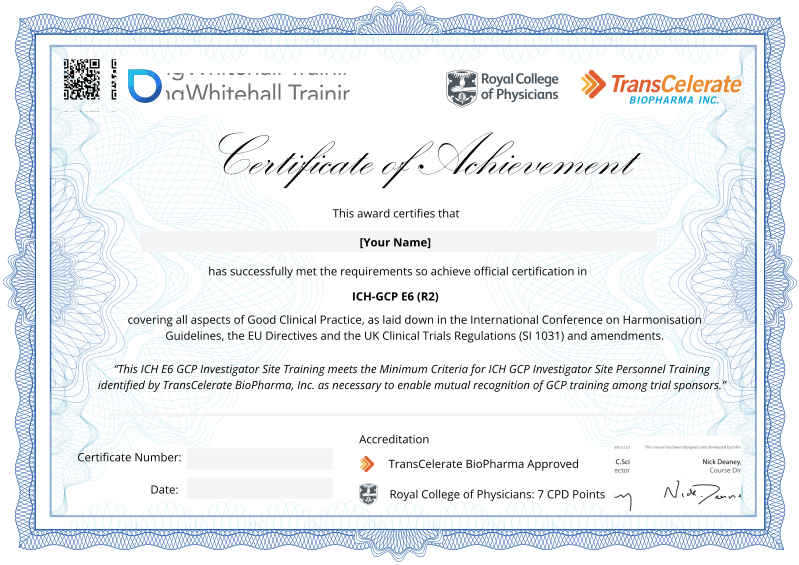
Course Certificate

On course completion, you receive your official ICH-GCP e6(R2) certification, allowing you to participate in clinical trials internationally
course_certificate_icon

Our GCP certified customers

novartis
NHS
takeda
roche
baxter

Learner Rating & Reviews

4.7
Average Rating
536 global ratings
87.0%
5.0%
3.0%
3.0%
2.0%
RC

Working with Whitehall training for the last two years of partnership has been a very successful experience – I have fast access to all the GCP course...

SM

I have finalised the demo for the ICH-GCP E6 R3 refresher course. Overall, I liked the content and the interface. I also want to thank Whitehall Train...

Frequently Asked Questions

Good Clinical Practice (GCP) training is a vital educational programme designed to arm researchers and clinical trial professionals with essential knowledge of ethical and scientific standards. These standards are crucial for executing high-quality clinical trials. The training encompasses the globally acknowledged guidelines set forth by the International Council for Harmonisation (ICH).

The key objectives of GCP training include:

  • Safeguarding the rights, safety, and welfare of human participants
  • Upholding the accuracy and reliability of data collected during clinical trials
  • Fostering uniform, superior practices across all facets of clinical research

Whitehall Training's Good Clinical Practice Course thoroughly explores these critical areas. Our comprehensive programme equips learners with a robust understanding of GCP principles and their practical implementation in real-world clinical research scenarios. By completing this course, participants gain the necessary skills to conduct clinical trials that meet the highest standards of ethical and scientific rigour.

Absolutely. For those involved in clinical trials, GCP certification isn’t just valuable—it’s essential. But even if you’re not directly participating in trials, obtaining GCP certification offers numerous benefits:

  • It demonstrates your commitment to upholding global research standards
  • Your research gains added credibility and quality assurance
  • You’ll be better equipped to safeguard the rights and wellbeing of study participants
  • Your career opportunities in the clinical research sector may expand significantly

Our Whitehall Training Good Clinical Practice Course goes beyond mere certification. We provide you with practical, hands-on knowledge that you can immediately apply in your professional endeavours. By mastering GCP principles through our course, you’ll be well-prepared to navigate the complexities of clinical research with confidence and expertise.

Good Clinical Practice (GCP) certification is crucial for a broad spectrum of individuals working in clinical research:

  • Lead Researchers and Co-investigators: These are the primary and supporting scientists responsible for overseeing and conducting trials at research facilities.
  • On-site Trial Team: This includes study coordinators, research nurses, and other personnel involved in the day-to-day management of clinical trials.
  • Trial Sponsors and Research Organisations: Professionals who manage the overall planning, commencement, and documentation of clinical studies.
  • Regulatory Bodies: Officials tasked with supervising and assessing trial compliance with established standards.
  • Ethics Committees: Groups responsible for reviewing and approving proposed trial protocols to ensure ethical conduct.
  • University and Research Centre Staff: Individuals ensuring that institutional research aligns with international benchmarks.
  • Researchers Funded by National Health Organisations: All scientists and support staff engaged in publicly funded clinical trials.

Our comprehensive GCP course is designed to meet the needs of this varied audience, offering both universal principles and role-specific guidance. Additionally, it serves as an excellent resource for those aiming to enhance their research capabilities and refine their approach to clinical trial operations. The Whitehall Training Good Clinical Practice Course provides tailored content to address the unique requirements of each of these professional groups, ensuring that all participants gain the knowledge necessary for their specific roles in the clinical research process.

Our Good Clinical Practice (GCP) course is designed to provide comprehensive coverage of the ICH-GCP (E6-R2) international guidelines, ensuring you meet the necessary training requirements for participation in international clinical trials. We offer this course in multiple languages to cater to a diverse audience.

This course serves as a detailed, step-by-step guide to the most recent ICH-GCP (E6-R2) guidelines, making it an indispensable resource for anyone involved in clinical trial management. The content has been meticulously crafted by an industry veteran with over three decades of experience, including a tenure as Research Director at a leading pharmaceutical company.

We’re proud to offer a course that’s accredited by the Faculty of Pharmaceutical Medicine of the Royal College of Physicians of the United Kingdom. This accreditation underscores the quality and relevance of our training material. To accommodate our global learners, we’ve made the course available in ten languages: English, German, Bulgarian, French, Italian, Japanese, Polish, Portuguese, Russian, and Spanish. Additionally, we’ve developed region-specific versions tailored to the regulatory frameworks of Australia, the UK, the US, France, Germany, and Latin America.

Our course stands out for its user-friendly design and clear visual presentation. This format allows for easy navigation and reference to the ICH-GCP E6 document. Drawing from the author’s extensive industry experience, the course offers practical insights into the application of GCP principles.

Upon completion, participants can earn 6 Continuing Professional Development (CPD) points, further enhancing the value of this training programme.

Indeed, our GCP course has received certification from the Faculty of Pharmaceutical Medicine at the Royal College of Physicians. This prestigious body, established in 1989, is renowned for its role in setting stringent research standards and serves as the professional membership organisation for pharmaceutical physicians across the United Kingdom.

The certification bestowed upon our course is a testament to its quality and relevance. It signifies that our programme meets exacting industry and academic criteria, providing you with a qualification that is widely acknowledged and respected within the field. By completing this certified course, you can be confident that you’re receiving training that aligns with the most current and rigorous standards in pharmaceutical research and practice.

The price of GCP certification can fluctuate based on several key factors:

  • Endorsement: Has the course received approval from official bodies?
  • Validity: Does the training meet ICH standards, allowing researchers to engage in global clinical studies?
  • Content quality: Is the material current and authored by an industry expert?
  • Duration of access: For how long can students utilise the course materials?

Our Whitehall Training GCP course is priced at £79, reflecting its high value across these areas:

  • Endorsement: The Royal College of Physicians has accredited our course, awarding it 6 CPD points.
  • Validity: Upon completion, researchers are equipped to participate in clinical trials, in line with ICH E6(R2) guidelines.
  • Content quality: Lucy Parker, our GCP specialist with over ten years’ experience leading research at major institutions like the NHS, has crafted the course content.
  • Duration of access: We support ongoing professional development by offering unlimited access to course materials.

For group purchases, we offer a 10% discount when buying 5 licences at checkout. If you’re interested in larger group discounts, please reach out to our team for a tailored quote.