
 New
New











Is AI Changing Clinical Research Faster Than We Expected?
Introduction
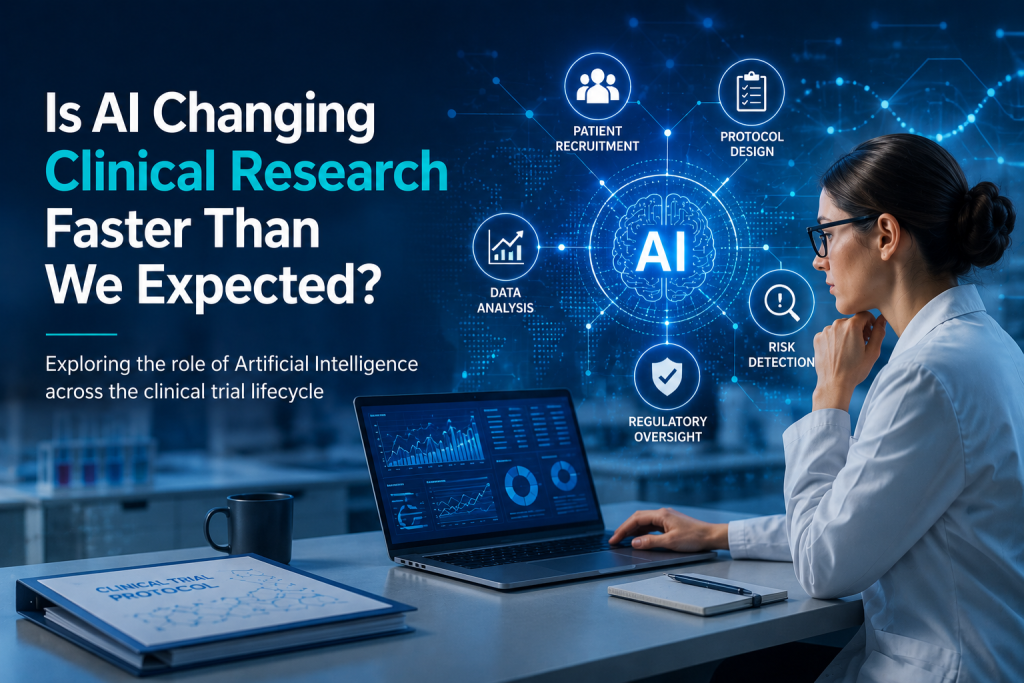
Artificial Intelligence (AI) is no longer a futuristic concept in clinical research. From patient recruitment and protocol design to data analysis and risk detection, AI is increasingly being integrated into various stages of the clinical trial lifecycle.
As clinical research continues to evolve, AI has the potential to improve efficiency, enhance decision-making, and support the development of new therapies. However, its growing use also raises important questions regarding oversight, data quality, and regulatory expectations.
Why Is AI Gaining Attention in Clinical Research?
Clinical trials generate vast amounts of data and involve numerous complex processes. Managing this information efficiently while maintaining quality and compliance remains a significant challenge.
AI technologies can help researchers analyse large datasets, identify patterns, support faster decision-making, and improve operational efficiency. As a result, many organisations are exploring how AI can complement traditional clinical research activities and help accelerate innovation.
Where Is AI Being Used Today?
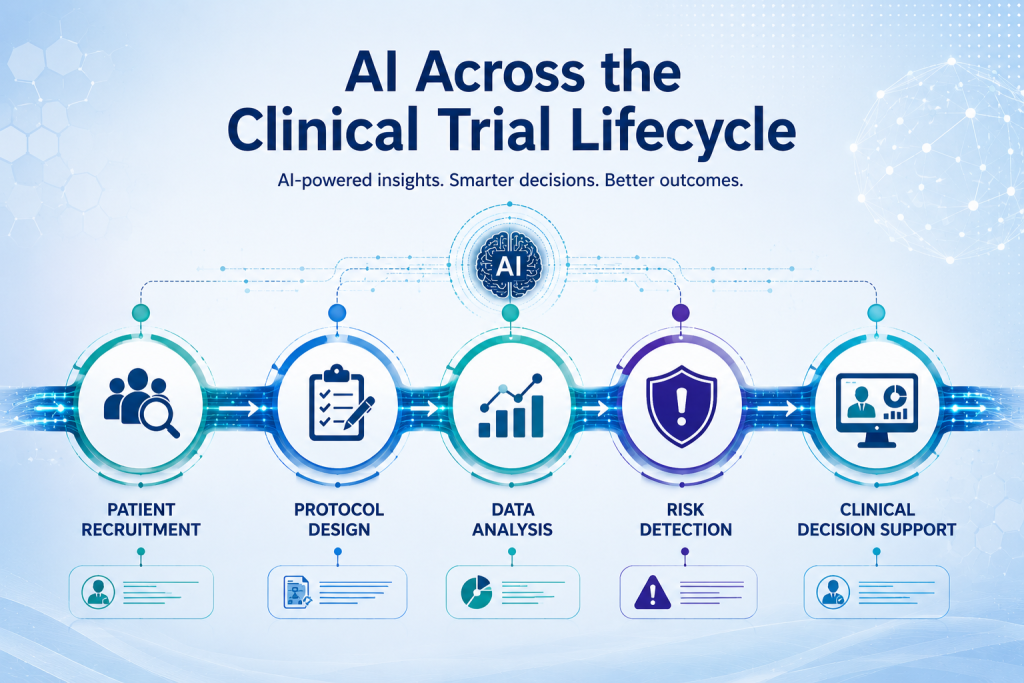
AI is already supporting several areas of clinical research.
Patient Recruitment
Identifying suitable participants is often one of the most time-consuming aspects of a clinical trial. AI can assist by analysing healthcare records and matching patients to study eligibility criteria more efficiently.
Protocol Design
AI-powered tools can help researchers evaluate study designs, identify potential operational challenges, and optimise protocol development before trial initiation.
Data Analysis
Clinical trials generate large volumes of data. AI can support faster analysis by identifying patterns, trends, and anomalies that may require further investigation.
Risk Detection
AI-driven systems can help identify unusual data patterns and potential risks, supporting quality management and oversight activities throughout the study lifecycle.
Potential Benefits of AI in Clinical Research
The growing interest in AI is driven by several potential advantages:
- Improved operational efficiency
- Faster data processing and analysis
- Enhanced patient recruitment strategies
- Better identification of risks and trends
- Support for evidence-based decision-making
- Reduced administrative burden on research teams
While AI is unlikely to replace clinical research professionals, it has the potential to help them work more effectively and focus on higher-value activities.
Challenges and Considerations
Despite its potential, AI also presents important challenges that organisations must address.
Key considerations include:
- Data quality and reliability
- Transparency of AI-generated outputs
- Regulatory expectations and compliance
- Patient privacy and data protection
- Human oversight and accountability
Ensuring the responsible use of AI remains essential for maintaining trust, quality, and integrity within clinical research.
Will AI Replace Clinical Research Professionals?
One of the most common questions surrounding AI is whether it will replace human expertise in clinical research.
While AI can automate certain tasks and assist with data processing, clinical research relies heavily on scientific judgement, ethical decision-making, regulatory compliance, and human oversight. These responsibilities cannot be fully delegated to technology.
Rather than replacing professionals, AI is more likely to become a tool that supports researchers, helping them make better-informed decisions and work more efficiently.
Conclusion
Artificial Intelligence is becoming an increasingly important part of modern clinical research. Its ability to support patient recruitment, protocol design, data analysis, and risk detection presents exciting opportunities for the industry.
However, successful implementation will depend on balancing innovation with appropriate oversight, regulatory compliance, and human expertise.
As AI technologies continue to evolve, understanding their role and limitations will be essential for clinical research professionals seeking to navigate the future of the industry. Developing AI-related knowledge and skills can help professionals remain prepared for emerging trends and evolving industry expectations.
Explore AI Training Opportunities
As AI continues to influence healthcare, pharmaceuticals, and clinical research, professionals may benefit from developing a deeper understanding of AI applications, governance, and implementation.
Whitehall Training offers specialised learning opportunities including:
📘 AI in Healthcare and Pharmaceuticals
https://www.whitehalltraining.com/ai-clinical/ai-in-healthcare-and-pharma
📘 AI Bootcamp: Copilot for Clinical, Pharmacovigilance & Regulatory Teams
https://www.whitehalltraining.com/ai-clinical/ai-bootcamp
📘 Clinical Research Associate (CRA) Learning Path
https://www.whitehalltraining.com/learning-path/cra-guide
📘 ICH GCP (E6 R3)
https://www.whitehalltraining.com/good-clinical-practice/english-r3-version
📘 ICH GCP (E6 R3) Refresher
https://www.whitehalltraining.com/good-clinical-practice/r3-version-refresher
For more professional development opportunities, visit:
