
 New
New


 Trending





What Makes a Good CRA? 7 Skills That Matter Beyond Monitoring
Introduction
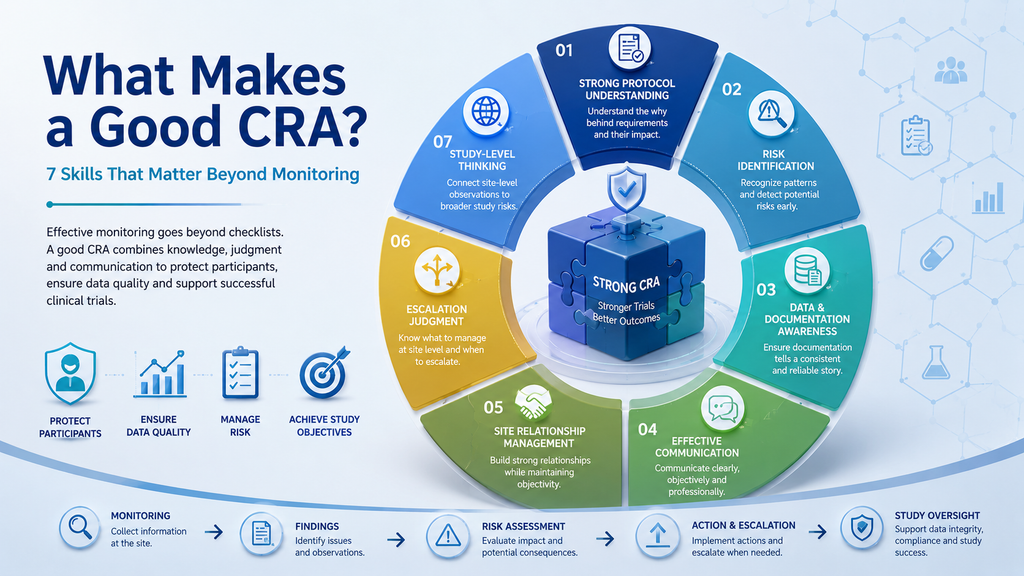
Clinical Research Associates are often closely associated with one core responsibility: monitoring.
But effective clinical trial monitoring involves much more than reviewing documents, checking data and completing monitoring visits.
A strong CRA needs to understand the protocol, recognise potential risks, evaluate site processes, communicate effectively, assess findings and determine when an issue requires further action.
As clinical trials become increasingly complex and monitoring approaches continue to evolve, CRAs need a broader combination of technical knowledge, critical thinking and professional skills.
So, what actually makes a good CRA?
The answer goes beyond monitoring experience.
1. Strong Protocol Understanding
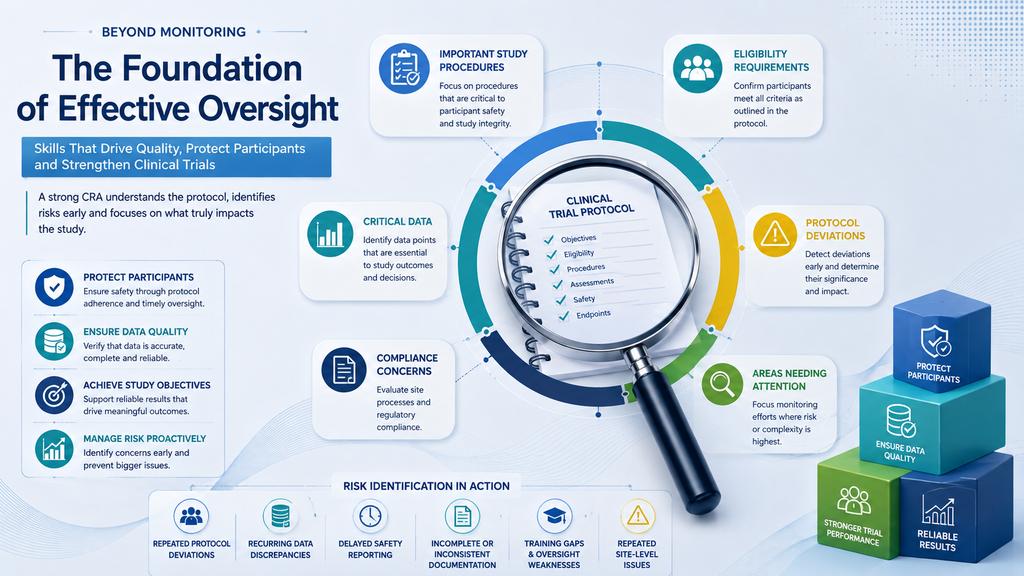
Effective monitoring begins with understanding the protocol.
A CRA should not simply know what procedures are required. They should understand why those requirements are important and how they relate to participant safety, data quality and study objectives.
A strong understanding of the protocol helps a CRA identify:
- Important study procedures
- Eligibility requirements
- Critical data
- Protocol deviations
- Potential compliance concerns
- Areas where additional attention may be required
The objective is not simply to identify whether something was missed.
It is to understand the significance of what was missed and its potential impact on the study.
2. Risk Identification
Clinical trials involve numerous potential risks, but not every issue carries the same level of importance.
A good CRA needs to recognise patterns that may indicate emerging risks.
These may include:
- Repeated protocol deviations
- Recurring data discrepancies
- Delayed safety reporting
- Incomplete or inconsistent documentation
- Training gaps
- Inadequate investigator oversight
- Repeated site-level issues
One isolated issue may require correction.
A recurring pattern may indicate a deeper process weakness.
This is why effective monitoring requires the ability to look beyond individual findings and recognise what those findings may indicate.
3. Data and Documentation Awareness
Clinical trial documentation provides evidence of how a study has been conducted.
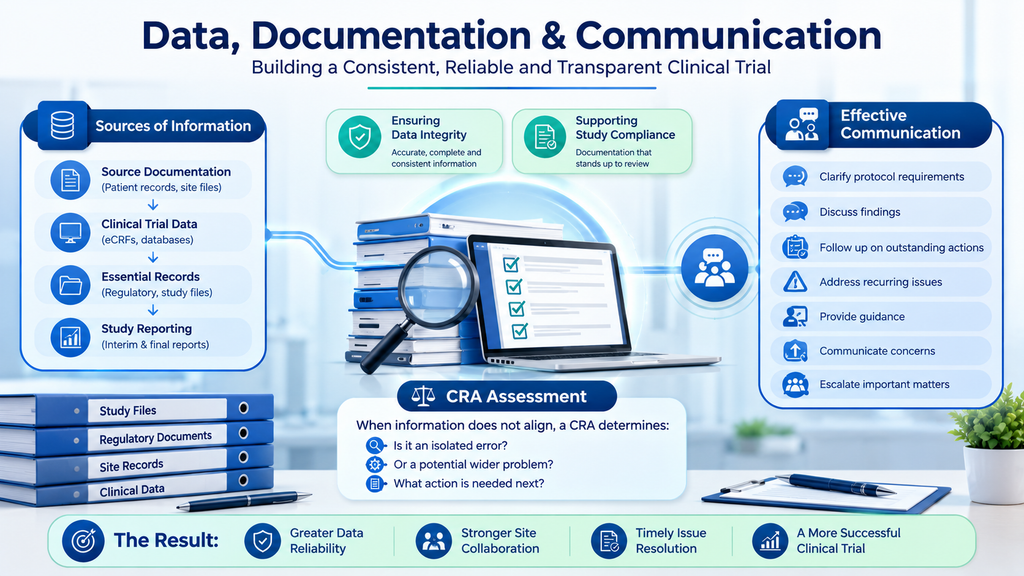
A CRA should understand how different sources of information connect, including:
Source documentation → Clinical trial data → Essential records → Study reporting
When information does not align, the CRA needs to determine whether the discrepancy is an isolated error or a potential indication of a wider problem.
For example, one inconsistent data entry may be corrected easily.
Repeated inconsistencies involving the same process may suggest that the site needs additional guidance, training or corrective action.
A strong CRA therefore does not simply check whether documentation exists.
They assess whether the documentation tells a consistent and reliable story.
4. Effective Communication
Monitoring involves continuous communication with investigators, coordinators and other study stakeholders.
A CRA may need to:
- Clarify protocol requirements
- Discuss findings
- Follow up on outstanding actions
- Address recurring issues
- Provide guidance
- Communicate concerns
- Escalate important matters
Good communication means being clear, professional and objective while maintaining a productive relationship with the site.
A CRA should be able to raise a concern without creating unnecessary conflict and explain the reason behind a required action.
Good monitoring depends on good communication.
5. Site Relationship Management
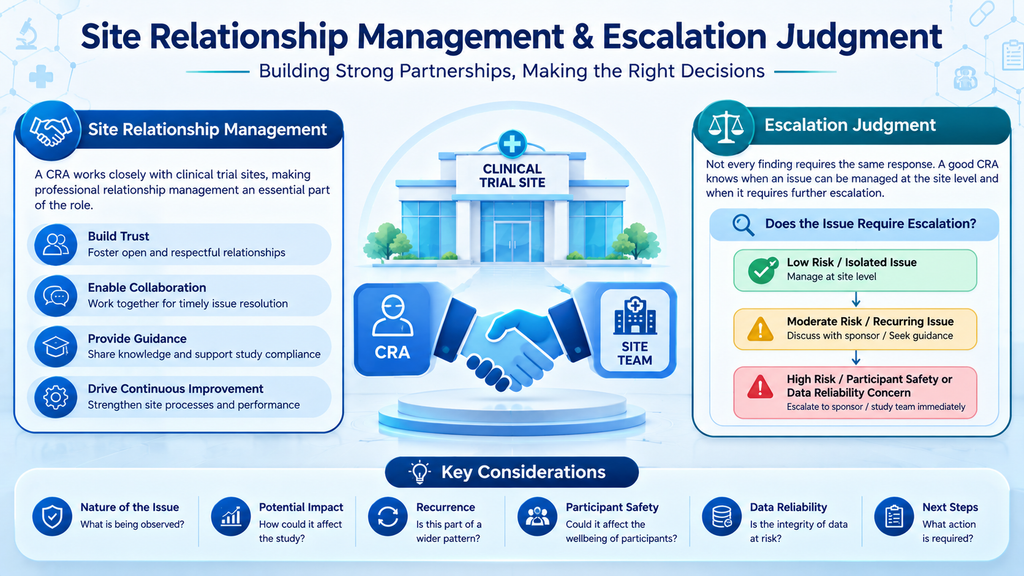
A CRA works closely with clinical trial sites, making professional relationship management an important part of the role.
However, maintaining a positive relationship does not mean avoiding difficult conversations.
A CRA needs to remain objective while working collaboratively with the site.
This means being:
Supportive without compromising standards.
Approachable without losing objectivity.
Collaborative without ignoring risk.
Strong site relationships can help improve communication, encourage timely resolution of issues and support better study execution.
6. Escalation Judgment
Not every finding requires the same response.
One of the important skills a CRA develops through experience is knowing when an issue can be managed at the site level and when it requires further escalation.
A CRA should consider:
- The nature of the issue
- Its potential impact
- Whether it is recurring
- Whether participant safety may be affected
- Whether data reliability may be affected
- Whether similar issues exist elsewhere
- Whether additional action is required
Under-escalating an important issue can allow a risk to continue.
Over-escalating every minor issue can make it harder to focus on significant concerns.
Good CRA judgment involves understanding what matters, why it matters and what should happen next.
7. Study-Level Thinking
Although CRAs may be responsible for monitoring individual sites, their observations contribute to the wider clinical trial.
Consider a site that repeatedly misses an important study procedure.
At first, this may appear to be a site-level problem.
But if the same issue appears across several sites, the situation may indicate a broader concern involving:
- Protocol understanding
- Training
- Study processes
- Communication
- Operational planning
- Study-level risk
A strong CRA therefore learns to recognise when an individual finding may have implications beyond one site.
This ability to connect site-level observations with broader study risks is an important part of effective clinical trial oversight.
What Separates an Average CRA From a Strong CRA?
An average approach may focus on:
“Did I complete all the required monitoring activities?”
A stronger approach asks:
“What did I learn from the monitoring activity?”
An experienced approach goes one step further:
“What does this information tell me about the risk to the study?”
This progression—from completing activities to understanding findings to identifying risk—is what helps transform monitoring from a checklist exercise into meaningful oversight.
Skills CRAs Should Continue to Develop
CRA development does not stop after entering the role.
Professionals can continue strengthening areas such as:
- ICH GCP and regulatory knowledge
- Protocol interpretation
- Monitoring methodology
- Risk-based monitoring
- Data review
- Source-document review
- Essential documentation
- Investigator oversight
- Communication
- Issue management
- Problem-solving
- Escalation and decision-making
Developing these capabilities can help CRAs become more confident in handling complex study situations and prepare for greater responsibilities within clinical research.
Conclusion
Being a good CRA is not about finding the highest number of issues.
It is about understanding which findings matter, why they matter and what should happen next.
Monitoring requires technical knowledge, but effective monitoring also requires risk awareness, communication, critical thinking, professional judgment and the ability to see beyond individual findings.
The role of a CRA continues to evolve as clinical trials become more complex and increasingly risk-focused.
The strongest CRAs are not simply those who complete monitoring activities.
